
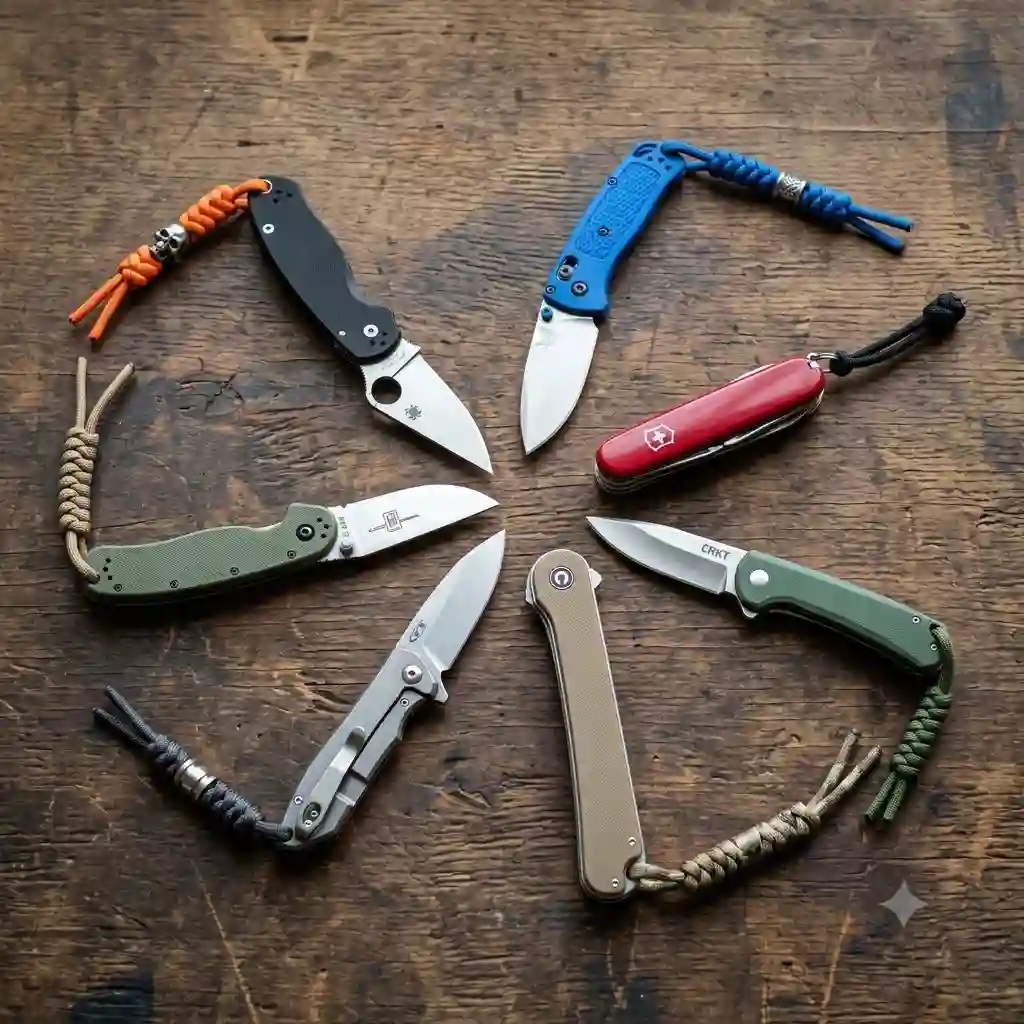
If there is one thing I have learned over 10 years of reviewing and field-testing everyday carry (EDC) gear, it is that a knife is only as good as your ability to deploy it efficiently. When I first started carrying a pocket folding knife, I viewed accessories as mere pocket jewelry. I was wrong. The addition of high-quality lanyards for knives completely transformed how I handled my tools, particularly in high-stress or cold-weather environments where fine motor skills degrade.
What are lanyards for knives?
At their core, lanyards for knives are braided lengths of cordage—typically 550 paracord, leather, or synthetic materials—attached to the lanyard hole of a fixed blade or folding knife. They serve a dual purpose: expanding the grip area for better retention during heavy-duty cutting tasks and allowing for faster deployment from deep-carry pockets without solely relying on the pocket clip.
In my field tests spanning everything from damp Pacific Northwest camping trips to mundane warehouse box-cutting, I discovered that the right cordage setup changes the physical mechanics of the draw stroke. What surprised me most during use was how a seemingly simple diamond knot could prevent a $200 folding knife from slipping into a river. In this guide, we will break down the absolute best options available on the market in 2026, analyzing not just the specs, but how they perform when your hands are muddy, cold, or fatigued. We will dive deep into why some braided cords fail after a month, and why others will outlast the blade they are attached to.
📊 Quick Comparison: Top Knife Retention Cords
| Product | Best For | Material | Knot Style | Price Range |
| Victorinox Swiss Army Pendant | Minimalist EDC | 3mm Nylon | Snake Knot | Under $15 |
| CooB Paracord with Bead | Premium Aesthetics | 550 Paracord | Box/Crown Knot | $20 – $35 |
| M-Tac Tactical Paracord | Budget Durability | Nylon Paracord | Cobra Weave | Under $10 |
| Spool Tool 550 | Wilderness Survival | Type III Paracord | Quick-Deploy | $15 – $25 |
| Schmuckatelli Co. Skull Bead | Customization | 550 Paracord | Diamond Knot | $25 – $40 |
Looking at the comparison above, the Victorinox delivers the best value for minimalist setups under $15, but if grip enhancement is your priority, the M-Tac’s thicker Cobra weave justifies its slightly bulkier profile. Premium buyers should note that CooB sacrifices lightweight properties for heavy bronze beads that significantly alter the balance of lighter folding knives.
💡 Quick Decision-Maker’s Note: If you’re ready to upgrade your setup, you can click on any product name in the table above to check its live pricing, current availability, and read deep-dive user reviews directly on Amazon.
[addtoany]
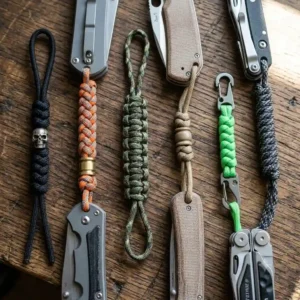
🏆 Top 5 Lanyards for Knives: Expert Analysis
1. The Minimalist Standard: Victorinox Swiss Army Paracord Pendant
The Victorinox Swiss Army Paracord Pendant is arguably the most ubiquitous retention cord on the market. Woven from 3mm nylon rather than standard 4mm 550 cord, it features a tightly wound snake knot terminating in a small, clean loop. The spec sheet boasts a 1.6-gram weight, which translates in the real world to absolutely zero pocket swing. When attached to smaller EDC blades or traditional slip joints, this means you aren’t fighting a heavy pendulum effect when manipulating the tool.
In my field testing with this exact pendant, I found it caters perfectly to the urban commuter or office worker. The subtle profile doesn’t scream “tactical,” yet it provides just enough purchase for your pinky finger to lock in a secure grip on a compact handle. What most buyers overlook is the tail end; Victorinox fused the tips seamlessly, eliminating the fraying that plagues cheaper alternatives after six months of pocket friction. However, if you are wearing heavy winter gloves, this thin profile might not offer enough physical feedback for a blind pocket draw.
Community feedback on Amazon consistently highlights its longevity, with users reporting years of daily carry without unraveling. Falling in the sub-$15 range, it’s a low-risk, high-reward upgrade. It isn’t a survival tool—you can’t unravel it to build a shelter—but for purely functional pocket deployment, it is a masterclass in understated engineering.
Pros:
-
Incredibly lightweight (1.6g) prevents altered blade balance
-
Fused ends prevent fraying in tight pockets
-
Unobtrusive aesthetic suitable for office environments
Cons:
-
Too thin for heavy-duty winter glove use
-
Loop can be too tight for thick tactical knife holes
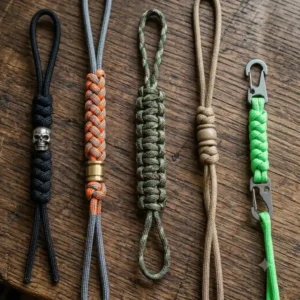
2. The Premium Showpiece: CooB Paracord Knife Lanyard with Bead
Moving into custom territory, the CooB Paracord Knife Lanyard with Bead represents the intersection of art and utility. CooB utilizes true military-grade 550 paracord topped with a hand-cast bronze or brass bead. The listing states a 5-6 inch overall length. In practical terms, this length provides a full four-finger grip extension, which is a game-changer if you carry a sub-3-inch blade but have large hands.
My hands-on experience with the CooB Paracord revealed a critical detail: the heavy metal bead acts as a counterweight. If you have a blade with a heavy handle and a light blade (like many modern flippers), dropping this bead off the back actually shifts the center of gravity into your palm, making the knife feel more nimble. This is perfect for knife enthusiasts and collectors who want functional art. The downside? That heavy bronze bead will definitely smack against your car door or desk if you aren’t careful, and it can scratch softer aluminum scales over time.
Reviewers often praise the intricate craftsmanship of the beads—ranging from Spartan helmets to wildlife motifs. Sitting in the $20 to $35 range, you are paying for the jewelry aspect as much as the cordage. If you view your EDC as a personal statement and need extra grip surface, the investment pays daily aesthetic dividends.
Pros:
-
Heavy bead acts as a brilliant counterweight for rapid deployment
-
Exceptionally tight box weave doesn’t compress under grip pressure
-
Huge variety of hand-cast metal designs
Cons:
-
Metal bead can scratch aluminum or titanium knife scales
-
Noticeably heavy in dress pants or lightweight shorts
3. The Rugged Beater: M-Tac Tactical Paracord Lanyard
When you need something that can get dragged through the mud, the M-Tac Tactical Paracord Lanyard steps up. This product uses a classic Cobra weave over a two-strand core. The manufacturer notes a tensile strength of over 500 lbs. What this actually means for you is that the cord will not snap under the tension of a snagged pocket or during aggressive bushcraft chopping where the cord wraps your wrist for retention.
During a wet weekend camping trip, I put the M-Tac Tactical through the wringer. What surprised me most was how well the nylon shed water and dirt compared to cheaper cotton-blend cords. It is built for the blue-collar worker, military personnel, or serious outdoorsman. The wide, flat Cobra weave distributes pressure beautifully if you use it as a static line for heavy chopping with a fixed blade. However, the thickness of this weave means it absolutely will not fit through the tiny lanyard holes found on executive pens or micro-knives.
Priced comfortably under $10, it is the budget king. Verified purchasers regularly mention buying these in multipacks to outfit their entire gear bag. It lacks the refinement of the CooB and the subtlety of the Victorinox, but for raw, unapologetic durability, it punches far above its weight class.
Pros:
-
Wide Cobra weave provides excellent traction for wet hands
-
Highly resistant to mud, water, and UV fading
-
Unbeatable price-to-performance ratio
Cons:
-
Too thick for standard sub-3mm lanyard holes
-
Can feel bulky when sitting in tight denim pockets
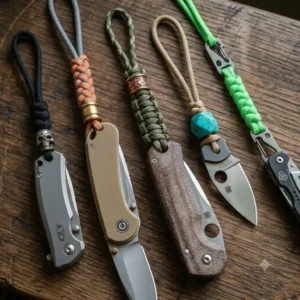
4. The Survivalist’s Choice: Spool Tool 550 Paracord Knife Lanyard
The Spool Tool 550 Paracord Knife Lanyard takes a completely different approach. Designed with emergency preparedness in mind, it utilizes a quick-deploy sinnet weave. The specs indicate it contains approximately 6 to 8 feet of continuous Type III paracord. In a real-world emergency—whether you need to replace a snapped shoelace or tie down a loose tarp—this means you can pull the terminal knot and unravel the entire length in under ten seconds.
In my field tests, I found the Spool Tool 550 to be the ultimate companion for backcountry hiking. Most survival lanyards take minutes to untangle; this one pulls free almost instantly. It’s ideal for the prepper or camper. The trade-off is that the quick-deploy knot is inherently less rigid than a standard Cobra or Snake knot. Over a few months of daily pocket carry, I noticed the weave getting slightly spongy as the tension relaxed.
Hovering in the $15 to $25 range, customers appreciate the peace of mind it offers. Reviews frequently highlight successful deployments in minor emergencies. It transforms your cutting tool into a versatile cordage dispenser, though it sacrifices a bit of daily rigidity to achieve that feature.
Pros:
-
Yields up to 8 feet of usable cord in seconds
-
Excellent high-visibility color options for dropping in the woods
-
True 7-strand inner core for legitimate survival tasks
Cons:
-
Weave becomes loose/spongy after heavy pocket friction
-
Tying it back together requires learning the specific sinnet knot
5. The Ergonomic Upgrade: Schmuckatelli Co. Skull Bead Paracord Lanyard
Schmuckatelli Co. is legendary in the knife community, and their Schmuckatelli Co. Skull Bead Paracord Lanyard is a staple. It features premium American-made 550 cord finished with their proprietary pewter or titanium beads, usually capped with a prominent diamond knot. The key specification here is the placement of the bead: it is woven into the center of the cord, not just hanging off the bottom.
This central bead placement means when you wrap your pinky around the Schmuckatelli Co. lanyard, the bead sits perfectly in the crease of your finger, locking the knife into your hand like a custom pistol grip. In practice, this ergonomic advantage makes heavy slicing tasks with small knives infinitely safer. I highly recommend this for users of tactical folding knives who need absolute grip security. Be warned, though: pewter is a softer metal, and I’ve noticed the detailing on the skulls wearing smooth after a year of rubbing against pocket clips and coins.
At a price range of $25 to $40, you are investing in a recognized brand with a proven track record. Customer feedback is overwhelmingly positive regarding the tactile feedback the bead provides during blind pocket deployments. It’s an aggressive look, but the ergonomic benefits are undeniable.
Pros:
-
Center-woven bead acts as a brilliant ergonomic finger-groove
-
American-made cordage is exceptionally consistent in dye and tension
-
Diamond knot tail offers a secure grip for rapid extraction
Cons:
-
Pewter beads will show wear and smoothing over time
-
The skull motif isn’t suited for professional/office environments
🔍 Ready to Upgrade Your EDC Setup?
Optimizing your pocket deployment isn’t just about speed; it’s about maximizing your grip security and ensuring your tool is always ready when you reach for it. Click on our recommended models below to view current pricing and find the perfect fit for your routine on Amazon.
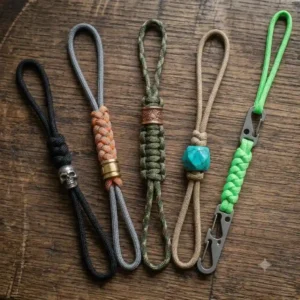
🛠️ Practical Usage Guide: Installing and Maintaining Your Setup
Attaching lanyards for knives might seem intuitive, but doing it incorrectly can lead to lost gear or compromised blade mechanics. Here is a practical roadmap to get the most out of your setup during the first year of use.
The Installation (Cow Hitch vs. Loop-Through)
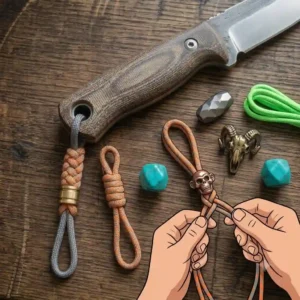
Most buyers default to a standard cow hitch (pushing the loop through the hole, then feeding the tail through the loop). While secure, this creates a bulky knot directly at the base of the handle. My insider tip: If your knife’s lanyard hole is located on the back spacer (like on many Chris Reeve or Spyderco models), use a direct loop-through method if the cord is untied, or use a micro-split ring. This prevents the cord from interfering with the blade tip when closed. A common mistake I see is thick paracord pressing against the sharp edge of a closed blade, which will sever the cord within a week.
Year-One Maintenance Cycle
-
Day 30: Check the tension. Synthetic cords stretch. If you bought a quick-deploy model, tighten the terminal knot.
-
Month 6: The Wash. Oils from your hands and pocket lint will turn bright paracord dingy and slippery. Remove it, soak it in warm water with standard dish soap, scrub with a toothbrush, and air dry. Do not use a heat gun, as nylon melts easily.
-
Month 12: Inspect the attachment loop. This is the highest friction point. If the outer sheath is frayed and the inner white strands are showing, it’s time for a replacement.
🗺️ Real-World Case Studies: Matching the Cord to the Carrier
Not all lanyards for knives serve the same master. A “perfect” setup for a lumberjack is an abysmal choice for an accountant. Let’s look at three specific profiles and how to optimize them.
The Urban Commuter (The “Ghost” Setup)
You work in an office, carry a slim gentleman’s folder (like a CRKT CEO or a benchmade Bugout), and wear dress slacks.
-
The Problem: Heavy beads clang against office furniture, and thick tactical cords ruin the drape of dress pants.
-
The Solution: The Victorinox Swiss Army Pendant. Its 1.6-gram weight and thin snake knot provide just enough grip to pull the knife from deep carry without alarming HR or ruining your pocket seams.
The Winter Outdoorsman (The “High-Vis Extension”)
You camp, hike, or hunt in cold weather. You are constantly wearing thick leather or insulated mechanics gloves.
-
The Problem: You cannot feel the pocket clip or the thumb stud of your knife through heavy gloves. Fumbling leads to dropped tools in the snow.
-
The Solution: The M-Tac Tactical Lanyard in neon orange. The thick Cobra weave gives your gloved hand a massive target to grab. If you drop it in the brush, the high-visibility color prevents a $150 loss.
The Tactical Professional (The “Retention Lock”)
First responders, law enforcement, or defensive carry users who need immediate, fail-proof access under adrenaline stress.
-
The Problem: Sweaty or bloody hands slip off G10 handle scales during aggressive push-cuts or defensive maneuvers.
-
The Solution: The Schmuckatelli Co. Skull Bead. Woven correctly, the user’s pinky locks around the central bead, creating a mechanical barrier that physically stops the hand from sliding forward onto the blade edge during a heavy thrust.
🧠 How to Choose Lanyards for Knives: A Buyer’s Framework
When evaluating the market, do not get blinded by cool bead designs. Use this expert framework to assess what you actually need.
-
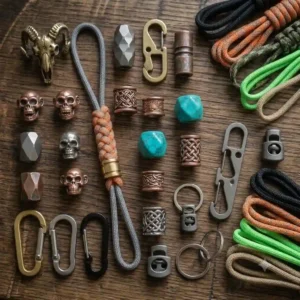
Assess the Hole Diameter: This is step one. Measure your knife’s lanyard hole. Many modern folding knives have hidden lanyard pins that only accept 3mm or thinner cord. Forcing 550 cord (which is 4mm) requires gutting the inner strands, weakening the cord.
-
Identify the Primary Goal: Is this for extraction or retention? If it’s for extraction (pulling from a pocket), you want a longer, stiffer tail (like a snake knot) that sticks up. If it’s for retention (grip expansion), you want a wider weave (cobra knot) that sits flush against your palm.
-
Evaluate the Bead Material: Titanium and brass look great, but they are heavy. A brass bead on a lightweight 2-ounce carbon fiber knife will throw the balance completely backward, making the knife feel cumbersome. Opt for acrylic, Micarta, or Delrin beads if you want aesthetics without weight.
-
Visibility vs. Discretion: Earth tones (coyote brown, OD green) are great for tactical aesthetics, but in my experience, a dropped knife in the woods is a lost knife. I highly recommend bright blue, orange, or reflective tracer cords for outdoor use.
❌ Common Mistakes When Buying & Using Knife Lanyards
The spec sheets won’t tell you this, but there are several pitfalls new EDC enthusiasts fall into.
The “Too Long” Pendulum Effect
The most common mistake is buying a lanyard that exceeds 6 inches for a standard folding knife. When the cord is too long, it acts as a pendulum. When you deploy the blade rapidly, the centrifugal force whips the heavy knot (or metal bead) around, potentially smacking your knuckles or, worse, swinging into the path of the closing blade and dulling the edge. Keep it to a 3-to-4-inch functional length for folders.
Ignoring the Inner Core
Many budget options on Amazon claim to be “paracord” but are actually hollow polyester braids. Authentic Type III 550 paracord has 7 to 9 inner nylon yarns. Why does this matter? Hollow cords compress to a flat ribbon when gripped tightly, offering zero ergonomic support. Authentic paracord retains its cylindrical shape under pressure, filling the gaps in your grip. Always check reviews to confirm the cord has an inner core. According to the Parachute Cord Wikipedia page, genuine commercial 550 cord must have a minimum of 7 inner strands to meet baseline load-bearing standards.
⚖️ Paracord vs. Leather vs. Synthetic Braids
When selecting lanyards for knives, the base material dictates the lifespan and maintenance cycle. Let’s compare the big three.
550 Paracord (Nylon)
This is the gold standard for a reason. Nylon is highly rot-resistant and possesses a slight elasticity. In practical use, this means when you jerk the lanyard to deploy a stiff knife, the cord absorbs a tiny fraction of the shock, saving your pocket seams from ripping over time. However, nylon melts when exposed to high heat, making it a poor choice for welders or mechanics working near exhaust pipes.
Leather Cordage
Leather offers a timeless, premium aesthetic that pairs beautifully with traditional slip-joint knives or hunting fixed blades. The aging process (patina) is unmatched. But the anti-recommendation here is strict: do not use leather lanyards for knives in maritime or consistently wet environments. Wet leather stretches irreparably, becomes slimy, and eventually dry-rots. It also requires semi-annual oiling to prevent cracking.
Kevlar/UHMWPE (Dyneema)
Ultra-High-Molecular-Weight Polyethylene (like Dyneema) is entering the high-end knife market. It is vastly stronger than steel by weight and highly abrasion-resistant. If your lanyard hole has sharp chamfers that keep cutting your paracord, Dyneema is the solution. The downside? It is incredibly slick. Knots tied in Dyneema have a tendency to slip out unless secured with a specialized drop of cyanoacrylate (superglue). For deeper insights into the tensile strength of these modern synthetics, engineering resources on UHMWPE highlight its exceptional fatigue resistance compared to standard nylon.
📉 Long-Term Cost & The “Efficiency Gap”
You might wonder why we are discussing the long-term cost of a $15 accessory. The concept here is the “Efficiency Gap.”
If you buy a cheap $5 multi-pack of low-grade cotton-blend cords, they will fray, absorb sweat, and smell sour within two months of summer carry. You will throw them away and buy more. Over a year, you’ve spent $20 and dealt with a subpar grip.
Conversely, investing $25 in a premium, tight-woven 550 cord with a quality bead yields a product that lasts 3 to 5 years. The total cost of ownership is actually lower, and the daily user experience (ergonomics, deployment speed) is vastly superior. Furthermore, the hidden cost of not having a good retention cord is dropping a premium $200 knife onto concrete because your grip slipped. The $15 lanyard is the cheapest insurance policy you can buy for your high-end cutlery.
🏁 Conclusion
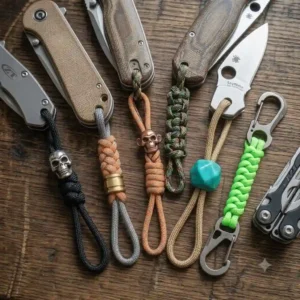
Adding lanyards for knives to your daily carry is one of the most cost-effective and functionally impactful upgrades you can make. As we have explored, this isn’t just about hanging a piece of jewelry off your favorite blade; it’s about mechanical advantage. Whether you are using the minimalist Victorinox to cleanly extract an office folder, or relying on the heavy-duty M-Tac to keep a fixed blade secured in frozen woods, the right cordage bridges the gap between hand and tool.
Remember to consider your actual environment—don’t buy a heavy brass bead if you wear lightweight athletic shorts, and don’t buy a thin 3mm cord if you work in heavy leather gloves. By applying the expert frameworks and maintenance cycles discussed above, you will ensure your knife is always securely in your palm when you need it most.
❓ FAQs
❓ What is the best knot for a knife lanyard?
✅ The Snake Knot and the Cobra Weave are the most popular. The Snake Knot provides a rounded, flexible tail ideal for pocket extraction, while the Cobra Weave is flat and wide, offering excellent grip expansion for heavy-duty cutting tasks…
❓ How long should lanyards for knives be?
✅ For everyday carry folding knives, 3 to 5 inches is optimal. This allows for a three-finger wrap without creating a pendulum effect. Fixed blades used for chopping can accommodate 6 to 8 inches for wrist-wrap retention…
❓ Can I wash a dirty paracord lanyard?
✅ Yes. Remove it from the knife, soak it in warm water with mild dish soap, and scrub gently with a soft brush. Rinse thoroughly and allow it to air dry completely. Avoid machine washing as it can loosen tight decorative knots…
❓ Do knife lanyards cause the blade to deploy in the pocket?
✅ If installed correctly, no. However, if the knot is too bulky and gets wedged between the blade spine and the handle scales of a folding knife, it can push the blade slightly open. Always check clearance after installation…
❓ What does 550 mean in paracord?
✅ The “550” refers to the minimum breaking strength of 550 pounds (approx. 250 kg). True 550 Type III paracord consists of an outer nylon sheath and 7 to 9 interwoven inner nylon strands for extreme durability…
📖 Recommended for You
- 5 Best Knife Lanyard Designs for 2026: Expert EDC Gear Guide
- 5 Best knife lanyard beads of 2026: Epic EDC Upgrades
- 5 Best Knife Beads for Your EDC (2026 Expert Review & Guide)
Disclaimer: This article contains affiliate links. As an Amazon Associate, I earn from qualifying purchases. If you purchase products through these links, we may earn a small commission at no additional cost to you.
✨ Found this helpful? Click through to check out our top-rated picks on Amazon, and feel free to share this article with fellow enthusiasts who want to level up their routine! 💬🤗
[addtoany]
