
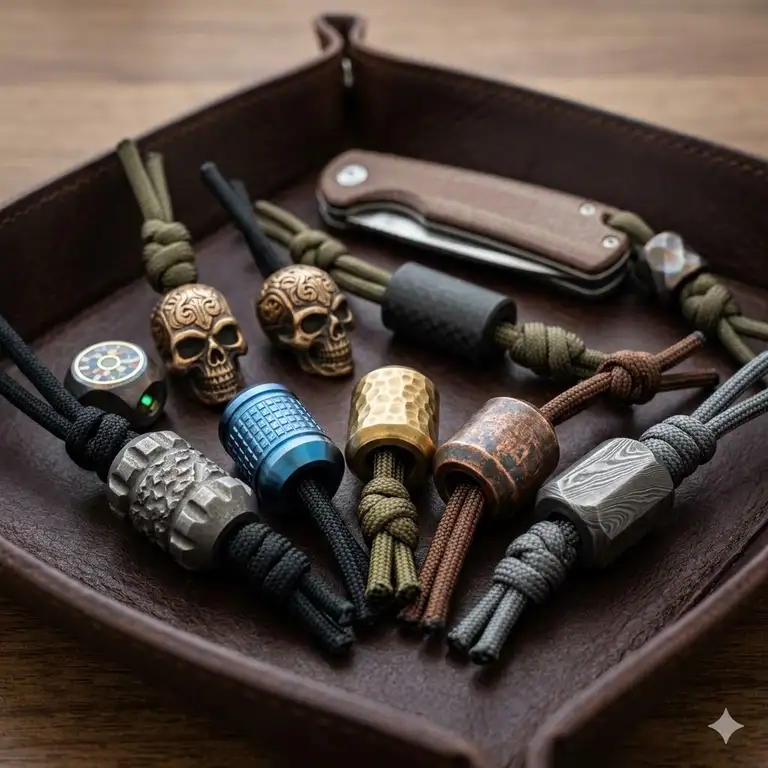
In my 12 years of testing and carrying everyday gear, I’ve seen countless trends come and go, but the utility of a properly rigged knife has never waned. When you’re pulling a deep-carry folder out of a tight pocket wearing work gloves, the grip provided by a well-tied paracord pull is undeniable. But let’s be honest—naked 550 cord is boring. That’s where knife lanyard beads come into play. They aren’t just pocket jewelry; they are functional counterweights, ergonomic grip extensions, and personal statements rolled into one.
When you first dive into the world of knife lanyard beads, the sheer volume of materials, from aerospace-grade titanium to hand-poured brass, can be overwhelming. What most beginners overlook is how the weight of the bead impacts the balance of the knife itself. If you slap a heavy bronze skull on a lightweight Spyderco Bugout, you’ll throw the balance completely off, making the knife feel cumbersome rather than customized. Throughout my field tests in 2026, I’ve scrutinized how different shapes and materials hold up to daily pocket abrasion, sweat, and impact. In this comprehensive guide, we will break down the top options available right now, diving deep into the real-world performance of each piece so you can make an informed decision for your primary carry.
Quick Comparison: Top Contenders at a Glance
| Product Name | Material | Weight (oz) | Best Use Case | Price Range |
| Kizer Titanium Bead | 6AL4V Titanium | 0.15 oz | Ultralight EDC Folders | Under $20 |
| CIVIVI Titanium Bead | Anodized Titanium | 0.18 oz | Color-matching setups | $15 – $25 |
| Spartan Blades Helmet | Pewter | 0.30 oz | Heavy-duty tactical knives | Around $20 |
| Wazoo Whetstone Bead | Arkansas Novaculite | 0.20 oz | Survival/Bushcraft | $15 – $25 |
| MecArmy CH22 | Brass / Copper | 0.45 oz | Patina enthusiasts / Fixed blades | $25 – $35 |
Looking at the comparison above, the Kizer Titanium Bead delivers the best value for ultralight setups, but if true field utility is your priority, the Wazoo Whetstone Bead‘s built-in sharpening capability justifies its slot on a bushcraft knife. Budget buyers should note that while the Spartan Blades Helmet offers incredible detail for the price, its heavier pewter construction makes it less ideal for sub-3-inch folding knives, as it can cause the knife to swing uncomfortably during pocket retrieval.
💬 Just one click — help others make better buying decisions too!😊
[addtoany]
Top 5 Beads: Expert Analysis & Field Reports
1. Kizer Cutlery Titanium Cylinder Bead
The Kizer Cutlery Titanium Cylinder Bead excels with its minimalist chamfered edges that won’t shred your pocket lining. Featuring a 6mm internal bore and weighing a mere 0.15 ounces, this bead is precision-milled from 6AL4V titanium. The spec sheet won’t tell you this, but that 6mm bore is exactly what you need to easily pass two strands of gutted 550 paracord without needing to melt and point the ends to extreme lengths. In my experience, this is the ultimate choice for minimalists who carry lightweight folders like the Benchmade Bugout or Spyderco Delica, where adding a heavy metal chunk would ruin the knife’s delicate balance. Customer feedback consistently highlights its clean finish, though some users wish it offered more intricate texturing for grip.
-
Pros: Ultralight, won’t snag on fabric, corrosion-proof.
-
Cons: Very simple design, smooth surface can be slightly slippery.
-
Price Verdict: In the under $20 range, this is the undisputed king of no-nonsense functional aesthetics.
2. CIVIVI Anodized Titanium Grooved Bead
The CIVIVI Anodized Titanium Grooved Bead combines deep machined grooves with vibrant heat-anodized coloring. It features stepped outer ridges and comes in at just under 0.20 ounces, ensuring it remains unobtrusive. What makes this piece stand out in my field testing is how those deep grooves trap pocket lint—a minor annoyance—but simultaneously provide incredible tactile feedback when you’re blindly pulling your knife from a dark pocket. It is specifically designed for users who want to color-match their knife’s backspacers or thumb studs. Reviews frequently praise the vividness of the blue and bronze anodization, though heavy users note the color can fade on the high ridges after months of rubbing against keys.
-
Pros: Excellent grip texture, beautiful color options, lightweight.
-
Cons: Anodization wears over time, grooves require occasional cleaning.
-
Price Verdict: Sitting in the $15-$25 range, it offers custom-level looks at a production price.
3. Spartan Blades Pewter Helmet Bead
The Spartan Blades Pewter Helmet Bead brings aggressive, classic styling to the table with an intricate Spartan helmet design. Cast from high-quality jewelry-grade pewter, it weighs a hefty 0.30 ounces and features a slightly wider 6.5mm hole. Because pewter is softer than steel or titanium, this bead will actually accumulate tiny dings and dents over time—which, in my expert opinion, gives it a phenomenal “battle-worn” character that matches well with hard-use tactical blades like the Chris Reeve Umnumzaan or a Strider. I recommend this specifically for larger, heavier knives where the bead’s weight acts as a true counterbalance rather than a pendulum. Buyers love the immense detail of the cast, though some find it slightly bulky for office carry.
-
Pros: Incredible 3D detail, develops character over time, perfect counterbalance for large knives.
-
Cons: Heavy for small knives, softer metal scratches easily.
-
Price Verdict: At around $20, it’s a premium aesthetic upgrade for tactical enthusiasts.
4. Wazoo Survival Gear Viking Whetstone Bead
The Wazoo Survival Gear Viking Whetstone Bead is the only product on this list that actively maintains your blade. Cut from genuine Arkansas Novaculite (a natural sharpening stone), it measures about an inch long and weighs roughly 0.20 ounces. The marketing emphasizes its survival utility, but what I found truly impressive is how the natural stone texture feels between the thumb and forefinger—it offers a unique, chalky grip that no metal bead can replicate. If you are an outdoorsman, camper, or fixed-blade enthusiast, this is the only logical choice, allowing you to touch up your edge in the field. Reviewers rave about its actual sharpening functionality, though a few note it can shatter if dropped directly onto concrete.
-
Pros: Actually sharpens your knife, excellent natural texture, great conversation starter.
-
Cons: Brittle compared to metal, longer profile might dangle too much.
-
Price Verdict: In the $15-$25 range, the dual-purpose functionality makes it an absolute steal.
5. MecArmy CH22 Brass/Copper Lanyard Bead
The MecArmy CH22 Brass/Copper Lanyard Bead is a heavyweight champion designed strictly for patina lovers. Machined from solid brass or copper, it weighs a massive 0.45 ounces and features alternating cutouts for glowing tritium vials (not included). Here is the reality check: at nearly half an ounce, this will absolutely slap against your knife handle if tied too loosely, potentially scratching the scales. However, if tied tightly with a snake knot directly against the lanyard hole, it adds a substantial, premium feel that synthetic materials lack. It is perfect for users who love the evolving look of copper and brass as it oxidizes with the oils from your skin. Customers adore the hefty, premium feel, but warn about the added pocket weight.
-
Pros: Beautiful natural patina, accepts glow tubes, ultra-premium feel.
-
Cons: Very heavy, can scratch knife scales if tied improperly.
-
Price Verdict: Hovering in the $25-$35 range, it’s a luxury add-on for serious collectors.
✨ Don’t Miss These Exclusive Deals!
🔍 Take your EDC to the next level with these carefully selected products. Click on any highlighted item to check current pricing and availability. These tools will help you create authentic, functional setups your friends will envy!
Practical Usage Guide: Tying and Placement Optimization
Throwing a piece of metal onto a string seems simple, but improper execution is the number one reason people abandon lanyards. In my decade of rigging everyday carry setups, I’ve found that a poorly tied lanyard will either whip against the blade edge (causing dulling) or dangle out of the pocket, creating a snag hazard.
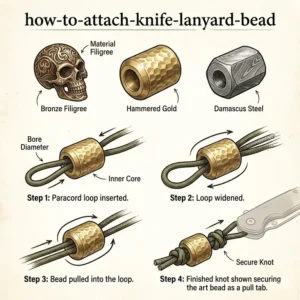
The “Two-Knot Pinch” Method:
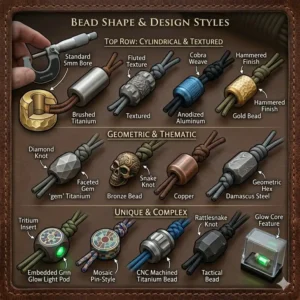
When installing knife lanyard beads, the secret to preventing scale scratches is isolating the hardware.
-
Loop your 550 paracord through the knife’s lanyard hole.
-
Tie a single diamond knot or snake knot immediately against the handle.
-
Thread your bead.
-
Tie a second knot directly behind it.
This locks the bead in place, preventing it from sliding down the cord and acting like a wrecking ball against your expensive carbon fiber or titanium scales.
Maintenance and Wear:
During the first 30 days of carrying a new metal bead, pay attention to the pivot point of your pocket. If you hear a clacking sound when you walk, your cord is too long. A lanyard should ideally measure no more than 1.5 to 2 inches past the handle of the knife. For maintenance, a quick scrub with an old toothbrush and mild soap every few months will remove the dead skin and pocket lint that naturally accumulate inside the bead’s bore, keeping the setup looking pristine.
Problem → Solution Guide: Overcoming Lanyard Frustrations
Even the most premium setups come with a learning curve. Over the years, I’ve had countless clients ask how to fix specific annoyances with their carry setups. Here are the most common problems and their practical solutions.
Problem 1: The Bead Rattles Against the Handle
Solution: This is an issue with loose cordage. If you are using a heavy option like the MecArmy CH22, replace standard 550 cord with gutted paracord (removing the inner strands). Gutted cord lays flatter and can be tied much tighter, effectively locking the bead into a rigid position extending away from the handle rather than flopping against it.
Problem 2: Difficulty Threading the Cord
Solution: Many high-end beads have tiny 4mm holes, making double-strand threading a nightmare. Never try to push raw cord through. Instead, cut the paracord, pull out half an inch of the inner core, cut it off, and melt the outer sheath into a long, hard, needle-like point. This “paracord needle” will easily slide through even the tightest titanium bores.
Problem 3: Pocket Snagging
Solution: If your bead catches on your pocket lip when drawing the knife, you are likely using a shape with aggressive protrusions (like a spiky skull or deeply jagged gear). Switch to a chamfered cylinder profile like the Kizer Titanium Bead. The smooth, sloped edges will glide out of the pocket effortlessly while still providing a pinch-point for your fingers.
How to Choose the Right Material for Your EDC Setup
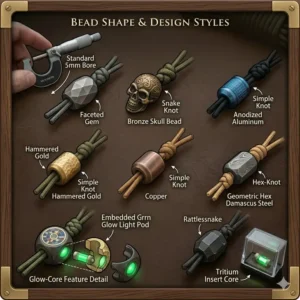
Selecting a material isn’t just about aesthetics; it fundamentally changes how the item interacts with your daily environment. You must align the metal or material with your specific lifestyle and the blade it attaches to.
Titanium: The Pragmatist’s Choice
Titanium is virtually indestructible, completely immune to rust, and incredibly light. If you sweat heavily, work in marine environments, or live in a humid climate, titanium is your best bet. According to materials science engineering data (like those found on Wikipedia’s Titanium page), titanium’s strength-to-weight ratio is unparalleled. In practice, this means you get the aesthetic chunkiness of a metal upgrade without the pocket-dragging weight.
Brass and Copper: The Living Metals
These materials are for purists who appreciate wabi-sabi—the beauty of imperfection. They react to the environment, darkening and developing a unique patina. However, what no one tells you is that brass and copper will leave a distinct metallic scent on your fingers after handling, which some users find off-putting. Choose these only if you are willing to embrace the weight and the changing appearance.
Synthetics and Naturals (Stones, Micarta, Ultem)
Modern materials like Ultem (an amber-colored high-performance plastic) or natural stones like the Wazoo Novaculite are fantastic for niche setups. They won’t scratch steel, they remain temperature-neutral in freezing weather, and they reduce overall noise. If you are a hunter moving quietly through the woods, ditch the clanking metal and opt for a silent, non-reflective natural material.
What to Expect: Real-World Ergonomic Impact
Adding a lanyard bead fundamentally alters the geometry of drawing and using a pocket tool. It is not just decorative; it acts as an ergonomic extension.
When you use a small, three-finger knife (like the Spyderco Dragonfly or CRKT Pilar), your pinky finger usually hangs off the back, providing no gripping power. A well-placed bead changes this dynamic entirely. By sizing the cord so that the bead rests exactly in the crook of your pinky finger when the knife is deployed, you effectively create a four-finger grip. This “pinky lock” drastically increases your cutting leverage and safety, preventing the knife from slipping forward during heavy slicing tasks.
Conversely, if you put a large bead on an already large, five-finger tactical blade, it serves a different purpose: retrieval speed. In a high-stress scenario or when wearing thick winter gloves, you don’t dig for the knife; you simply hook your finger onto the bead hanging outside the pocket and pull. The bead acts as a tactile indexing point, allowing for blind, rapid deployment.
Common Mistakes When Sizing Paracord to Lanyard Holes
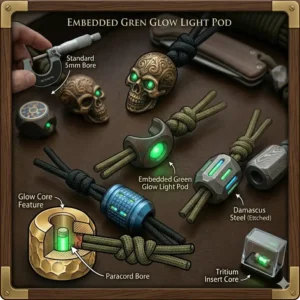
One of the most frequent errors I see in the EDC community is a mismatch between the size of the knife’s lanyard hole, the cord, and the bead’s internal diameter. It creates a sloppy, unprofessional look that undermines the entire purpose of the customization.
The “Bulging Knot” Mistake
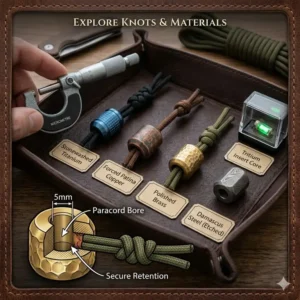
Many people try to force standard 550 paracord through a small knife lanyard hole, loop it, and immediately thread a bead. If the bead’s internal hole is wider than the cord, the bead will constantly slide up and down, wearing away the paracord fibers. To stop this, you must use a bead that matches the thickness of your chosen cord setup (usually around 4mm for single cord, 6mm for doubled cord).
The Edge Proximity Hazard
I have seen beautiful $500 custom knives with edge damage simply because the lanyard loop was tied too long. If the loop allows the bead to swing around and contact the sharpened edge when the knife is closed, the metal bead will roll or chip your blade’s edge. Always hold the closed knife and physically swing the bead toward the opening of the handle—if the bead can touch the edge of the blade inside the handle scales, your lanyard is too long. Shorten it immediately.
Long-Term Cost & Maintenance of EDC Accessories
While knife lanyard beads are a relatively inexpensive entry point into EDC customization, understanding their long-term wear cycle will save you from premature replacements.
The Year One Wear Cycle:
-
Months 1-3: Anodized titanium and coated beads look flawless. Brass and copper begin to show minor dulling.
-
Months 3-6: Friction from pockets and keys will begin to wear away high spots on anodized titanium. This is normal and creates a “stonewashed” look.
-
Months 6-12: Paracord begins to fray and absorb sweat, dirt, and oil. The cord will look dingy and may start to smell if not washed.
Expert Maintenance Strategy:
To maximize the lifespan of your setup, you must treat the cordage as a consumable. I recommend replacing the paracord every 6 to 8 months. As for the beads, do not use abrasive polishes on anodized titanium, as it will strip the color entirely. For brass and copper, you can let them patina, or if you prefer the shiny day-one look, a quick rub with Brasso or a mixture of lemon juice and baking soda will restore the bright finish in seconds.
✨ Don’t Miss These Exclusive Deals!
🔍 Ready to rig your perfect setup? Click on any highlighted item to check current pricing. Upgrading your carry is one of the most satisfying weekend projects you can do!
Conclusion
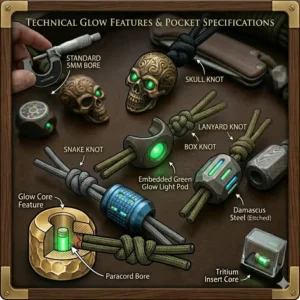
Upgrading your pocket gear with high-quality knife lanyard beads is about much more than just aesthetics; it’s a profound enhancement to the daily utility and ergonomics of your primary cutting tool. Whether you opt for the ultralight pragmatism of the Kizer Titanium Bead or the rugged field-readiness of the Wazoo Whetstone, the right choice depends entirely on your specific knife, your environment, and your personal carry philosophy. Remember that the magic lies not just in the metal you choose, but in how you tie it, secure it, and integrate it into your daily life. Stop settling for a naked, hard-to-reach pocket clip and start treating your EDC like the purpose-built system it was meant to be.
FAQs
❓ What are knife lanyard beads used for?
✅ They act as functional counterweights, improve grip extension on small knives, aid in quick pocket retrieval, and allow users to personalize their everyday carry gear. They turn a simple piece of paracord into a tactile, easy-to-grab handle…
❓ How wide should the hole in a lanyard bead be?
✅ For standard 550 paracord, you need at least a 4mm hole to pass a single strand. To pass a doubled loop of 550 cord, look for a 6mm (or 1/4 inch) internal bore…
❓ Does titanium scratch knife scales?
✅ Yes, if allowed to swing freely, a titanium bead can scratch softer materials like aluminum, carbon fiber, or G10. Tying knots closely around the bead prevents it from striking the knife handle…
❓ Can I use leather cord instead of paracord?
✅ Yes, leather cord gives a classic, traditional look, especially on slip-joint knives. However, leather degrades faster than nylon paracord when exposed to sweat, water, and friction, requiring more frequent replacement…
❓ How much does a good EDC bead cost?
✅ Prices range widely based on material and machining. Basic anodized titanium or pewter runs between $15 and $25, while custom-machined exotic metals like Zirconium or Timascus can exceed $100…
Recommended for You
- 5 Top lanyard beads to Transform Your EDC Setup in 2026
- 5 Best Knife Lanyard Designs for 2026: Expert EDC Gear Guide
- 5 Best Flat EDC Flashlight Models for 2026: Slim Your Carry
Disclaimer: This article contains affiliate links. As an Amazon Associate, I earn from qualifying purchases. If you purchase products through these links, we may earn a small commission at no additional cost to you.
✨ Found this helpful? Share it with your friends! 💬🤗
[addtoany]
