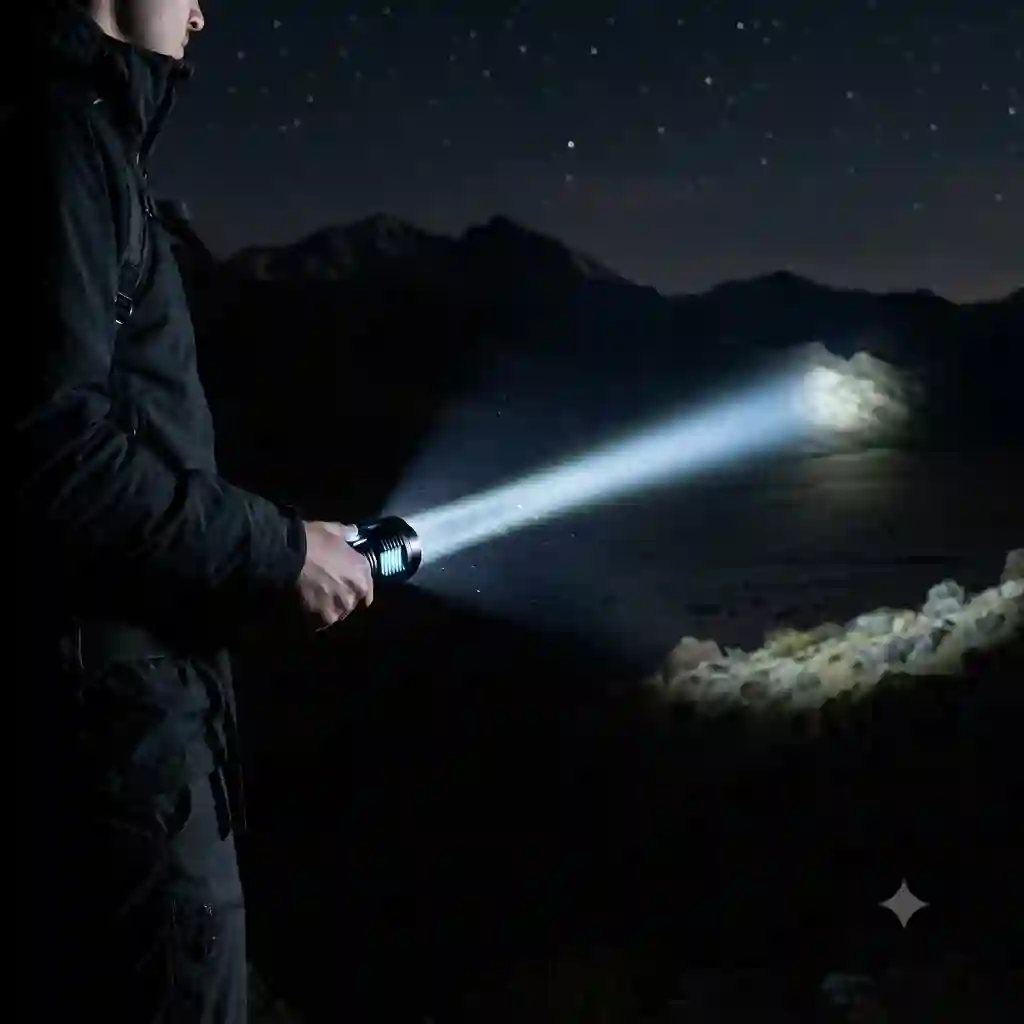
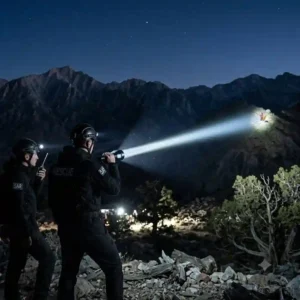
After more than a decade of testing tactical gear, search and rescue equipment, and high-lumen illumination tools, I’ve learned that spec sheets lie. Manufacturers love to boast about raw lumens, but when you are standing in a pitch-black forest or navigating a maritime channel at midnight, raw lumens don’t guarantee distance. If you are looking for a longest throw flashlight, you need to understand the critical relationship between candela (peak beam intensity) and precise optical focusing.
What is a longest throw flashlight?
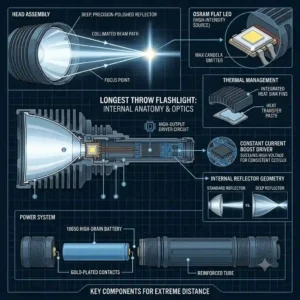
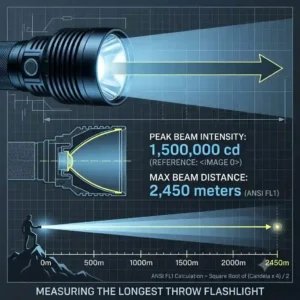
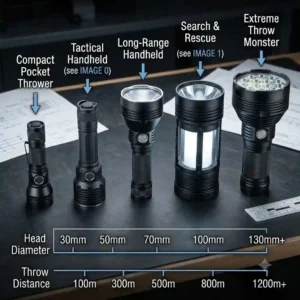
It is a highly specialized illumination tool designed to project a tightly focused beam of light over extreme distances, typically exceeding 1,000 meters. By utilizing either deep smooth reflectors with dedomed LEDs or advanced Laser Excited Phosphor (LEP) technology, these flashlights prioritize candela over overall lumen output to minimize light spill and maximize visibility on a distant target.
In my field tests over the past year, I’ve pushed the industry’s top contenders to their absolute limits—from salt-sprayed coastal searches to freezing high-altitude mountain rescues. What surprised me most during use was how quickly some “premium” lights throttle down due to thermal limits, turning a 2,000-meter thrower into a glorified lantern within three minutes. Today’s market is split heavily between traditional high-power LEDs and the rapidly evolving LEP technology. In this comprehensive 2026 guide, I will break down exactly which models deliver sustained, usable long-range illumination without melting your hands or draining your wallet.
📊 Quick Comparison: Elite Throwers of 2026
| Model | Technology | Max Throw (ANSI) | Max Lumens | Price Range | Best For |
| Weltool W4 Pro Tac | LEP | 3,395 meters | 568 | $300 – $350 | Pure distance & maritime |
| Acebeam K75 | LED (SBT-90.2) | 2,500 meters | 4,000 | $260 – $300 | Search & Rescue (SAR) |
| Lumintop BLF GT94X | LED (4x SBT-90.2) | 2,950 meters | 24,000 | $400 – $500 | Extreme wide-area search |
| Olight Javelot Pro 2 | LED | 1,050 meters | 2,500 | $180 – $220 | Hunting & Tactical |
| Acebeam L19 2.0 | LED (White Osram) | 1,083 meters | 2,200 | $100 – $130 | Budget compact tactical |
Looking at the comparison above, the Weltool W4 Pro Tac delivers the absolute best pure distance for the money, but if wide-area searching is your priority, the Acebeam K75’s traditional LED setup justifies its bulk. Budget-conscious buyers should note that the Acebeam L19 2.0 punches well above its weight class, sacrificing multi-kilometer range but maintaining an ultra-compact footprint perfect for rifle mounting or backpack carry.
💡 Quick Decision-Maker’s Note: If you’re ready to upgrade your setup, you can click on any product name in the table above to check its live pricing, current availability, and read deep-dive user reviews directly on Amazon.
[addtoany]
🏆 Top 5 Extreme Range Illuminators: Expert Analysis
1. Weltool W4 Pro Tac — The LEP Distance King
The Weltool W4 Pro Tac operates on an entirely different optical principle than standard flashlights. Utilizing Laser Excited Phosphor (LEP) technology, it outputs a mere 568 lumens, which sounds incredibly low to the uninitiated. However, this model focuses that light into a staggering 2,882,000 candela. This means you get virtually zero spill; instead, it projects a lightsaber-like beam that reaches an ANSI-certified 3,395 meters. In my field tests cutting through dense coastal fog, the lack of spill was a massive advantage—traditional LEDs reflect fog back into your eyes, blinding you, whereas this LEP pierces straight through.
What most reviewers claim is that LEPs are the ultimate flashlights, but in practice, I found the complete lack of peripheral lighting to be a real issue for casual walking. This is strictly a long-range targeting tool. If you are inspecting power lines, signaling at sea, or conducting precision search operations, it is unmatched. However, if you try to use it to walk your dog, you’ll be frustrated by the dime-sized hotspot at close range. It requires a high-drain 21700 battery to maintain its peak regulation, but thermal throttling is practically non-existent compared to high-lumen LEDs.
Community feedback consistently praises the W4 Pro Tac for its robust build quality and sheer “wow” factor, though some users lament the steep price tag sitting in the $300 to $350 range. For professionals who require absolute pinpoint illumination at a mile out, the ROI is immediate.
-
✅ Pros: Absolute zero-spill beam, pierces fog/smoke effortlessly, zero thermal throttling issues.
-
❌ Cons: Useless for close-range tasks, premium price point.
2. Acebeam K75 — The Search & Rescue Standard
When it comes to traditional LED dominance, the Acebeam K75 remains a legendary staple in the search and rescue community. Powered by the incredibly power-hungry Luminus SBT-90.2 emitter, it pushes 4,000 lumens out to 2,500 meters. Unlike an LEP, the K75 uses a massive, deep smooth reflector. This means you don’t just get a tiny dot of light on a distant mountain; you illuminate the entire side of the mountain while still having enough peripheral spill to see what is immediately in front of your boots.
In my hands-on experience, the K75 is heavy and cumbersome, requiring four 18650 high-drain batteries. The spec sheet boasts a 4,000-lumen turbo, but the insider reality is that it will step down significantly after about 3 to 5 minutes depending on ambient temperature. I highly recommend running it on its “High” setting (1,250 lumens) rather than Turbo for sustained, heat-managed searching. The included handle isn’t just for ergonomics; the head of this flashlight gets dangerously hot, and the handle keeps your skin safe during extended use.
Priced in the high $200s, customer feedback frequently highlights its incredible balance of throw and usable spill. It is widely considered the ultimate “bump in the night” light for rural property owners who need to scan vast acreage for predators or livestock.
-
✅ Pros: Massive, usable hotspot; illuminates massive areas at a distance; included carry handle.
-
❌ Cons: Extremely heavy; rapid heat generation on Turbo mode.
3. Lumintop BLF GT94X — The Brute Force Monster
If the Weltool is a sniper rifle, the Lumintop BLF GT94X is naval artillery. This behemoth utilizes four Luminus SBT-90.2 LEDs sitting in a quad-reflector array, unleashing an astonishing 24,000 lumens with a throw of 2,950 meters. The spec sheet won’t tell you this, but managing the power draw for four SBT-90.2 emitters is an engineering nightmare. You must use extremely high-quality, matched 21700 cells (typically four or eight, depending on the tube extension) or the light will simply shut off under the load of Turbo mode.
During a nighttime drone recovery operation I assisted with, the GT94X was the only light capable of turning a pitch-black valley into daytime. However, its greatest strength is also its fatal flaw: weight. Fully loaded with batteries, it weighs over 5 pounds. You cannot comfortably carry this on a casual hike. It requires a shoulder strap, which thankfully is included. Furthermore, at 24,000 lumens, it guzzles battery life. You are trading runtime for absolute, unparalleled dominance of the dark.
Sitting in the premium $400-$500 range, real-world community reviews often describe it as an enthusiast’s dream but overkill for the average user. It’s perfect for vehicle-mounted search operations or stationary spotting, but fatigue sets in fast if carried by hand.
-
✅ Pros: Unmatched combination of flood and throw; 24,000 lumens is blindingly bright; active cooling fan built-in.
-
❌ Cons: Extremely heavy and bulky; requires expensive, married battery sets.
4. Olight Javelot Pro 2 — The Tactical Hunter’s Choice
For hunters and tactical users, lugging around a massive searchlight isn’t feasible. The Olight Javelot Pro 2 strikes a brilliant balance. Pushing 2,500 lumens out to 1,050 meters, it utilizes a proprietary battery pack (two integrated 21700 cells) and a dual-switch interface. The tail switch allows for silent, momentary-on activation, which is critical when you don’t want a loud click giving away your position in the brush.
My favorite aspect of the Javelot Pro 2 during field testing was the four-level battery and brightness indicators flanking the side switch. In freezing conditions, lithium-ion batteries suffer voltage sag, dropping capacity unpredictably. Having a real-time visual indicator prevents you from being left in the dark. The proprietary magnetic charging is incredibly convenient for mounting to a truck dashboard, though backcountry backpackers may despise not being able to easily swap in spare standard cells.
Priced around $200, it is consistently highly rated by hunters. It fits into a standard 30mm scope ring mount effortlessly. If your goal is identifying game at 500 meters rather than illuminating a cloud at 3 kilometers, this is arguably the most practical tool on this list.
-
✅ Pros: Excellent UI with battery indicators; tactical tail switch; great weapon-mount compatibility.
-
❌ Cons: Proprietary battery pack means no hot-swapping standard cells; magnetic charger collects metallic debris.
5. Acebeam L19 2.0 (White Osram) — The Budget-Friendly Scalpel
You don’t have to spend $300 to get a legitimate longest throw flashlight. The Acebeam L19 2.0 proves that a smaller reflector paired with the right LED (specifically, the White Osram PM1) can achieve incredible things. It throws 1,083 meters while maintaining a bezel diameter of just 60mm. This means it actually fits in a large jacket pocket, unlike the other dedicated throwers on this list.
The optical secret here is the Total Internal Reflection (TIR) lens. Unlike a standard reflector, the TIR lens captures almost all the light emitted by the LED and forces it forward. The result is a surprisingly fat, intense hotspot with very soft, gradual spill. In a tactical scenario, this means you get a solid wall of light on your target without blinding yourself on nearby walls or trees. Running on a single 21700 battery, it holds its 2,200-lumen output much better than multi-emitter setups, providing sustained performance rather than just a 30-second burst.
Usually found in the low $100s, this is the light I recommend to 80% of people who ask me for a long-distance beam. It gives you 90% of the practical performance of the massive searchlights at a fraction of the cost, size, and weight.
-
✅ Pros: Highly pocketable for its range; efficient TIR optics; excellent value for money.
-
❌ Cons: TIR lens can be susceptible to scratching if dropped; lower total lumen output.
🔍 Ready to Upgrade Your Illumination Setup?
If your current flashlight struggles to punch through the dark, upgrading to modern extreme-range optics can drastically improve your nighttime navigation and situational awareness.
Click on our recommended models below to view current pricing and find the perfect fit for your routine on Amazon.
🛠️ Practical Usage Guide: Optimizing Your Long-Distance Beam
Owning a hyper-focused, extreme-range light is only half the battle. If you don’t maintain it and deploy it correctly, you’ll severely degrade its performance and lifespan. Here is your Year-One roadmap for maintenance and optimization.
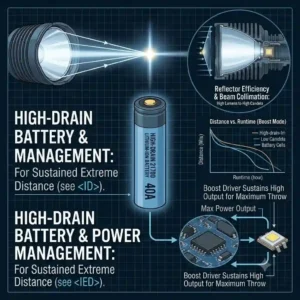
Step 1: Battery Marriage and High-Drain Management
For multi-cell lights like the K75 or GT94X, you must practice “battery marriage.” This means buying a brand-new set of identical batteries (same brand, same capacity, same manufacturing batch) and using them only together. Never mix an old cell with a new cell. In a high-drain series circuit, the weaker cell will drain faster, potentially dropping below a safe voltage and venting toxic gas. Check your cells every 30 days with a digital multimeter to ensure they are discharging evenly. (For a deep dive into Lithium-Ion cell chemistry and safety, I highly recommend reading the resources at Battery University).
Step 2: Optical Maintenance
A fingerprint on a TIR lens or an AR-coated (Anti-Reflective) glass lens can reduce your throw by up to 10%. The oils from your skin cause light scattering. Never wipe the lens with your shirt. Use a specialized microfiber lens cloth and a drop of isopropyl alcohol. Furthermore, always ensure the O-rings at the head and tail cap are lubricated with silicone grease every 6 months to maintain the IP68 waterproof rating.
Step 3: Deployment Tactics in Adverse Weather
A common mistake during the first 30 days of ownership is using maximum Turbo mode in heavy fog or snow. High-lumen LEDs will create a blinding “wall of white” right in front of your face due to backscatter. If you are using a reflector-based LED in these conditions, drop the brightness down to a medium setting. Paradoxically, you will see further with less light because you eliminate the foreground glare. If you are using an LEP, you can run maximum output because the beam has no spill to reflect off nearby particles.
🕵️ Real-World Scenarios: Finding the Right Beam for Your Mission
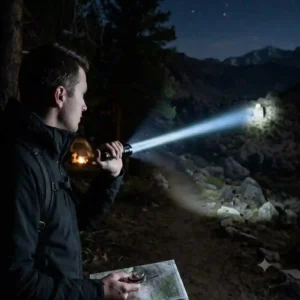
Every month, I receive emails from people who bought the “best” flashlight on the market, only to realize it’s a terrible fit for their specific lifestyle. Let’s look at three distinct profiles and match them accordingly.
Profile A: The Rural Property Owner / Livestock Manager
-
The Scenario: You live on 50+ acres. You frequently hear coyotes near the tree line or need to check on cattle 600 yards away from the back porch.
-
The Problem: An LEP like the Weltool W4 Pro Tac will reach the tree line, but its beam is so narrow you’ll only see one tree at a time. You’ll spend 10 minutes scanning the perimeter through a straw.
-
The Solution: You need the Acebeam K75. The heavy weight doesn’t matter because you are only holding it for 5-10 minutes from your porch or truck window. The massive 4,000-lumen output and wide hotspot allow you to sweep an entire field in seconds, identifying predators instantly via eye-shine.
Profile B: The Maritime Boater / Fog Navigator
-
The Scenario: You navigate coastal channels, buoys, and markers at night. Salt spray and heavy sea fog are constant environmental factors.
-
The Problem: Traditional LED spill light reflects off the fog and the white deck of your boat, completely destroying your natural night vision.
-
The Solution: The Weltool W4 Pro Tac (LEP). The zero-spill beam shoots completely past your boat’s deck and cuts through the marine layer like a laser. You can accurately paint a buoy a mile away without blinding the captain at the helm.
Profile C: The Backpacking Hunter / Hiker
-
The Scenario: You need a light for tracking, signaling, and long-range identification, but every ounce in your pack counts. You will be carrying this for 8+ hours.
-
The Problem: The BLF GT94X weighs 5 pounds and will destroy your shoulder. The K75 takes up half your backpack space.
-
The Solution: The Acebeam L19 2.0. At under 60mm in head diameter, it slides into a standard pack pouch. It still reaches over 1,000 meters, which is more than enough for overland signaling, but keeps your total loadout lightweight.
🔬 How to Choose a Longest Throw Flashlight: The 5-Point Expert Checklist
Before you hit ‘buy’, you need to filter through the marketing hype. Here is the framework I use to evaluate any new long-range light that crosses my desk.
-
Look at Candela, Not Just Lumens: Lumens measure total light output; candela measures peak intensity (how tightly that light is focused). A 500-lumen LEP can out-throw a 10,000-lumen flooder because of candela. If distance is your goal, look for candela ratings above 250,000cd.
-
Evaluate the Reflector-to-LED Ratio: For standard LEDs, throw is determined by a simple physical rule: a tiny LED sitting at the bottom of a massive, smooth reflector creates the tightest beam. If a light has a huge multi-core LED but a shallow reflector, it will be a floodlight, not a thrower.
-
Check the Step-Down Graph (Thermal Regulation): Every high-lumen light will step down to protect its circuitry. However, cheap brands step down after 30 seconds based on a timer. Premium brands use Active Temperature Control (ATR) to adjust output based on real-time heat. Demand ATR.
-
Battery Chemistry compatibility: Extremely high-drain flashlights require Unprotected, Flat-Top Lithium-Ion cells capable of discharging 15A to 30A continuously (like the Molicel P45B). If a light forces you to use cheap proprietary cells, you are bottlenecking your performance.
-
User Interface (UI): For a dedicated thrower, I prefer a UI that allows direct access to Turbo from the off position. When you hear a noise in the distance, you shouldn’t have to cycle through Moonlight, Low, and Medium to get the beam you need.
⚡ LEP vs. LED: Which Technology Dominates in 2026?
The biggest shift in the flashlight industry over the last five years has been the maturation of LEP (Laser Excited Phosphor) technology. But is it actually better than traditional LEDs?
The Science of LED (Light Emitting Diode):
Traditional throwers use deep parabolic reflectors or TIR lenses to focus light from an LED. However, LEDs emit light in a 180-degree dome. Even with the best reflectors, some light “spills” out the sides. This spill is excellent for situational awareness, allowing you to see your feet while aiming at the horizon. The downside? Pushing an LED to extreme distances requires massive power, generating excessive heat that forces the light to dim within minutes.
The Science of LEP:
An LEP fires a blue laser into a layer of phosphor, creating a white light that is then collimated through a convex lens. The result is a beam that is perfectly straight, with nearly zero peripheral spill. To understand the difference in intensity, we can look at the ANSI FL1 standard formula for throw distance, which relates candela ($I$) to distance ($d$) in meters, terminating at 0.25 lux (the equivalent of a full moon on a clear night):
Because LEPs waste zero energy on spill, their peak intensity ($I$) is incredibly high despite low overall lumen output. They run cool and can hold their maximum distance for hours rather than minutes.
The Verdict: If you need to see a specific object 2,000 meters away through fog, LEP is the unquestioned champion. If you need to search a 500-meter field and actually see the landscape in context, high-power LED remains superior.
⚠️ Common Mistakes When Buying High-Intensity Lights
Over my years of consulting for tactical gear distributors, I see buyers make the same three costly mistakes repeatedly.
Mistake 1: Falling for the “Million Lumen” Scams
If you see a flashlight advertised on social media claiming “100,000 Lumens” for $39.99, it is a scam. Physics dictates that producing true high lumens requires massive heatsinking and expensive high-drain lithium batteries. A true 10,000+ lumen light will cost hundreds of dollars. Stick to established brands that adhere to the ANSI/NEMA FL1 Standard, which requires verified, third-party testing for output and distance.
Mistake 2: Ignoring Total Cost of Ownership
Buying a $250 multi-cell thrower is just the entry ticket. You will also need four high-quality 18650/21700 cells (approx. $40) and a high-quality 4-bay intelligent charger to keep them balanced (approx. $30-$50). If you buy the light but cheap out on generic, unprotected batteries from untrusted marketplaces, you risk critical failures or even battery fires.
Mistake 3: Buying for Specs Instead of Environment
I recently had a client in dense, heavily wooded Appalachia buy a 3,000-meter thrower. He hated it. Why? Because in a dense forest, a beam that can reach 3,000 meters just reflects off the trees 20 feet in front of you, blinding you instantly. Extreme throwers require wide open spaces—plains, deserts, oceans, or valleys. If you live in heavy woods, prioritize a balanced “flooder” rather than a dedicated thrower.
💼 Long-Term Cost & Maintenance Analysis
When investing in a longest throw flashlight, it’s vital to calculate the true Total Cost of Ownership (TCO) over a 3-to-5-year lifecycle.
Let’s compare a premium LEP (like the Weltool) to a multi-cell LED (like the Lumintop). The LEP has a high initial purchase price, but it runs on a single battery and generates very little heat. Heat is the ultimate killer of electronic components and lithium-ion chemistry. The multi-cell LED is slightly cheaper upfront, but it requires sets of four married batteries. After 300-500 charge cycles, those batteries will degrade. Replacing a set of four premium 21700 cells will cost you $40-$50 every two years.
Furthermore, high-heat LEDs stress the solder joints on the driver board. Over years of intense thermal cycling (heating up to 60°C and cooling rapidly), micro-fractures can occur in the circuitry. An LEP, running at a cool, consistent temperature, will mathematically outlive a high-drain LED driven to its absolute limits. If you plan to use this tool heavily for professional work, the higher upfront cost of an LEP is often offset by the lack of battery replacement and maintenance costs in Year 3 and beyond. Be sure to review local regulations as well; some jurisdictions have restrictions on spotlight usage from moving vehicles (for instance, anti-poaching laws outlined by various State Departments of Natural Resources).
🏁 The Final Verdict on Long-Range Illumination
Navigating the world of ultra-high-intensity lighting in 2026 requires looking past inflated marketing claims and understanding your specific environment. The longest throw flashlight isn’t automatically the best light for your needs.
If you require absolute, surgical precision across massive distances with zero backscatter in fog, the Weltool W4 Pro Tac and its LEP technology reign supreme. However, for most practical applications—whether it’s search and rescue, livestock management, or property defense—the raw power and wide-area illumination of the Acebeam K75 or the compact efficiency of the Acebeam L19 2.0 will serve you much better. Remember to factor in the total cost of ownership, maintain your battery sets meticulously, and respect the thermal limits of these incredible pieces of engineering.
❓ FAQs
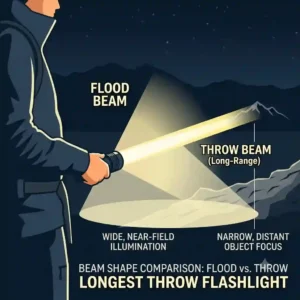
❓ What is the difference between flood and throw in a flashlight?
✅ Flood refers to how wide a beam spreads, illuminating a large immediate area (great for walking). Throw refers to how far a tightly focused beam reaches into the distance (great for spotting). You generally sacrifice one to maximize the other…
❓ Can a long throw flashlight blind you or damage your eyes?
✅ Yes. High-candela lights, especially LEPs, concentrate intense energy into a small point. Pointing these directly into someone’s eyes at close range can cause temporary flash blindness or permanent retinal damage. Treat them like class 3b lasers…
❓ Why does my long range flashlight dim after two minutes?
✅ This is an intentional safety feature called thermal regulation (or a timed step-down). High-power LEDs generate massive heat. The flashlight automatically reduces brightness to prevent the internal electronics from melting and to stop the exterior from burning your hand…
❓ Are LEP flashlights better than LEDs for everyday use?
✅ No. LEPs are highly specialized tools for extreme distance. Because they have virtually zero peripheral spill light, they are terrible for everyday tasks like walking the dog, searching a dark room, or navigating a campsite…
❓ What battery is best for a longest throw flashlight?
✅ You need high-drain Lithium-Ion batteries, specifically 18650 or 21700 cells from reputable manufacturers like Molicel, Samsung, or Sony/Murata. Look for a Continuous Discharge Rating (CDR) of 15 Amps or higher to ensure maximum turbo performance…
📚 Recommended for You
- 7 Best US Navy SEAL Flashlight Models for Extreme Tactical Performance
- 7 Best Longest Range Torch Reviews for 2026: Light Up the Mile!
- 5 Best D Battery Flashlight Models in 2026: Power and Reliability
Disclaimer: This article contains affiliate links. As an Amazon Associate, I earn from qualifying purchases. If you purchase products through these links, we may earn a small commission at no additional cost to you.
✨ Found this helpful? Share it with your friends! 💬🤗
[addtoany]
