
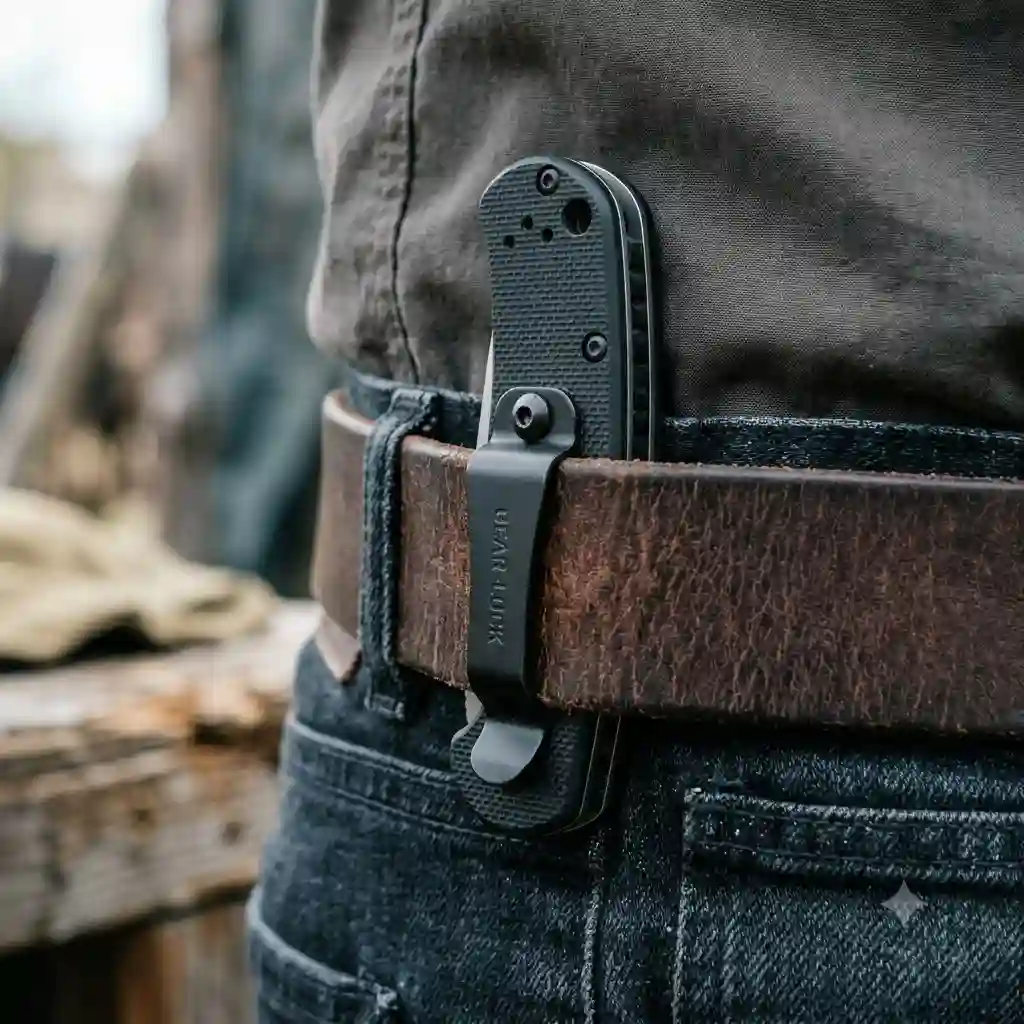
After a decade of testing everyday carry (EDC) gear, if there is one thing I have learned the hard way, it is that a premium blade is absolutely useless if its mounting hardware fails when you need it most. We spend hours agonizing over blade steel, handle ergonomics, and deployment mechanisms, yet we often treat the knife belt clip as an afterthought.
What is a knife belt clip? In its simplest form, it is the mechanical interface that secures your knife sheath (or the knife itself) to your clothing or belt. However, in 2026, the technology has evolved far beyond simple bent steel. Today’s retention systems involve specialized spring alloys, cam-locking polymer clasps, and high-friction textiles designed to keep your tool anchored under extreme physical duress.
In my field tests, I’ve had “military-grade” clips snap off during a simple hike and budget clips that miraculously held a heavy fixed blade secure during rigorous outdoor work. The difference rarely lies in the marketing hype; it lies in the metallurgy, the clamping force, and the geometry of the clip itself. In this guide, I will break down the exact hardware I trust on my own waistline, interpret the technical specifications that actually matter, and help you avoid the common pitfalls that lead to lost gear and frustrated users.
Quick Comparison Table
| Product | Best For | Material | Attachment Style | Price Range |
| Ulticlip Slim 3.3 | Beltless Carry | Spring Steel | Cam-lock / Friction | $15 – $25 |
| Blade-Tech Tek-Lok | Heavy OWB Duty | Glass-filled Nylon | Hinged Clasp | $10 – $20 |
| Discrete Carry Concepts Mod 4 | Maximum Concealment | HLR3 Steel | Over-the-belt | $10 – $15 |
| Spyderco G-Clip | Multi-Position Fix | Polymer | Slide-on tension | $8 – $15 |
| Nite Ize HipClip | Clipless Folders | Stainless Steel | VHB Adhesive | $5 – $10 |
Looking at the comparison above, the Discrete Carry Concepts Mod 4 delivers the absolute best retention under $15, but if you frequently wear gym shorts or sweatpants, the Ulticlip’s cam-lock mechanism justifies its slightly higher price tag. Budget buyers looking to modify traditional pocket knives will find the Nite Ize HipClip a functional patch, though it sacrifices the structural permanence of the heavier-duty sheath attachments.
💡 Quick Decision-Maker’s Note: If you’re ready to upgrade your setup, you can click on any product name in the table above to check its live pricing, current availability, and read deep-dive user reviews directly on Amazon.
[addtoany]
Top 5 Knife Belt Clips — Expert Analysis
1. Ulticlip Slim 3.3
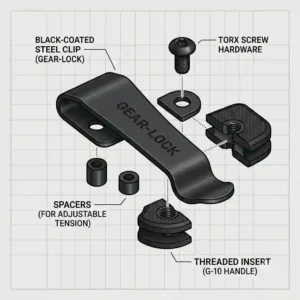
The Ulticlip Slim 3.3 utilizes a dual-hole mounting bracket and a patented cam-locking system rather than traditional spring tension. What this means in practice is that you do not actually need a belt to use it. It clamps directly onto the fabric of your waistband, hem, or pocket edge with a vice-like grip. Measuring 3.3 inches in length, it provides enough surface area to stabilize medium-to-large fixed blade sheaths without adding unnecessary bulk to your profile.
In my experience, what most buyers overlook about this model is the mechanical wear it can put on delicate fabrics over time. If you clamp this onto thin suit trousers daily, you will eventually see fraying. However, for those of us wearing tactical pants, jeans, or thick athletic shorts, it is a game-changer. It is the only clip I trust when I am running in sweatpants, completely eliminating the need for an inner rig.
Community feedback consistently praises its incredible grip strength, though some users note a slight learning curve when disengaging the lock one-handed. Sitting comfortably in the $15-$25 range, it offers unmatched versatility for beltless carry, making it a mandatory upgrade for anyone tired of traditional slide-on clips sliding right off.
-
✅ Pros: Unmatched beltless retention, very slim profile, highly concealable.
-
❌ Cons: Can damage thin clothing over time, requires deliberate mechanical un-clamping.
2. Blade-Tech Tek-Lok
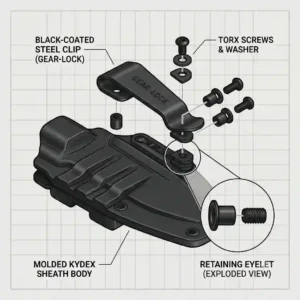
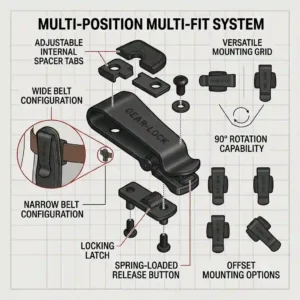
The Blade-Tech Tek-Lok is essentially the industry standard for outside-the-waistband (OWB) fixed blade carry. Constructed from high-strength glass-filled nylon, it features a hinged, clamshell design with a secondary locking mechanism. The spec sheet boasts adjustable internal shim bars to accommodate belts from 1.25 inches up to 2.25 inches. In reality, this means you can swap the same knife from your everyday leather gun belt to a massive, padded battle belt without needing to unscrew a single piece of hardware.
What surprised me most during use was how well the secondary lock holds up to blunt force. Most reviewers claim it is bulky, and in practice, I found that to be the real issue if you are attempting concealed carry. It pushes the knife sheath a solid half-inch away from your body. However, if you are open carrying in the woods, hunting, or working on a job site, that offset is actually a benefit, allowing for a cleaner, faster grip on the knife handle even while wearing thick gloves.
Reviews across the board celebrate its bomb-proof durability and ease of attachment. Priced reasonably in the $10-$20 range, it isn’t meant for deep concealment, but it remains the undisputed king of rugged, modular OWB carry systems.
-
✅ Pros: Incredibly durable, fits almost any belt width, fast on/off convenience.
-
❌ Cons: Too bulky for concealed carry, pushes the sheath away from the body.
3. Discrete Carry Concepts Mod 4
The Discrete Carry Concepts Mod 4 (DCC) is forged from a proprietary HLR3 spring steel. Unlike generic stamped steel clips that lose their shape after a few months, this metallurgy provides an extreme yield strength. This translates directly to a clip that will literally bite into your belt and refuse to let go, even if you are grappling or tumbling. It features a behind-the-belt mounting flange, meaning only the thinnest sliver of black metal is visible from the outside.
I have run the DCC Mod 4 on my primary appendix-carry defensive knife for two years. The insider tip here is that the clamping force is so aggressive that it will gouge cheap leather belts. You must pair this with a high-quality, reinforced nylon or top-grain leather EDC belt. For those needing true deep concealment in non-permissive environments, this clip vanishes completely against dark clothing.
User consensus highlights its unparalleled concealment and retention, with the only major complaint being that it can be a struggle to take off at the end of the day. Floating in the $10-$15 range, it represents the pinnacle of covert, ultra-secure mounting hardware.
-
✅ Pros: Extreme clamping force, nearly invisible profile, will not lose tension over time.
-
❌ Cons: Will scratch soft leather belts, difficult to remove quickly.
4. Spyderco G-Clip
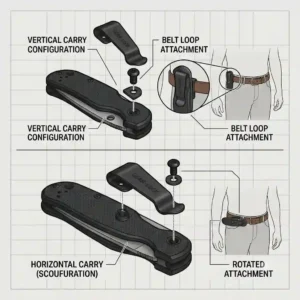
The Spyderco G-Clip is a fiberglass-reinforced polymer clip that relies on a simple, high-tension slide-on design. Its defining feature is the multi-hole mounting matrix. This allows you to mount a small fixed blade vertically, horizontally, or at various canted angles. This means you can tune your draw stroke perfectly, whether you carry on your hip, small of back, or cross-draw.
The anti-recommendation logic here: I actually think this is a terrible clip for heavy, 5-inch-plus fixed blades. The polymer tension is excellent, but it lacks the mechanical lock of a Tek-Lok or the aggressive bite of a DCC. If you use it for a heavy tool, a snag on a branch will pull the whole sheath off your belt. However, for a small neck knife or a 2.5-inch fixed blade, it is wonderfully lightweight and low-profile.
Real-world feedback points out that it sits very flat against the body, making it a great hybrid for both OWB and IWB (inside-the-waistband) carry. At the highly accessible $8-$15 range, it’s a brilliant, cost-effective replacement for the cheap chains or paracord that often accompany neck knives.
-
✅ Pros: Highly adjustable cant/angle, very lightweight, comfortable against the body.
-
❌ Cons: Lacks a mechanical locking mechanism, not suitable for heavy blades.
5. Nite Ize HipClip
The Nite Ize HipClip is a completely different animal. It is a simple stainless steel clip backed with 3M VHB (Very High Bond) adhesive. The spec sheet says it mounts to “almost any surface.” In practice, this means you can take a traditional slip-joint knife, a Swiss Army Knife, or a modern folder that came with a broken factory clip, and permanently stick a functional pocket clip onto it without drilling or tapping screws.
Let’s be clear: this is not a heavy-duty tactical mount. If you leave this in a hot car in Arizona, the adhesive can soften. But for an office worker who wants to stop their favorite smooth-bone traditional folder from sinking to the bottom of their pocket, this is an ingenious solution. The secret to success here is preparation; you must scrub the knife scale with rubbing alcohol and let the adhesive cure for a full 24 hours before use.
Customers love the DIY simplicity, though inevitable complaints arise from those who fail to prep the surface properly before application. Dropping in at the $5-$10 range, it is an unbeatable aftermarket modification for casual EDC items.
-
✅ Pros: Requires no tools or drilling, extremely affordable, fits almost any flat surface.
-
❌ Cons: Adhesive can fail in extreme heat, not meant for heavy outdoor use.
🔍 Ready to Upgrade Your EDC Setup?
Finding the perfect balance of concealment and accessibility can completely change how you carry your gear daily. Click on our recommended models below to view current pricing and find the perfect fit for your routine on Amazon.
Practical Usage Guide: The First 30 Days
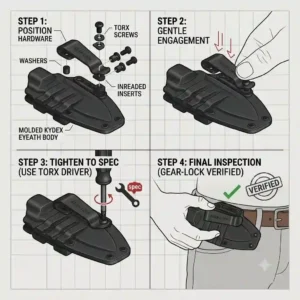
Even the best knife belt clip on the market will fail if mounted incorrectly. Over my years of testing, I’ve found that the vast majority of retention failures happen within the first 30 days of use, entirely due to user error during the setup phase.
Step 1: The Loctite Rule
Never trust factory assembly. When you receive your new clip, back out all the mounting screws. Apply a small drop of Blue threadlocker (never Red, unless you want it there permanently) to the threads, and re-tighten. Vibrations from walking, running, and driving will back out untreated screws in a matter of weeks. Check the torque again after your first 48 hours of carry.
Step 2: Ride Height Calibration
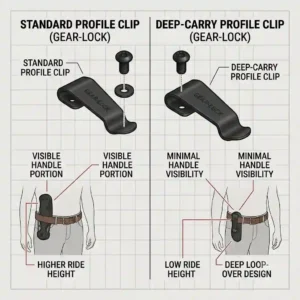
Don’t just slap the clip on the middle holes of your sheath. Test the “ride height.” If the clip is mounted too high on the sheath, the handle of the knife will flop away from your body, causing severe printing and discomfort. If mounted too low, the sheath will dig into your thigh when you sit. Spend your first week adjusting the clip up and down by one hole spacing until you find the perfect balance between concealment and a clean master grip.
Step 3: The 3-Month Maintenance Cycle
Dirt and lint are the enemies of locking mechanisms like the Ulticlip and Tek-Lok. Every 90 days, use compressed air to blow out the hinges, followed by a dry Teflon lubricant. Avoid wet oils, as they will attract grit and act like sandpaper on the polymer or metal components.
Problem → Solution Guide: Overcoming Carry Frustrations
Even with a premium setup, carrying a fixed blade daily presents unique challenges. Here are the most common problems I see, along with the exact solutions to fix them.
Problem 1: The Handle Prints Through Your Shirt
You have a great knife, but the handle looks like a tumor under your t-shirt.
-
The Solution: You are likely using a bulky OWB clip like a Tek-Lok for a concealed task. Switch to a flat, tension-based system like the DCC Mod 4 or an Ulticlip. Furthermore, angle the clip to a 45-degree cant (cross-draw). This aligns the handle with the natural slope of your waistline, instantly eliminating the printing issue.
Problem 2: The Clip Slides Around Your Belt
Every time you go to draw, the knife has migrated three inches from where you put it.
-
The Solution: This is an efficiency gap between the belt width and the clip’s internal dimension. If you have a 1.5-inch belt in a clip designed for 1.75-inch belts, it will slide. Use the internal sizing shims (standard on Blade-Tech gear) to lock down the internal width, or wrap a discreet layer of black friction tape around your belt exactly where the clip sits to act as an anchor point.
Problem 3: Rust on the Hardware
Sweat is highly corrosive, and after a hot summer, your steel clip might start showing orange spots.
-
The Solution: If you carry IWB (against the skin), upgrade from standard carbon steel to a polymer option like the Spyderco G-Clip, or ensure your steel clip has a heavy-duty Cerakote finish. For existing rust, scrub it with superfine steel wool and apply a thin layer of a rust-inhibitor like FrogLube or mineral oil.
How to Choose a Knife Belt Clip: The Decision Framework
Navigating the sea of aftermarket hardware can be overwhelming. To make an informed decision, you need to assess your daily environment through a structured framework rather than just picking what looks tactical.
-
Assess Your Wardrobe (The Foundation): If you wear suits or gym shorts, standard clips are useless. You need a fabric-grabbing cam-lock (Ulticlip). If you wear rigid 1.5-inch gun belts daily, over-the-belt spring steel (DCC) is your best friend.
-
Define the Deployment Scenario: Are you using this knife for rapid self-defense, or opening boxes at a warehouse? For defense, you need a clip that allows for a deep, immediate master grip without the sheath moving an inch. For utility, a simple slide-on clip provides enough retention while allowing you to easily take the knife off when sitting at a desk.
-
Evaluate the Sheath Material: As detailed in studies on thermoplastics (often referenced in Wikipedia’s breakdown of Kydex), hard sheaths require rigid mounting points. If your sheath has soft eyelets or uneven spacing, you may need a clip with slotted mounting holes to accommodate the irregular dimensions.
Common Mistakes When Buying a Knife Belt Clip
The biggest mistake I see in the EDC community is the “one-size-fits-all” mentality. People buy an expensive custom fixed blade and ruin the experience by slapping a $3 generic plastic clip on it.
Another major pitfall is ignoring the hole spacing. The industry standard is often 0.75 inches or 1.5 inches between mounting holes, but many custom makers drift from this standard. Always measure the distance between the eyelets on your sheath center-to-center before ordering hardware. If you buy a rigid clip with fixed holes that don’t match your sheath, it becomes an expensive paperweight.
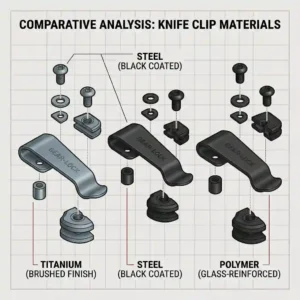
Lastly, buyers often underestimate the destructive power of cheap spring steel. A low-quality metal clip will lose its temper (its springy memory) after being stretched over a thick leather belt a few dozen times. Once it loses that tension, it becomes a liability. Investing in advanced metallurgy up front saves you from losing a $200 knife later.
Traditional Belt Loops vs. Modern Belt Clips
Why not just use the traditional leather or nylon belt loops that come with most knives? It comes down to modularity and convenience.
Traditional leather loops are incredibly secure and aesthetically pleasing, but they require you to literally take your belt off, thread the knife on, and re-buckle. If you go into a post office or a non-permissive environment, taking your knife off means undressing in the parking lot.
A modern knife belt clip solves this. You can attach or detach the system in seconds without touching your belt buckle. However, the trade-off is the risk of accidental detachment. A closed loop cannot be pulled off a belt; a clip can, if the clamping force is overcome by a snag. This is why understanding the specific retention mechanics (hinge-lock vs. spring tension) of the clips reviewed above is critical for your safety and gear security.
What to Expect: Real-World Performance & Limitations
Let’s strip away the marketing jargon. When you buy a high-end clip, you are buying peace of mind, but you are not buying magic.
In the real world, rigid polymer clips like the Tek-Lok are incredibly strong against vertical pulls (drawing the knife), but they can be brittle if struck hard from the side in freezing temperatures. I’ve seen glass-filled nylon snap when crushed against a rock at 10°F. Conversely, spring steel will bend rather than snap, but if it bends too far, it requires a vice to bend back into shape.
Furthermore, expect some wear and tear on your clothing. Any device designed to clamp tightly onto fabric or leather will create friction. You will eventually see shiny spots on your leather belt or minor pilling on the waistband of your pants. This is the accepted cost of doing business in the EDC world.
Conclusion
Securing your blade is just as important as the blade steel itself. Choosing the right knife belt clip dictates whether your tool is comfortably accessible when you need it, or lost in the brush miles behind you. By moving away from cheap factory mounts and investing in purpose-built hardware like the DCC Mod 4 for deep concealment or the Tek-Lok for rugged outdoor use, you dramatically increase the safety and reliability of your EDC setup. Remember to measure your sheath’s hole spacing, use threadlocker on your screws, and match the hardware strictly to your daily wardrobe and environment.
FAQs
❓ What is a knife belt clip?
✅ A knife belt clip is a mechanical fastener, usually made of steel, titanium, or polymer, designed to secure a knife sheath (or the knife itself) to a belt, waistband, or pocket edge. It allows for secure carry and rapid deployment without requiring a closed belt loop…
❓ Can you put a belt clip on any knife?
✅ Not directly on the knife unless it is a folder drilled for one, or by using aftermarket adhesive clips. However, almost any hard Kydex or polymer fixed-blade sheath can accept a knife belt clip if the mounting eyelets align…
❓ Which clip is best for carrying without a belt?
✅ The Ulticlip series is widely considered the industry standard for beltless carry. Its cam-locking mechanism clamps directly onto fabric, providing immense retention on sweatpants, athletic shorts, or backpack straps without slipping…
❓ Does a metal belt clip scratch leather belts?
✅ Yes, aggressive spring steel clips, especially those with under-the-belt retention tabs, will dig into and scratch soft leather over time. Pairing them with reinforced nylon tactical belts or heavy-duty gun belts minimizes this damage…
❓ How do I stop my belt clip screws from loosening?
✅ Apply a small drop of medium-strength (blue) threadlocker to the screw threads before installation. This prevents the micro-vibrations of daily walking and movement from backing the screws out, ensuring the clip remains tightly secured to the sheath…
Recommended for You
- 5 Best Knife Forging Tools for 2026: Expert Bladesmith Guide
- 5 Best ceramic knife sharpeners in 2026: Expert Reviews & Insider Warnings
- Top 5 knife sheath belt clip Options for 2026: Expert EDC Guide
Disclaimer: This article contains affiliate links. As an Amazon Associate, I earn from qualifying purchases. If you purchase products through these links, we may earn a small commission at no additional cost to you.
✨ Found this helpful? Share it with your friends! 💬🤗
[addtoany]
