
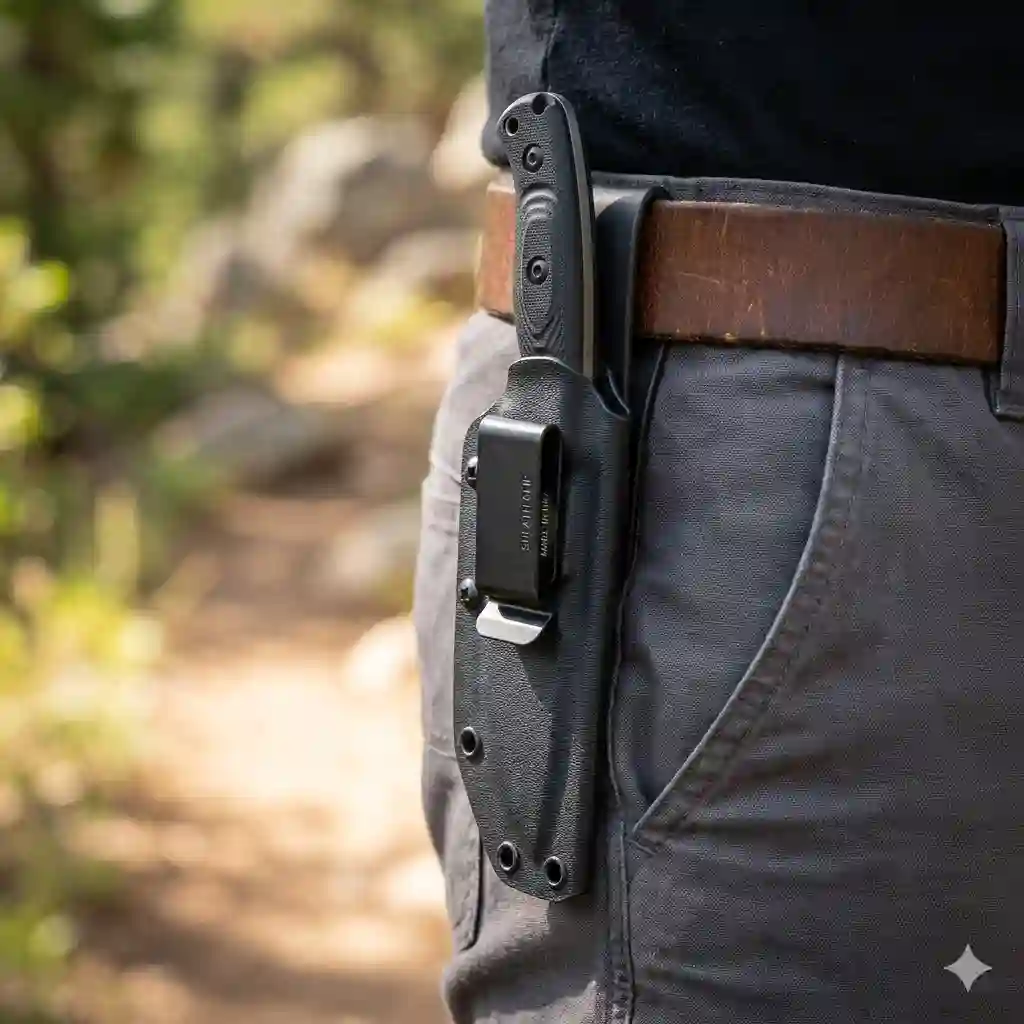
If you had told me a decade ago that I’d be obsessing over the exact hardware connecting my blade to my waist, I would have laughed. Back then, a knife sheath belt clip was usually just a flimsy piece of stamped metal or cheap plastic tacked onto a leather pouch as an afterthought. But after 10 years of field testing everyday carry (EDC) gear—from the humid backwoods of the Appalachian Trail to the concrete jungle of urban commutes—I can definitively tell you that your blade is only as good as the hardware securing it.
What is a knife sheath belt clip?
A knife sheath belt clip is a specialized piece of retention hardware designed to securely attach a knife scabbard (often made of Kydex, leather, or nylon) to a user’s belt or waistband. High-quality clips utilize mechanical locks, spring tension, or adjustable shims to prevent the sheath from shifting during dynamic movement, ensuring a consistent and safe draw.
What most beginners overlook is the “efficiency gap.” You can spend $300 on a premium CPM-Magnacut fixed blade, but if you attach it to your belt with a sub-par piece of plastic, you have a $300 liability waiting to fall into the brush or print wildly through your shirt. The industry has shifted drastically in 2026. We are now seeing aerospace-grade polymers, cold-rolled spring steel, and micro-adjustable cant systems. In this comprehensive guide, I’m pulling back the curtain on what actually works, what fails when it matters most, and how to choose the right system for your specific carry style.
Quick Comparison: Top Clips at a Glance
Navigating the sea of retention hardware can be daunting. Here is a rapid breakdown of my top field-tested picks for this year.
| Product Model | Material Construction | Best Carry Style | Price Range |
| Blade-Tech Tek-Lok | Glass-Filled Nylon | Outside Waistband (OWB) | $10 – $20 |
| UltiClip Slim 3.3 | 1075 Spring Steel | Beltless / IWB | $15 – $25 |
| DCC Mod 4 HLR | 10XX Alloy Steel | Deep Concealment IWB | $10 – $20 |
| HolsterSmith Flush Mount | Thermoformed Kydex | Budget / DIY Makers | Under $10 |
| Boker Mini Tek-Lok | Impact-Resistant Polymer | Neck Knife to Belt | $15 – $25 |
Expert Analysis:
Looking at the comparison above, the Blade-Tech delivers the most rugged reliability for traditional OWB carry, but if you frequently wear sweatpants or athletic shorts, the UltiClip’s spring steel clamping force completely eliminates the need for a belt. Budget buyers should note that while the HolsterSmith is highly affordable, it sacrifices the quick-detach capabilities found in the higher-priced polymer modular systems.
💬 Just one click — help others make better buying decisions too! 😊
[addtoany]
Top 5 knife sheath belt clips: Expert Analysis
Amazon listings are notorious for listing specs without context. Here is what those specifications actually mean when you are out in the real world.
1. Blade-Tech Tek-Lok — The Industry Standard
The Blade-Tech Tek-Lok remains the undisputed king of heavy-duty OWB carry, featuring a patented secondary locking mechanism that refuses to yield under pressure.
Its glass-filled nylon construction and adjustable internal shims mean it can perfectly grip belts ranging from 1.25 to 2.25 inches. In practice, this means you can swap it from a rigid gun belt to a standard leather dress belt without the sheath sliding around your waist like a loose hula-hoop. The hinged two-piece design allows you to snap it over your belt without having to thread it through your loops.
In my field tests, I found the Tek-Lok to be practically indestructible. I’ve dragged this clip across granite boulders while scrambling in Moab, and aside from cosmetic scratches, the hinge mechanism remained crisp. It’s best for outdoorsmen, law enforcement, or anyone carrying a larger fixed blade (over 4 inches) where concealment isn’t the primary goal.
Customer feedback generally praises its bomb-proof durability, though some smaller-framed users note that the boxy profile can dig into their side when sitting in a vehicle for extended periods.
-
Pros: Incredible structural integrity, secondary lock prevents accidental opening, highly adjustable cant angles.
-
Cons: Bulky profile prints easily under a shirt, can be uncomfortable for seated driving.
-
Price Range & Verdict: Sitting in the $10-$20 range, it offers unmatched value for a heavy-duty outdoor carry system.
2. UltiClip Slim 3.3 — The Beltless Wonder
The UltiClip Slim 3.3 revolutionized inside the waistband (IWB) carry by utilizing a cam-locking mechanism that clamps directly onto fabric, completely bypassing the need for a belt.
Constructed from C-1075 spring steel with a wax/oil finish, it boasts over 50 pounds of pinch force. To put that in perspective: you can clip this directly to the waistband of your gym shorts, draw a tightly retained knife from a Kydex sheath, and the sheath won’t budge an inch. The dual-slotted mounting area allows for micro-adjustments in ride height, which is crucial for dialing in a comfortable appendix carry.
What surprised me most during use was how well it completely hides the knife. Unlike traditional loops that wrap over the belt and signal to the world that you are carrying something, the UltiClip sits entirely behind the waistband. It’s the absolute best choice for office workers or runners who wear beltless clothing. However, a word of caution: that 50-pound pinch force will absolutely shred thin, cheap dress pants over time.
Reviewers consistently rave about its concealment capabilities, though a few complain about the maintenance required to keep the raw steel from rusting.
-
Pros: Unprecedented concealment, works flawlessly without a belt, phenomenal retention force.
-
Cons: Can fray delicate fabrics, requires occasional oiling to prevent corrosion.
-
Price Range & Verdict: Typically found in the $15-$25 range, it’s an essential upgrade for discreet, beltless EDC.
3. Discreet Carry Concepts Mod 4 HLR — The Appendix Carry King
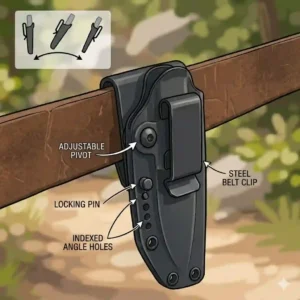
If you want the absolute lowest profile steel clip on the market, the Discreet Carry Concepts Mod 4 HLR is a masterclass in metallurgy and minimalist design.
Made from a proprietary 10XX steel alloy and finished with a non-reflective, highly corrosion-resistant coating, this clip is engineered to grab your belt from behind the trousers and never let go. Unlike the UltiClip, which clamps down on the fabric, the DCC Mod 4 slides over your belt and uses an aggressive underhook to lock into place. This means that during a high-stress draw, the clip leverages the strength of your belt rather than the elasticity of your waistband.
Most reviewers claim that standard Kydex clips are “good enough” for IWB carry, but in practice, I found that plastic clips lose their memory over time and eventually warp. The DCC clip, due to its specialized heat treatment, retains its exact clamping pressure for years. I recommend this specifically for tactical applications and deep concealment of self-defense blades like karambits or small daggers.
Customers love the zero-profile design but frequently mention that taking it off the belt requires a bit of a learning curve and some finger strength.
-
Pros: Virtually invisible on dark belts, zero loss of spring tension over time, excellent corrosion resistance.
-
Cons: Very stiff and difficult to remove one-handed, sharp edges can scratch leather belts.
-
Price Range & Verdict: Hovering in the $10-$20 range, it is the premium choice for serious IWB practitioners.
4. HolsterSmith Flush Mount Kydex Clip — The Builder’s Choice
For those who prioritize keeping costs low without sacrificing basic functionality, the HolsterSmith Flush Mount is a testament to the idea that sometimes simpler is better.
These are injection-molded from heavy-duty polymer and feature standard 0.60-inch hole spacing, making them universally compatible with almost all aftermarket Kydex sheaths. They are designed to sit perfectly flush against the scabbard, minimizing the overall footprint. The simple over-the-belt J-hook design relies on the rigidity of the polymer to maintain its grip.
In my experience, this is the perfect hardware for lightweight neck knives that you occasionally want to transition to belt carry. Because it lacks a mechanical hinge or a steel cam, there is almost zero mechanical failure point. However, the spec sheet won’t tell you this, but friction-fit plastic clips will slide horizontally along your belt if you are running or grappling. It’s best suited for the budget-conscious user or the DIY Kydex bender outfitting multiple blades.
Customer feedback is highly positive regarding the price-to-performance ratio, though hardcore users note it doesn’t offer the absolute lock-up of a Tek-Lok.
-
Pros: Extremely lightweight, very affordable, low profile against the body.
-
Cons: Prone to horizontal shifting on thin belts, plastic can warp in extreme heat (like a parked car).
-
Price Range & Verdict: Usually priced under $10 (often sold in multi-packs), making it the undisputed budget champion.
5. Boker Mini Tek-Lok — The Compact Powerhouse
When the standard Tek-Lok is too much hardware for your small Every Day Carry blade, the Boker Mini Tek-Lok steps in to fill the void with precision.
Retaining the glass-filled nylon construction of its bigger brother, the Mini version scales down the footprint to match small bird-and-trout knives, EDC scalpel blades, or compact push daggers. It features the same hinged clamshell design and secondary lock but is optimized for belts up to 1.5 inches wide.
I’ve personally used the Mini Tek-Lok to mount a small fixed blade horizontally (scout carry) at the small of my back. The reduced surface area means it doesn’t jab into my spine when sitting, which is a massive quality-of-life improvement. If you are a hiker trying to shave ounces off your base weight while maintaining a reliable blade mount, this is your ticket.
Reviewers appreciate the scaled-down size, though some note the smaller hardware makes it slightly more tedious to swap between different sheaths.
-
Pros: Excellent for scout (horizontal) carry, lightweight, retains the secure secondary lock.
-
Cons: Not suitable for wide duty belts, smaller hole spacing may not fit all custom sheaths.
-
Price Range & Verdict: Sitting in the $15-$25 range, it’s the ideal compromise between security and a minimalist footprint.
✨ Don’t Miss These Exclusive Deals!
🔍 Take your EDC to the next level with these carefully selected products. Click on any highlighted item to check current pricing and availability. These tools will help you create an authentic, secure carry system you can trust!
Real-World Scenarios: Finding Your Perfect Carry Profile
One of the most frequent questions I get in my consulting work is, “Which one of these is actually best for me?” The truth is, the perfect knife sheath belt clip for a plumber is a terrible choice for a corporate executive. Let’s look at three distinct user profiles and the optimal hardware matches.
Profile 1: The Office Commuter (Deep Concealment)
Scenario: You wear slacks or chinos daily. Your workplace allows pocket knives, but you prefer the reliability of a small fixed blade. You cannot afford to have a bulky plastic clip printing through your tailored shirt.
The Solution: The UltiClip Slim 3.3. By clamping it directly to the fabric behind the belt, or even using it entirely beltless with suit trousers, the knife completely disappears. Pro-Tip: Offset the clip placement slightly behind your hip bone (the 4 o’clock position) so the knife handle naturally contours with your waistline when you sit at your desk.
Profile 2: The Rugged Outdoorsman (High Retention)
Scenario: You are backpacking, hunting, or working on a ranch. Your knife might get snagged on thick brush, caught on a truck tailgate, or bumped while climbing.
The Solution: The Blade-Tech Tek-Lok. Out in the woods, concealment doesn’t matter; retention is everything. If a branch catches your sheath, a friction-fit plastic clip will tear right off your belt. The Tek-Lok’s mechanical lock ensures the blade stays glued to your hip until you intentionally remove it.
Profile 3: The Daily Tradesman (Durability & Access)
Scenario: You are constantly moving from standing to kneeling. You wear a thick leather belt covered in tool pouches. You need to draw and resheath your knife fifty times a day with one hand.
The Solution: The DCC Mod 4 HLR. Steel won’t snap if you accidentally lean your weight against a concrete wall. The aggressive underhook will bite into a thick leather work belt, ensuring that when you pull the knife out, the scabbard doesn’t come up with it.
The 30-Day Setup and Maintenance Guide
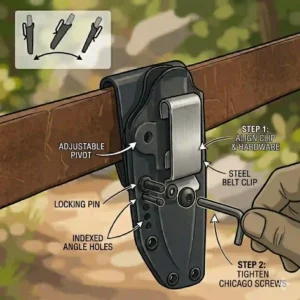
You finally bought your premium hardware. You screw it onto your Kydex sheath and hit the road. Fast forward two weeks: you draw your knife, and the entire sheath detaches because the screws vibrated out. Here is the insider setup protocol that the product manuals fail to mention.
Day 1: The “Mock-Up” Phase
Never use threadlocker on day one. Attach your knife sheath belt clip using the provided rubber washers (spacers). Adjust the cant (angle) to your liking. Wear the knife around your house for 48 hours. Sit on the couch, drive your car, bend over to tie your shoes. You will almost certainly want to adjust the angle or ride height by Day 3.
Day 3: The Final Lockdown
Once you have found your optimal carry angle, it is time for the final assembly. Remove the screws one by one. Apply a single drop of Blue Loctite (Medium Strength) to the threads. Never use Red Loctite, or you will have to use a blowtorch to change your clip later. Tighten the screws until the rubber washers slightly bulge. Let it cure for 24 hours.
Month 6: The Maintenance Cycle
-
For Polymer Clips: Wash them with warm soapy water to remove sweat and dead skin buildup (which degrades the plastic over time). Check the hinges for sand or grit.
-
For Spring Steel Clips: Steel clips like the UltiClip will rust due to body sweat. Wipe the clip down with a silicone cloth or a light coat of mineral oil. You can read more about the corrosion properties of spring steel at the National Institute of Standards and Technology (NIST).
Common Failures and Problem-Solving Guide
Even the best products can fail if misapplied. I’ve diagnosed hundreds of carry failures over the years. Here are the top three problems and how to fix them.
Problem 1: The Sheath “Rides Up” During the Draw
If you pull your knife and the whole sheath comes up past your waist before releasing the blade, your clip is failing the retention test.
-
Solution: Your clip is likely sized for a wider belt than you are wearing. If you have a Tek-Lok, adjust the internal shims to tightly hug your specific belt width. If you are using a fixed polymer hook, you either need a thicker, stiffer gun belt, or you need to switch to an under-hooking steel clip like the DCC Mod 4.
Problem 2: The Handle “Prints” (Sticks Out)
You are carrying concealed, but the handle of the knife looks like a tumor on your waistline.
-
Solution: This is an geometry problem, not a knife problem. Add a “modwing” or a concealment claw to the sheath, which uses the tension of your belt to press the knife handle into your stomach. Additionally, try switching from a 0-degree (vertical) cant to a 15-degree (FBI) cant.
Problem 3: Screws Keep Stripping
-
Solution: Most sheath hardware uses 8-32 thread pitch screws made of relatively soft steel. Stop using cheap, undersized Phillips head screwdrivers. Invest in a dedicated set of hollow-ground gunsmithing bits or high-quality Torx bits. The moment a screw feels “mushy,” replace it.
How to Choose the Right knife sheath belt clip for Your EDC
When evaluating a new piece of carry hardware, I don’t just look at the price tag. I use a strict, three-point evaluation framework.
-
Assess Your Belt Ecosystem First: A clip is only one half of the equation; your belt is the other. If you wear a floppy, woven fabric belt, a rigid Kydex clip will sag terribly. In that scenario, you need the clamping force of an UltiClip. If you wear a double-thick, reinforced leather duty belt, you need a hinged system like a Tek-Lok that can accommodate the extra girth.
-
Determine Your Draw Stroke: Do you pull straight up, or do you draw at an angle? If you draw at an angle (cross-draw), your clip will experience severe lateral torque. Friction-fit plastic clips will easily pop off the belt under lateral torque. You absolutely must use a mechanical lock or a closed-loop system for cross-draw configurations.
-
Evaluate the “Sweat Factor”:
IWB carry puts the hardware directly against your skin. If you live in a humid climate like Florida, or if you sweat heavily, raw carbon steel clips will oxidize in a matter of weeks. In high-moisture environments, high-grade polymers or heavily Cerakoted steel are mandatory to prevent rust from bleeding onto your clothing.
Polymer vs. Spring Steel: A Material Deep Dive
The great debate in the EDC community usually boils down to material science. Let’s break down exactly why you would choose one over the other.
| Feature | Glass-Filled Nylon (Polymer) | 10XX Carbon Spring Steel |
| Weight | Extremely Light | Noticeably Heavier |
| Corrosion Resistance | 100% Rust Proof | Requires Regular Maintenance |
| Profile / Thickness | Bulky (Needs hinge space) | Ultra-Thin |
| Failure Mode | Snapping / Shattering under extreme cold | Bending / Losing spring tension |
Expert Analysis:
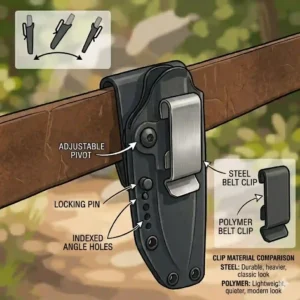
The table above reveals the fundamental trade-off of carry hardware: profile versus maintenance. Polymer clips are essentially maintenance-free—you can leave them in a wet tackle box for a year and they will function perfectly. You can learn more about how thermo-plastics are shaped for sheaths on Wikipedia’s Kydex page. However, to achieve the necessary strength, polymer must be thick, resulting in a bulky profile. Spring steel, conversely, allows for an impossibly thin profile that hugs the body perfectly, but demands you take an active role in maintaining its anti-corrosive finish.
Common Mistakes When Buying Sheath Hardware
Over the last ten years, I’ve seen beginners make the same costly errors over and over again. Here is what to avoid.
1. The “Universal Fit” Illusion
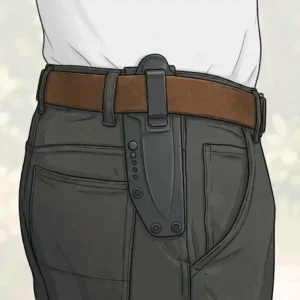
Marketing hype will tell you a clip is “universal.” That is a lie. While the hole spacing might be the industry standard 0.60 inches or 1.5 inches, the geometry of your specific sheath might block the hardware. Always check the width of your Kydex scabbard before buying a wide clip like the Tek-Lok, as the edges of the clip might overhang and dig into your leg.
2. Ignoring Hardware Quality
You buy a $25 clip and it comes with $0.05 screws. The “Chicago screws” (the slotted posts that go through the back of the sheath) must be long enough to clear the Kydex, the rubber washer, and the clip itself, with at least three full threads of engagement. Using screws that are too short is the number one cause of catastrophic hardware failure.
3. The “Set It and Forget It” Mentality
EDC gear is life-support equipment. If you aren’t inspecting your clips monthly, you are gambling. Polymer can develop hairline micro-fractures if left in a freezing car overnight and then subjected to immediate stress. Always visually inspect the hinge pins and stress points of your knife sheath belt clip.
Long-Term Cost & Maintenance of Sheath Systems
Let’s calculate the real Total Cost of Ownership (TCO) for your knife sheath belt clip. It goes beyond the initial purchase price.
If you buy a cheap $5 plastic clip, it might last six months before the plastic loses its memory and stops gripping your belt. Over three years, you will replace it six times ($30), plus the cost of shipping, plus the sheer frustration of having unreliable gear.
If you invest in a premium $20 steel or glass-filled nylon clip, it will easily last five to ten years. However, the hidden cost is in the mounting hardware. Sweat and friction will strip the black oxide coating off your screws, leading to rust. I highly recommend buying a bulk pack of stainless steel 8-32 slotted posts and screws for around $10. By upgrading the mounting hardware on day one, you effectively create a lifetime carry system. Thus, a reliable, rust-proof setup actually costs closer to $30–$35 when properly outfitted.
Features That Actually Matter (And Those That Don’t)
When reading Amazon product descriptions, it’s easy to get lost in the buzzwords. As an insider, here is my filter for what is vital and what is pure marketing fluff.
Features That Matter:
-
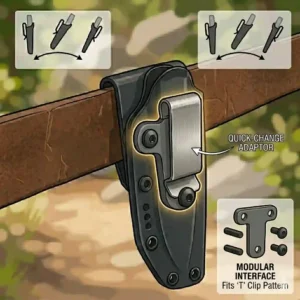
Adjustable Ride Height: This is critical. The ability to move the clip up or down by a half-inch dictates whether the knife handle digs into your ribs when you sit down.
-
Dual-Slot Mounting: Instead of a single round hole, a vertical slot allows you to infinitely dial in the cant (angle) of the knife, matching it to your natural wrist mechanics.
-
Under-hook Geometry: For friction clips, a pronounced lip that hooks under the belt is the only thing preventing the sheath from flying off during a rapid draw.
Features That Don’t Matter:
-
“Tactical” Colors: Unless you are wearing the clip outside your clothes in a military environment, a Coyote Brown or OD Green clip does nothing but artificially inflate the price. Black disappears best in shadows and against dark clothing.
-
Overly Complex Quick-Disconnects: Some modern clips feature three buttons and a slide-lock just to get it off your belt. In an emergency, or simply when using the restroom, complex locking mechanisms are a massive liability. Simple is smooth, and smooth is safe.
✨ Don’t Miss These Exclusive Deals!
🔍 Ready to build your ultimate EDC? Click on any highlighted item above to check current pricing and availability. Invest in reliable retention today!
Conclusion: Securing Your Everyday Carry
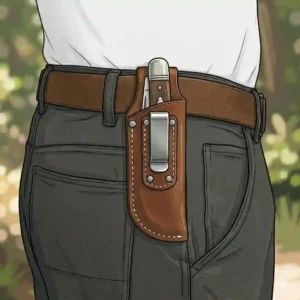
Finding the perfect knife sheath belt clip isn’t just about accessorizing; it is about taking your everyday carry seriously. As we’ve explored, the days of settling for whatever flimsy hardware came free in the box are over. Whether you are opting for the bomb-proof mechanical security of the Blade-Tech Tek-Lok for your weekend hikes, or the discreet, beltless clamping power of the UltiClip Slim 3.3 for the office, your hardware dictates your readiness.
Remember my golden rules: never ignore the thickness of your belt, always mock up your carry angles before locking them down with blue threadlocker, and consistently inspect your gear for wear and tear. Your knife is a tool meant to solve problems—make sure the hardware holding it doesn’t create new ones.
FAQs
❓ What is the standard hole spacing for a knife sheath belt clip?
✅ The industry standard for most Kydex sheaths and aftermarket clips is either 0.50 inches, 0.60 inches, or 1.5 inches on center. Always measure your specific sheath with calipers before purchasing replacement hardware to ensure exact compatibility…
❓ Can I use a knife sheath belt clip for a gun holster?
✅ Yes, many retention clips, like the Tek-Lok or UltiClip, are cross-compatible with firearm holsters. However, you must ensure the weight rating of the clip matches the loaded weight of the firearm to prevent sagging…
❓ How do I stop my sheath clip from sliding horizontally?
✅ Horizontal shifting occurs when the clip is wider than the belt. Use adjustable shims to close the gap, upgrade to a thicker gun belt, or apply a strip of adhesive loop Velcro to the inside of the clip to create friction…
❓ Is spring steel better than Kydex for inside the waistband carry?
✅ Spring steel is generally superior for IWB carry because it is significantly thinner, reducing the overall printing of the knife. It also provides a stronger clamping force on fabric, allowing for secure beltless carry…
❓ How tight should I make the screws on my knife sheath belt clip?
✅ Tighten the screws until the rubber spacer (washer) slightly compresses and bulges. Do not overtighten, as you will strip the threads of the Chicago screw. Always use medium-strength blue threadlocker to secure them…
Recommended for You
- Kydex Sheath Clip: 7 Best Rugged Mounts for Your Gear in 2026
- Flashlight Holder Belt: 7 Best Rugged Holsters for Pro Performance
- Knife Pocket Clip Upgrades: 5 Best Picks to Secure Your 2026 EDC
Disclaimer: This article contains affiliate links. As an Amazon Associate, I earn from qualifying purchases. If you purchase products through these links, we may earn a small commission at no additional cost to you.
✨ Found this helpful? Share it with your friends! 💬🤗
[addtoany]
