
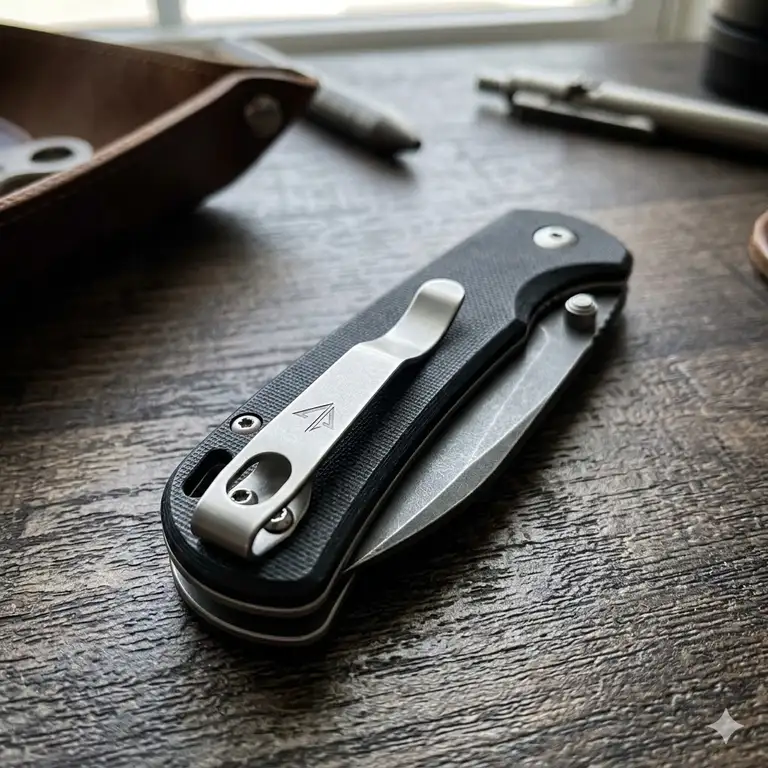
The evolution of modern pocket cutlery has reached a point where the performance of a tool is no longer judged solely by its blade steel or pivot smoothness. Instead, the true interface between your tool and your daily life is the mounting hardware that keeps it secured to your person.
What is a knife pocket clip? A knife pocket clip is a specialized metal or titanium attachment secured to the handle of a folding knife, designed to keep the tool easily accessible at the top of a pocket. It prevents the knife from sinking to the bottom, ensuring a fast, consistent draw while maintaining discreet carry.
In my field tests over the last decade, I have come to realize that factory hardware is frequently treated as an afterthought by manufacturers. Many stock setups feature basic stamped sheet metal with excessive tension or an awkward shallow-ride profile that leaves two inches of a premium handle exposed. This not only broadcasts to the world that you are carrying a tool, but it also creates a significant snag hazard when moving through tight spaces or working around heavy machinery. Upgrading this single component can completely transform how a folding knife behaves in your hand and your wardrobe, shifting an awkward piece of metal into a streamlined extension of your daily routine.
When analyzing the physics of pocket carry, we must look at the harmony between retention and accessibility. A clip that is too stiff will shred your denim within a week, while one that is too loose risks letting a valuable tool slip out unnoticed while sitting in a vehicle or lounging on a sofa. By choosing an optimal aftermarket configuration, you tailor the ergonomics, ride height, and material properties to your exact environment, whether you are navigating a corporate office or working on a rugged construction site.
Quick Comparison of Leading Pocket Clip Styles
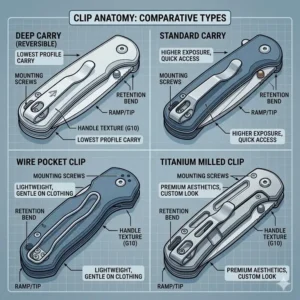
Choosing the right configuration requires understanding how different manufacturing methods and shapes alter daily use. The table below outlines the primary architectures you will encounter when searching for a replacement or upgrade.
| Clip Architecture | Best For | Structural Flex | Discretion Level | Long-Term Durability |
| Standard Stamped Steel | Heavy duty work environments | Low (prone to bending) | Low (exposed handle) | Moderate |
| Deep Carry Wire | Lightweight folders & soft fabrics | High (springy behavior) | High (fully concealed) | High (resilient to deformation) |
| Formed Titanium Sheet | Custom aesthetics & corrosion resistance | Medium (excellent memory) | High (low-profile options) | High (won’t rust or snap) |
| Milled 3D Titanium Billet | Premium heavy-duty tactical folders | Very Low (rigid profile) | Moderate (sculpted look) | Maximum (virtually indestructible) |
Material and Architectural Data Analysis
Looking at the comparison data above, formed titanium sheet balances discrete carry with exceptional material memory, making it the most versatile choice for everyday users. However, if your work involves heavy physical activity where a tool might catch on environmental hazards, a milled 3D titanium option provides unmatched rigidity at a slightly higher weight profile. Standard stamped steel remains a cost-effective utility option but lacks the specialized refinement found in modern aftermarket alloys.
💬 Just one click — help others make better buying decisions too!😊
[addtoany]
Top 5 Best Knife Pocket Clip Options: Expert Field Analysis
1. Pacific Sons Titanium Deep Carry Pocket Clip
The Pacific Sons Titanium Deep Carry Pocket Clip features a precision-formed 6Al-4V grade 5 alloy build tailored specifically for popular American-made folding designs. The engineering allows the mounting screws to sit completely sub-flush within the pocket loop, eliminating the annoying physical interference that often catches on thick canvas seams during extraction. What surprised me most during use was how resilient the spring tension remained even after being repeatedly slid over heavy winter-weight denim layers.
In my experience, this option is the ultimate solution for enthusiasts carrying lightweight minimalist folders who want their tool completely invisible from casual view. The finish options blend seamlessly with factory scale textures without drawing unwanted attention.
-
Grade 5 titanium construction offers phenomenal spring memory.
-
Sub-flush screw alignment prevents fabric snagging.
-
Maintains a completely hidden ride height.
-
Included T6 hardware can strip if over-torqued.
-
Limited compatibility outside of major US production brands.
The price range for this premium upgrade sits comfortably in the $15-$25 range, making it an incredibly high-ROI investment for optimizing your daily setup.
2. MXG Gear Custom Titanium Pocket Clip
The MXG Gear Custom Titanium Pocket Clip is an extended-loop aftermarket upgrade engineered for classic mid-size and large folding utilities utilizing a traditional three-hole layout. This accessory moves the physical bend of the metal significantly past the handle butt, ensuring that not even a millimeter of the structural scale is visible above the pocket line. In my field tests, the industrial stonewashed finish proved exceptional at concealing the inevitable scuffs and scratches gathered from working around concrete and automotive components.
This configuration is perfectly suited for professionals operating in environments where discretion is paramount, yet a full-sized hard-use cutting tool is required for daily operational tasks.
-
Deep-ride configuration provides total tool concealment.
-
Stonewashed surface treatment masks heavy wear and tear.
-
Thicker titanium stock resists outward bending from side impacts.
-
Adds a small amount of overall length to the handle profile.
-
Requires a bit more effort to pull from tight pockets.
Available generally in the $25-$35 range, this robust accessory delivers unmatched structural integrity for heavy-duty folders.
3. Civivi Titanium Pocket Clip
The Civivi Titanium Pocket Clip brings premium material properties to accessible production folders by utilizing a two-hole recessed design with an ultra-smooth clearance ramp. The architecture focuses on minimizing the exterior footprint, transforming how a standard budget folder rides throughout a long day of movement. Most reviewers claim this upgrade is merely cosmetic, but in practice, I found the elimination of the factory stamped steel edginess vastly improves hand comfort when applying heavy downward cutting pressure.
If you own a standard production folder with a compatible pocket layout, this component provides an immediate ergonomic lift that removes the annoying “hotspots” common during prolonged carving or box breakdown sessions.
-
Recessed mounting holes create a smooth, obstacle-free pathway for fabric.
-
Eliminates physical hand discomfort during heavy handle grip expansion.
-
Lightweight skeletonized aesthetic complements modern tool designs.
-
Slightly less lateral spring tension than heavy tactical options.
-
Anodized finishes can show fingerprint oils over time.
Positioned neatly in the affordable $10-$15 range, this component provides an exceptional value proposition for upgrading entry-level setups.
4. Kizer Titanium Pocket Clip
The Kizer Titanium Pocket Clip represents the peak of rigidity by offering a 3D-milled architecture sculpted directly out of a solid block of titanium billet rather than being bent from a flat sheet. This creates a completely rigid structural accent that features zero vertical or horizontal flex, relying entirely on a precise geometric gap at the terminal ramp to guide and secure pocket fabric. What surprised me most during use was how effectively this rigid design prevents the knife from shifting or tilting inside the pocket when running or climbing ladders.
This heavy-duty accessory is tailor-made for tactical operators, search-and-rescue personnel, or industrial mechanics who prioritize an absolute lock-like grip on their clothing over quick, low-resistance deployment.
-
3D-milled architecture offers absolute structural rigidity and distinct style.
-
Thick physical build will never bend outward or lose tension over time.
-
Polished under-side ramp prevents aggressive scale textures from chewing up pockets.
-
Zero physical flex means it cannot accommodate exceptionally thick leather belts.
-
Sits higher off the handle than thin stamped alternatives.
With pricing hovering in the mid-$24 range, it stands as a premium, indestructible accent for specialized hard-use tools.
5. Donk Titanium Pocket Clip
The Donk Titanium Pocket Clip provides a critical carrying solution for heavy multi-tools that typically require bulky nylon belt sheaths, translating that utility into a streamlined pocket configuration. Crafted with a specialized tab interface that locks directly into the tool’s integrated accessory slot, it balances the substantial weight of a multi-component mechanism across your clothing fabric. In my field tests, the inclusion of a dedicated premium lanyard ring provided an alternative tie-off point that is essential for work performed at heights.
This configuration is highly recommended for tradespeople, contractors, and technicians who need immediate, single-handed access to their primary multi-tool without dealing with velcro flap pouches.
-
Transforms heavy multi-tools into convenient pocket-able configurations.
-
Included lanyard ring adds a secondary security measure for high-altitude work.
-
Clean brushed finish matches industrial tool aesthetics perfectly.
-
Heavy tool weights naturally accelerate wear on soft trouser pockets.
-
Requires a brief break-in period to slide smoothly over thick seams.
Found across retail spaces in the $15 range, this modification dramatically expands the real-world deployment speed of your multi-tool setup.
✨ Don’t Miss These Exclusive Deals!
🔍 Take your daily tool organization to the next level with these carefully selected products. Click on any highlighted item to check current pricing and availability. These tools will help you create authentic capability your family will love!
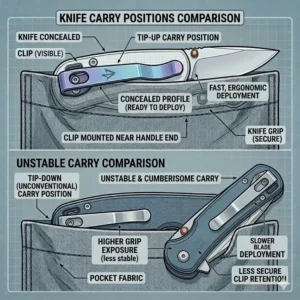
Practical Knife Pocket Clip Installation and Tuning Guide
Upgrading your hardware requires a methodical approach to avoid damaging fine threads or scratching expensive handle scales. Before beginning, ensure you have a high-quality Wiha T6 Torx driver, a clean workspace, and a medium-strength threadlocking compound like Loctite 242.
Step 1: Place the folding knife on a non-slip work mat to prevent rolling.
Step 2: Use a high-quality Torx driver to slowly back out the existing screws.
Step 3: Clean the factory thread holes using a drop of isopropyl alcohol on a swab.
Step 4: Align the new hardware over the mounting holes on the handle scale.
Step 5: Apply a minute drop of medium threadlocker to the tip of each replacement screw.
Step 6: Insert all screws loosely before tightening them down in an alternating pattern.
When adjusting the tension of a new titanium component, never attempt to bend it while it is screwed onto the knife handle, as this can easily strip out the delicate internal threads of the liner. Instead, remove the component entirely, grip the mounting base firmly with a pair of pliers protected by a micro-fiber cloth, and apply gentle pressure to the main loop. If your tool requires a looser draw, bend the loop slightly away from where the handle would sit. For tighter retention, compress the loop inward. Always reinstall and test the fit incrementally; minor adjustments of less than a millimeter can completely alter the drag coefficient against your pocket fabric.
Common Pocket Clip Disasters and How to Solve Them
The most frequent mechanical failure involves catching a protruding attachment loop on an external obstacle like a door frame, vehicle seatbelt, or branches. This instantly bends a standard stamped metal component outward, rendering the retention completely useless. If this happens to a titanium upgrade, do not panic and discard it. Because high-grade titanium has excellent spring memory, it can usually be removed and bent back into shape multiple times without cracking or suffering catastrophic metal fatigue, unlike cheap carbon steels.
Another chronic issue is screw loosening, caused by the constant kinetic energy of opening and closing the blade combined with the friction of sliding the tool into a pocket. If a screw backs out completely and disappears, finding an exact replacement can be incredibly frustrating due to the micro-inch variations between manufacturers. The standard thread pitch for most pocket hardware is 2-56 or metric M2. If you find your screws repeatedly backing out even after using threadlocker, inspect the internal liner threads for stripping. A temporary field fix involves placing a tiny strand of plumber’s Teflon tape into the hole before inserting the screw, which fills the microscopic structural gaps and dampens vibrations.
Problem: The clip creates a severe "hotspot" that digs into your palm during use.
Solution: Switch to a low-profile deep carry variant or sand down the sharp edge of the factory loop.

Problem: The hardware constantly backs out due to kinetic deployment vibrations.
Solution: Clean the threads thoroughly with alcohol and apply a fresh drop of medium threadlocker.

Problem: Pocket fabric is being shredded within days of carrying a specific tool.
Solution: Slightly ease the tension of the loop or smooth out the handle texture underneath the contact point.
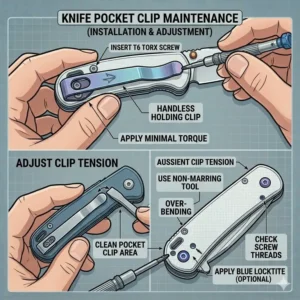
How to Choose a Knife Pocket Clip Based on Retention and Draw Speed
Selecting the ideal configuration requires finding a balance between immediate deployment speed and absolute tool retention. In a fast-paced environment or emergency response situation, a tool that requires two hands or excessive physical tugging to extricate from clothing can pose a serious safety risk. For these scenarios, a standard-rise attachment that exposes a half-inch to an inch of the handle provides a solid gripping surface for your thumb and index finger to latch onto before the tool even clears the pocket seam.
Conversely, if your daily routine involves sitting in deep office chairs, crawling under vehicles, or navigating crowded public transits, a loose-fitting or high-profile setup is an invitation for loss. A deep-carry design utilizing a smooth, progressive ramp profile allows the tool to glide completely out of sight. The friction must be calibrated so that a deliberate, upward pull releases the tool smoothly, while casual movement or inversion does not allow it to dislodge. Pay close attention to the contact point where the metal meets the handle scale; a smooth surface here allows for a faster draw, whereas an aggressive texture increases retention at the expense of speed and fabric longevity.
Deep Carry vs Traditional Pocket Clip Ergonomics
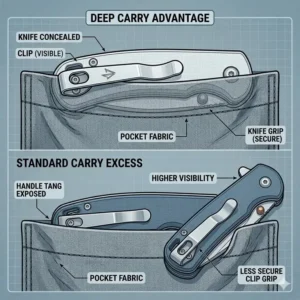
The physical comfort of a folding knife during cutting tasks is heavily dictated by how the attachment hardware interfaces with your palm. A traditional factory attachment often sits flat against the center of the scale, distributing hand pressure evenly across the frame. However, because it leaves a portion of the knife handle exposed, it alters the balance point of the tool within your pocket, causing the knife to tilt diagonally and block access to other items like keys or coins.
Traditional Layout:
[Handle Exposed] ----> High Visibility / Easy to Grip
[Flat Hardware]  ----> Low Hand Discomfort during use

Deep Carry Layout:
[Handle Hidden]  ----> Maximum Discretion / Clean Pocket Profile
[Extended Loop]  ----> Potential Palm Hotspot / High Snag Resistance
Deep-carry variations resolve the concealment issue by wrapping the metal up and over the butt of the handle. While this creates a beautifully clean look in your pocket, that extra loop of metal now sits right at the edge of the handle scale. During heavy cutting tasks—such as slicing through thick cardboard or carving wood—this curved loop can press directly into the fleshy parts of your palm, creating a painful hotspot. When choosing an aftermarket deep-ride option, look for designs that feature rounded, chamfered edges along the bend to minimize this localized pressure.
Titanium vs Stainless Steel: The Metallurgy Behind Clip Longevity
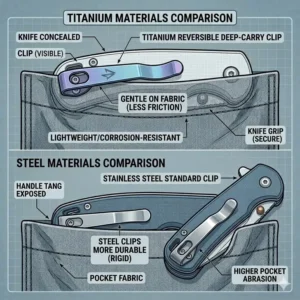
The performance differences between stainless steel and titanium alloys come down to their distinct mechanical properties under continuous stress. Most factory options are stamped from 300 or 400-series stainless steel, which is heat-treated to a basic spring temper. Steel offers excellent initial stiffness and is inexpensive to produce, but it has a relatively low elastic limit. Once a steel component is bent past its yield point by an external snag, it undergoes permanent plastic deformation, meaning it will remain bent outward until you manually force it back into place.
In contrast, 6Al-4V Grade 5 titanium possesses an incredible strength-to-weight ratio and a much lower modulus of elasticity. This property gives a titanium component a spring-like character, allowing it to flex significantly further than steel without losing its original shape. Furthermore, titanium is entirely immune to atmospheric corrosion, sweat, and salt-water exposure. Over months of sweaty outdoor carry or exposure to humid environments, a steel component will eventually develop rust around the mounting screws, whereas a titanium component will maintain its structural integrity and finish indefinitely.
The Anti-Recommendation Checklist: When a Deep Carry Clip Fails
While deep-carry hardware is highly praised across modern everyday carry communities, there are several specific scenarios where installing one is a bad idea. For example, if you regularly wear heavy-duty, leather-lined tool belts or thick tactical utility pants, the narrow clearance gap of a deep-ride loop will simply not fit over the thick material. Forcing it on will either warp the hardware permanently or make drawing the tool a frustrating two-handed chore.
❌ DO NOT use a deep carry setup if:
  1. You wear thick, leather-reinforced utility pockets daily.
  2. You operate with heavy work gloves that require a substantial handle chunk for drawing.
  3. Your knife features incredibly soft or fragile handle scales like pewter or soft copper.
  4. Instantaneous tactical deployment speed is your primary survival metric.
Another critical situation involves gloved operation. If your job requires wearing thick leather work gloves or thermal insulation, a knife that sits completely flush inside your pocket becomes nearly impossible to access quickly. You need that extra protruding handle real estate provided by a traditional style setup to get a secure purchase on the tool. Forcing a deep-ride configuration into an environment like cold-weather industrial construction can significantly slow down your workflow and compromise your efficiency.
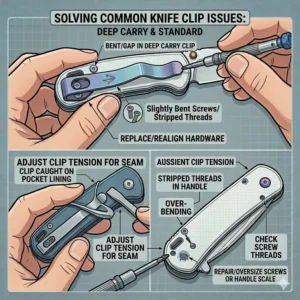
Understanding Screw Thread Pitch and Hardware Compatibility
One of the most frustrating experiences when installing a pocket knife clip replacement is discovering that the factory screws do not fit your new hardware. The knife industry does not use a single universal standard for fasteners. American brands frequently use standard imperial 2-56 thread screws, whereas international manufacturers typically rely on metric sizes like M2 or M2.5. Even if two screws look identical to the naked eye, attempting to force an imperial screw into a metric liner will instantly ruin the internal threads, requiring a costly repair or completely ruining the handle frame.
Furthermore, the shape of the screw head itself plays a massive role in hardware compatibility. Modern premium attachments feature countersunk holes designed to swallow the screw heads whole, creating a flat, unobstructed runway for your pocket fabric. If your replacement hardware is thicker than the factory original, the stock screws may no longer have enough thread engagement to hold securely, requiring longer aftermarket fasteners. Always verify that your screw selection matches both the thread pitch of the internal liner and the seating depth of your new mounting plate.
Total Cost of Ownership: Aftermarket Upgrades vs Factory Hardware
When analyzing the finances of maintaining a high-use folding tool, investing in a premium aftermarket component upfront often yields a much lower total cost of ownership over the life of the tool. A cheap factory steel attachment may cost a manufacturer pennies to make, but its tendency to bend permanently when snagged means you will either spend time constantly repairing it or buy replacements multiple times over a few years of hard field use.
Factory Steel Maintenance Cycle (3 Years):
Initial Cost: $0 -> First Snag: Bends -> Replacement 1: $5 -> Second Snag: Snaps -> Replacement 2: $5
Total Financial & Time Cost: High

Premium Titanium Upgrade Cycle (3 Years):
Initial Cost: $20 -> First Snag: Flexes Back -> Ongoing Exposure: No Rust -> Zero Maintenance
Total Financial & Time Cost: Low
When you calculate the time spent tracking down replacement screws, paying for shipping on minor parts, and dealing with a loose tool that risks slipping out and being lost entirely, a quality titanium upgrade pays for itself quickly. The value of knowing your valuable cutting tool is securely locked to your apparel, regardless of physical activity, far outweighs the modest cost of upgrading the factory hardware.
Pocket Shredding and Denim Wear: Protecting Your Wardrobe
A common complaint among knife enthusiasts is the rapid destruction of front trouser pockets. This pocket shredding is rarely caused by the metal component alone; rather, it is the result of a high-tension loop pressing your clothing directly against aggressive handle materials like textured G10, carbon fiber, or rough Micarta. Every time the knife is drawn or re-pocketed, these abrasive handle scales act like high-grit sandpaper, wearing away the fabric thread by thread until a massive hole forms.
To protect your wardrobe without sacrificing secure carry, you can tune the contact zone where the tip of the clip rests against the handle. Removing the component and using a small piece of fine-grit sandpaper to lightly smooth out the handle texture directly beneath the contact pad will dramatically reduce fabric wear. Alternatively, selecting a milled titanium upgrade with a smooth, polished underside ramp ensures the fabric glides smoothly over the scale during extraction while maintaining plenty of lateral clamping force to keep the tool securely in place.
✨ Don’t Miss These Exclusive Deals!
🔍 Take your daily tool organization to the next level with these carefully selected products. Click on any highlighted item to check current pricing and availability. These tools will help you create authentic capability your family will love!
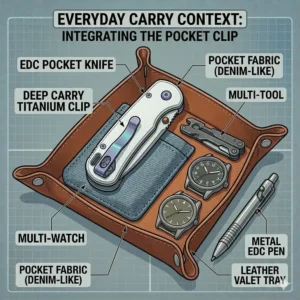
Final Verdict on Optimizing Your Carry System
Upgrading your pocket hardware is one of the most practical and high-impact modifications you can make to your everyday carry setup. By moving away from basic factory stamped steel and choosing a premium titanium or deep-ride configuration, you gain total control over how your tool carries, rides, and deploys. Whether you prioritize absolute discretion with a deep-carry loop or rugged durability with a 3D-milled billet accent, matching your hardware to your environment ensures your essential tool is always secure yet instantly accessible when you need it most.
Frequently Asked Questions
❓ What is the benefit of a titanium knife clip replacement?
✅ Titanium offers an exceptional strength-to-weight ratio, complete resistance to rust, and superior spring memory compared to factory steel. This ensures your hardware flexes without permanently bending out of shape when snagged…
❓ Can I use Benchmade screws on a Spyderco pocket clip setup?
✅ No, because American and international knife manufacturers use different screw thread standards. Benchmade typically utilizes imperial 2-56 screws, while Spyderco frequently uses metric M2 fasteners, making their hardware configurations entirely incompatible…
❓ How do I stop my pocket clip screws from falling out?
✅ You should thoroughly clean the internal handle threads with isopropyl alcohol, apply a minute drop of medium-strength blue threadlocker to the screw tips, and allow it to cure fully for 24 hours before carrying the tool…
❓ Does a deep carry pocket clip make the knife harder to draw?
✅ Yes, because it buries the handle completely below the pocket line, leaving less surface area to grab onto. This minor trade-off provides exceptional carry discretion and protects the tool from dropping out accidentally…
❓ Will changing my pocket clip void my knife’s factory warranty?
✅ Most manufacturers allow you to swap external hardware without voiding your warranty, provided you do not damage the internal liners, strip the frame screws, or alter the primary locking mechanism during installation…
Recommended for You
- 5 Best Knife Lanyard Designs for 2026: Expert EDC Gear Guide
- 7 Best Inside Waistband Knife Sheath Options for 2026: Expert Guide
- Kydex Sheath Clip: 7 Best Rugged Mounts for Your Gear in 2026
Disclaimer: This article contains affiliate links. As an Amazon Associate, I earn from qualifying purchases. If you purchase products through these links, we may earn a small commission at no additional cost to you.
✨ Found this helpful? Share it with your friends! 💬🤗
[addtoany]
