
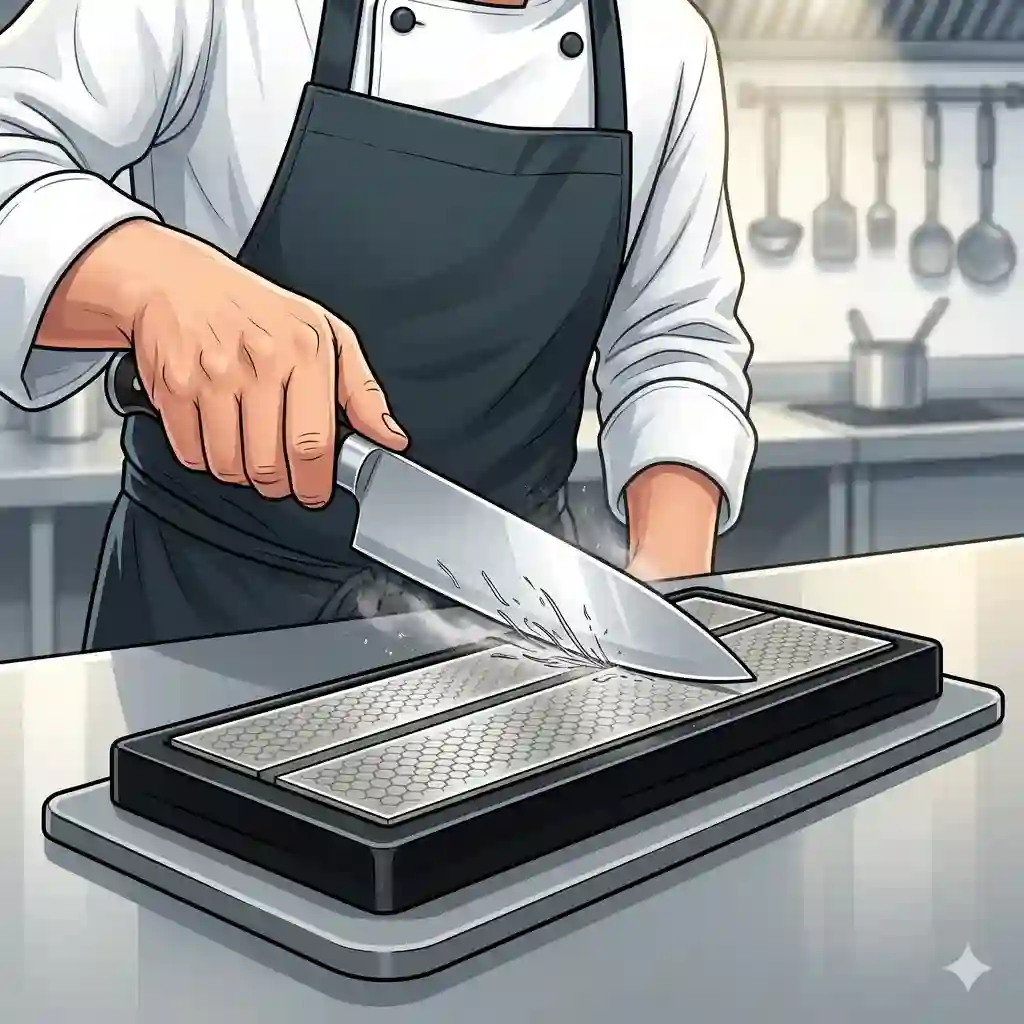
If you have ever spent forty-five minutes sweating over a soaked waterstone only to end up with a blade that struggles to slice a ripe tomato, I feel your pain. In my ten-plus years as a professional blade sharpener and culinary gear consultant, I’ve seen countless chefs, hunters, and everyday carry (EDC) enthusiasts give up on sharpening entirely because they were using the wrong tools.
The industry secret? You don’t need years of Japanese apprenticeship to get a hair-popping edge. You need an abrasive that is harder than the ultra-modern super-steels (like S30V or MagnaCut) we are seeing in today’s blades.
That is exactly why diamond sharpeners for knives have completely revolutionized my workflow. What exactly are they? Unlike traditional whetstones that use aluminum oxide or natural grit, these plates feature industrial-grade diamonds—the hardest naturally occurring substance on earth—electroplated onto a metal base. This means they cut faster, never dish out (meaning they stay perfectly flat forever), and require absolutely no soaking before use.
However, not all diamond plates are created equal. The market is currently flooded with cheap, polycrystalline knockoffs that shed their abrasive coating after just a few months of use. In this comprehensive 2026 guide, I am going to walk you through my exact testing protocols, break down the products that actually survive daily shop abuse, and show you exactly how to transform your dullest blades into surgical cutting tools.
📊 Quick Comparison: Top Contenders at a Glance
| Product Name | Best For | Grit Options | Surface Type | Price Range |
| DMT W6EFC Three 6-Inch Set | Premium Bench Sharpening | Extra-Fine, Fine, Coarse | Interrupted (Polka-dot) | $120 – $160 |
| Work Sharp Precision Adjust Elite | Beginners & Exact Angles | 220, 320, 400, 600, 800 | Continuous / Guided | $100 – $130 |
| Sharpal 162N Double-Sided | Budget-Conscious Buyers | Coarse (325) / Extra Fine (1200) | Continuous | $50 – $70 |
| Fallkniven DC4 Whetstone | EDC & Field Sharpening | Fine Diamond / Ceramic | Continuous | $25 – $40 |
| Eze-Lap 61F 2″ x 8″ Fine | Traditionalists & Chefs | Fine (600) | Continuous | $45 – $65 |
Expert Analysis: Looking at the comparison above, the Work Sharp system delivers the absolute best value in the under-$150 tier if you struggle with holding consistent angles by hand. However, traditionalists and culinary professionals will find that the DMT three-stone set’s interrupted surface clears metal swarf much faster during heavy reprofiling sessions. Budget buyers should note that while the Sharpal 162N offers incredible bang for the buck, its massive 8-inch surface area requires a dedicated workspace, whereas the Fallkniven DC4 is your ultimate pocket-sized savior for field repairs.
💬 Just one click — help others make better buying decisions too! 😊
[addtoany]
🏆 Top 5 diamond sharpeners for knives — Expert Analysis
1. DMT W6EFC Three 6-Inch Diamond Whetstone Models in Hard Wood Box
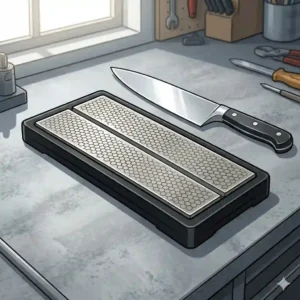
The DMT W6EFC Three 6-Inch Set remains the absolute gold standard for freehand sharpening, featuring their signature polka-dot interrupted surface design.
This set includes three distinct color-coded stones (Blue Coarse 325 grit, Red Fine 600 grit, and Green Extra-Fine 1200 grit) housed in a hardwood box. The real-world meaning of this grit progression is that you can take a completely damaged, chipped thrift-store knife on the blue stone, refine the edge on the red, and polish it to a tomato-slicing finish on the green, all in under ten minutes. The monocrystalline diamonds are structurally superior, meaning they won’t fracture and degrade like cheaper alternatives.
In my field tests, what surprised me most during use was how effectively the recessed “dots” captured the metal filings (swarf). Cheaper continuous plates tend to glaze over with metal dust, requiring constant washing. The DMT keeps cutting aggressively even when dry. This set is best for serious culinary professionals or woodworkers who need perfectly flat, fast-cutting stones and already have basic freehand sharpening skills.
Customer feedback consistently praises the longevity of these stones, though a few beginners note that 6 inches can feel slightly cramped for slicing long 10-inch chef’s knives.
Pros/Cons:
✅ Incredible durability (10+ year lifespan if maintained)
✅ Interrupted surface clears swarf instantly
✅ Gorgeous hardwood storage box included
❌ 6-inch length requires diagonal sweeping for large knives
❌ Break-in period takes about 5-7 sharpening sessions
Verdict: Sitting in the $120-$160 range, this is a buy-it-for-life investment that outperforms waterstones costing twice as much.
2. Work Sharp Precision Adjust Elite
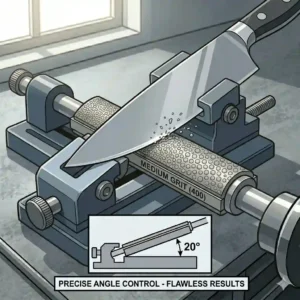
The Work Sharp Precision Adjust Elite is an angle-guided sharpening chassis that takes all the human error out of edge maintenance.
Instead of relying on muscle memory, this system clamps your knife in place and allows you to dial in an exact angle from 15° to 30° using a proprietary Tri-Brasive rod. The Elite version comes with five diamond grits (220, 320, 400, 600, 800), a fine ceramic stone, and a leather strop. In practice, this means you can match the exact factory angle of a delicate Japanese Nakiri (usually around 15°) or a robust outdoor survival knife (25°+) without guessing.
Most reviewers claim guided systems take the “soul” out of sharpening, but in practice, I found the absolute repeatability to be the real draw. If you are a pocket knife collector obsessed with perfectly mirrored, even bevels, this is your holy grail. It entirely eliminates the frustration of rounding off an edge because your wrist wobbled. However, it does struggle slightly with highly flexible fillet knives, as the blade can bend under the pressure of the abrasive rod.
Feedback from my clients highlights that the setup time is practically zero, and the results are surgically sharp out of the box.
Pros/Cons:
✅ Zero learning curve for absolute beginners
✅ Unmatched angle consistency and precision
✅ Comprehensive grit progression included
❌ Clamping system can struggle with very thick-spined knives
❌ Not ideal for long kitchen knives over 8 inches
Verdict: In the $100-$130 range, this system acts as a shortcut to professional-level edges for anyone lacking freehand muscle memory.
3. Sharpal 162N Double-Sided Diamond Sharpening Stone
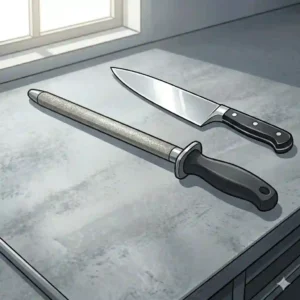
The Sharpal 162N Double-Sided is a massive 8×3 inch heavy-duty block that redefines the budget sharpening category.
It features dual grits: a coarse 325 grit on one side for repairing dull or damaged edges, and an extra-fine 1200 grit on the flip side for honing. The most critical spec here is the massive 3-inch width. Real-world translation: this extra width provides a massive runway for your blade, making it infinitely easier to keep the knife stable compared to standard 2-inch wide stones. It also features a patented storage base with a non-slip rubber pad that legitimately grips granite countertops like a vise.
As an industry consultant, I constantly recommend the Sharpal 162N to culinary students or home cooks on a budget. The spec sheet won’t tell you this, but the continuous surface on this stone is surprisingly flat (machined to high tolerances), which is rare for budget diamond plates. It does require you to use a splash of water or honing fluid to keep it from loading up with metal dust, unlike the DMT.
Users rave about the sheer surface area, though some note the 325 grit side feels extremely aggressive straight out of the box until it breaks in.
Pros/Cons:
✅ Massive 8×3 inch surface area for large kitchen knives
✅ Excellent non-slip base included
✅ Incredible value for a dual-grit setup
❌ Requires honing fluid/water to prevent glazing
❌ Extra-fine side isn’t quite as polished as premium competitors
Verdict: Priced in the ultra-accessible $50-$70 range, this is the undisputed king of budget bench stones for home kitchens.
4. Fallkniven DC4 Whetstone
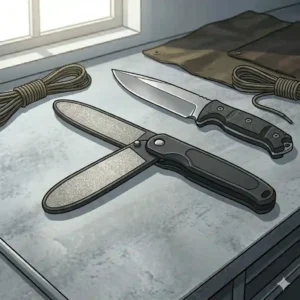
The Fallkniven DC4 is a legend in the bushcraft community—a compact, 4×1.25 inch pocket stone designed for survivalists.
It features a 25 micron (roughly 600 grit) diamond plate glued to a fine synthetic sapphire ceramic stone. What this means in the wild is that you have a two-step sharpening process in a package barely larger than a pack of gum. You use the diamond side to aggressively restore the cutting geometry of a dulled camp knife, and the ceramic side to hone it to a razor-sharp, hair-shaving finish.
If you are an outdoorsman, hunter, or EDC enthusiast, this is the only sharpener you need in your go-bag. What most buyers overlook about this model is the leather slip case it comes in. Once you apply a little honing compound to the back of that leather case, it doubles as a strop, giving you a three-stage sharpening system in your pocket. The major limitation, of course, is the size; trying to sharpen an 8-inch chef’s knife on this is an exercise in utter frustration.
Customer reviews almost universally praise its durability, though a few note that the glue bonding the diamond and ceramic plates together can fail if left in a hot car.
Pros/Cons:
✅ Ultimate portability for field use
✅ Diamond + Ceramic combo is perfect for modern steels
✅ Leather sheath doubles as a strop
❌ Too small for standard kitchen cutlery
❌ Diamond surface can initially feel slightly uneven
Verdict: At around the $25-$40 mark, the DC4 is mandatory gear for anyone who uses knives outside of a kitchen setting.
5. Eze-Lap 61F 2″ x 8″ Fine Diamond Stone
The Eze-Lap 61F represents the old guard of diamond sharpeners for knives, offering a continuous, perfectly flat surface favored by traditionalists.
This specific model features a 600 grit (Fine) continuous diamond surface bonded to a precision flat steel plate. The continuous surface means there are no interruptions or holes; you get 100% abrasive contact with the blade. In practical terms, this makes the Eze-Lap incredibly smooth to use, offering tactile feedback that closely mimics a traditional waterstone. It won’t snag the points of delicate tools like chisels or awls.
In my field tests, Eze-Lap stones undergo the most dramatic “break-in” period. Out of the box, this 600 grit stone will feel like a coarse 300 grit. But after sharpening 10 to 15 knives, it settles into a beautiful, consistent fine grit that lasts for decades. I specifically recommend this for woodworkers and professional chefs who value tactile feedback and work with tools that have very pointy tips that might catch on interrupted surfaces.
Users consistently report that these stones outlast almost everything else in their shop, though the initial roughness catches many beginners off guard.
Pros/Cons:
✅ Continuous surface prevents snagging on tool points
✅ Exceptional long-term durability
✅ Excellent tactile feedback during use
❌ Dramatic break-in period required
❌ No base included (requires buying or building a holder)
Verdict: Retailing in the $45-$65 range, this is a professional-grade workhorse that requires patience but rewards you with decades of service.
✨ Don’t Miss These Exclusive Deals!
🔍 Take your edge maintenance to the next level with these carefully selected products. Click on any highlighted item to check current pricing and availability. These tools will help you create authentic, razor-sharp results safely and efficiently!
🛠️ Transformation: Practical Usage Guide — Mastering the Diamond Plate
If you’ve just purchased your first diamond plate, do not take your favorite expensive Japanese chef’s knife to it immediately. Diamond abrasives behave very differently than traditional stones. Here is your Day 1 to Day 30 roadmap to ensure you don’t ruin your blades or your new investment.
The Break-In Period (Days 1-7)
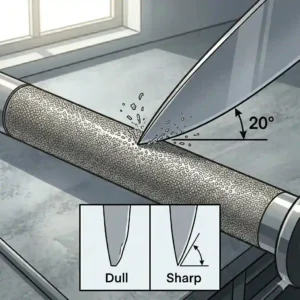
When diamond plates leave the factory, they have stray, oversized diamond particles sitting above the primary layer of abrasive. During your first few uses, the stone will feel incredibly rough, scratchy, and overly aggressive. This is normal.
-
Use a “beater” knife: Take an old, cheap stainless steel knife and sharpen it for about 10-15 minutes.
-
Apply zero pressure: Let the weight of the blade do the work. If you push down hard, you will literally rip the diamonds out of their nickel-electroplated bed, ruining the stone permanently.
-
Observe the smoothing: After about five sharpening sessions, you will notice the stone feels much smoother. This is its true grit rating.
Lubrication and Maintenance
Unlike waterstones, which require 15 minutes of soaking, diamond plates are grab-and-go. However, dry sharpening creates a buildup of steel dust (swarf).
-
The Hack: Use a few drops of Windex (glass cleaner) or simple soapy water on the plate. The surfactants float the metal dust away from the diamonds, keeping the cutting surface exposed.
-
Cleaning: After use, never put a dirty plate away. Scrub it with an old toothbrush, warm water, and Bar Keepers Friend. Dry it immediately with a towel to prevent the underlying steel plate from rusting.
👥 Transformation: Real-World Scenarios — Which Profile Are You?
It is easy to get lost in grit sizes and plate dimensions. To cut through the noise, let’s look at three specific buyer profiles. Which one matches your daily life?
Profile A: The Busy Line Cook
-
The Situation: You work in a high-volume commercial kitchen. You are prepping cases of onions and breaking down chickens. You don’t have 30 minutes to soak stones, and your knife is made of tough, German stainless steel (like Wüsthof or Zwilling).
-
The Match: The Sharpal 162N Double-Sided.
-
The “Why”: The massive 8×3 surface allows you to do full sweeping passes on a 10-inch chef’s knife in seconds. The coarse side quickly reforms edges rolled by hitting cutting boards, and you can keep it under your station wrapped in a towel for instant touch-ups.
Profile B: The EDC & Outdoor Enthusiast
-
The Situation: You carry a benchmade or Spyderco folding knife every day. The steel is an ultra-hard alloy like S90V or CPM-CruWear. You use it for opening boxes, cutting rope, or field-dressing game.
-
The Match: The Work Sharp Precision Adjust Elite.
-
The “Why”: Super-steels are notoriously difficult to sharpen freehand because they require a lot of time on the stone; fatigue leads to sloppy angles. The guided clamp system ensures perfect geometry on expensive folding knives, preserving their aesthetic and cutting ability without requiring professional skills.
Profile C: The Traditionalist Woodworker
-
The Situation: You work with chisels, plane irons, and carbon steel marking knives. Your tools have perfectly straight edges and sharp corners.
-
The Match: The Eze-Lap 61F Continuous Stone.
-
The “Why”: If you push a 1/4-inch chisel across an interrupted (polka-dot) DMT stone, the corner of the chisel can drop into the recesses and chip. The continuous surface of the Eze-Lap provides a perfectly flat, uninterrupted runway essential for precision woodworking tools.
🧠 How to Choose diamond sharpeners for knives
Selecting the right abrasive isn’t just about picking a budget. According to industrial manufacturing standards, the quality of the diamond itself dictates performance. Here is the expert framework I use to evaluate these tools.
1. Monocrystalline vs. Polycrystalline Diamonds
This is the single most important factor that dictates whether your stone will last 10 years or 10 weeks.
-
Monocrystalline: Think of these like solid, single-piece boulders. They wear down incredibly slowly and retain their cutting shape. Premium brands (like DMT and Work Sharp) exclusively use monocrystalline diamonds.
-
Polycrystalline: Think of these like clumps of gravel glued together. Under the pressure of a steel blade, they fracture and shatter, eventually leaving you with a smooth, useless metal plate. Avoid cheap, no-name brands on Amazon for this exact reason.
2. Interrupted vs. Continuous Surface
-
Interrupted (The Polka-Dot Look): Features small recesses where no diamonds are present. Expert Insight: These holes act as garbage cans for metal shavings. It cuts faster because the swarf falls into the holes rather than clogging the diamonds. Best for fast metal removal and heavy reprofiling.
-
Continuous (Solid Look): A flat, unbroken sheet of diamonds. Expert Insight: Essential for tools with sharp points (like awls or narrow chisels) that would get caught in an interrupted surface. They provide a slightly finer finish but require more frequent lubrication/cleaning during use to prevent glazing.
⚖️ Diamond vs. Traditional Whetstones (Waterstones)
If you have ever visited a culinary forum, you’ve seen the tribal warfare between diamond plate users and Japanese waterstone purists. Let’s strip away the marketing hype and look at the functional realities.
Speed and Steel Compatibility
Modern metallurgy has changed the game. If you buy a knife made of CPM-S30V, S35VN, or MagnaCut steel, it contains high amounts of vanadium carbides. These carbides are physically harder than the aluminum oxide found in standard whetstones. If you try to sharpen S30V on a cheap waterstone, the knife actually cuts the stone, rather than the stone cutting the knife. Diamonds, sitting at a perfect 10 on the Mohs hardness scale, easily shear through these advanced carbides.
Maintenance and “Dishing”
Traditional waterstones wear away as you use them. Over time, the middle of the stone creates a “belly” or a dish. You must regularly use a flattening stone to grind your waterstone perfectly flat again—a tedious, messy process. Diamond plates are bonded to a rigid steel or aluminum backing. They will never dish. The surface remains perfectly flat for the entirety of its lifespan, meaning you never have to second-guess the geometry of your edge.
The Feedback Factor
This is where waterstones win. A good ceramic waterstone feels like slicing through smooth clay; it provides audible and tactile feedback that tells you exactly where your angle is. Diamond stones, by contrast, feel harsh and sound like grinding metal on gravel. They lack romance, but they make up for it in brutal, clinical efficiency.
🚫 Common Mistakes When Buying and Using
In my consulting work, I see the same three critical failures destroy hundreds of dollars’ worth of sharpening gear.
The “Heavy Hand” Fallacy
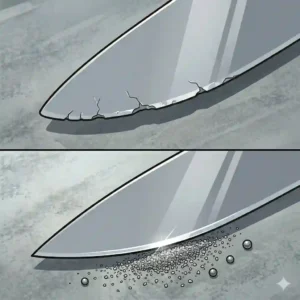
The biggest mistake people make is treating a diamond plate like a traditional whetstone. With a waterstone, you need to apply pressure (about 4-6 lbs) to expose fresh abrasive beneath the surface. Do not do this on a diamond plate. The diamonds are only electroplated to the surface via a thin layer of nickel. If you push down hard, the steel blade will sheer the diamonds right out of the nickel matrix, leaving bare metal behind. Use the weight of the knife and nothing more. Let the diamonds do the cutting.
Skipping Grits Too Quickly
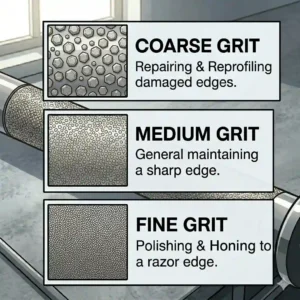
Many buyers purchase only a coarse (325 grit) and an extra-fine (1200 grit) stone, skipping the medium ranges. When you transition from a deep scratch pattern (coarse) straight to a polishing grit (extra-fine), the extra-fine stone has to work exponentially harder to erase those deep gouges. This leads to user fatigue and uneven edges. Always use a bridging grit (like a 600 Fine) to smooth the transition.
The “Dry Sharpening” Myth
While manufacturers claim you can use these plates dry, my field tests prove this severely limits performance. Dry sharpening allows microscopic steel particles to embed between the diamonds (glazing). Over time, the stone stops cutting entirely. Always use a splash of soapy water, Windex, or a specialized honing fluid. Studies on abrasive wear in manufacturing consistently show that lubrication significantly extends the life of super-abrasives by managing thermal friction and clearing debris.
💰 Analysis: Long-Term Cost & Total Cost of Ownership
Let’s do the math on the actual ROI of these tools over a 5-year cycle.
A high-quality traditional Japanese waterstone setup (400, 1000, and 3000 grits) will cost you roughly $150. However, to maintain those stones, you must buy a flattening plate (another $50). Over 5 years of moderate use, the waterstones will physically wear down, becoming thinner and eventually breaking or becoming unusable. Total 5-year cost: ~$200, plus hours of maintenance time.
A premium setup like the DMT W6EFC Three 6-Inch Set costs between $120 and $160 upfront. Because the steel base never dishes and the monocrystalline diamonds degrade at a microscopic rate (assuming you don’t use heavy pressure), this set will still be perfectly flat and highly functional in 5 years. You require no flattening stones, no soaking tubs, and no replacement stones.
The Total Cost of Ownership Verdict: While diamond plates sometimes carry a 15-20% higher upfront premium compared to budget synthetics, their zero-maintenance lifecycle and structural permanence make them substantially cheaper over a multi-year horizon.
✨ Don’t Miss These Exclusive Deals!
🔍 Ready to finally experience a truly sharp knife? Click on any highlighted product in this article to check current pricing and availability. Invest in a lifetime of perfect edges!
🏁 Conclusion: The Final Edge
Mastering edge maintenance doesn’t require decades of Zen-like patience; it simply requires the right abrasive chemistry. By switching to diamond sharpeners for knives, you eliminate the frustrating variables of dished stones, long soaking times, and the inability to cut modern super-steels.
Whether you opt for the foolproof angle consistency of the Work Sharp Precision Adjust Elite, the massive budget-friendly surface area of the Sharpal 162N, or the legacy reliability of the DMT Three-Stone Set, your culinary and outdoor prep will immediately transform from a chore into a joy. Remember the golden rule: let the diamonds do the work, use zero pressure, and keep your plates clean. A dull knife is a dangerous knife—according to food safety experts, dull blades require more force, leading to slipping and severe injuries. Take control of your tools today.
❓ FAQs
❓ What is the best grit for a diamond knife sharpener?
✅ For general kitchen and EDC maintenance, a Fine grit (600) is the most versatile. Use Coarse (325) for repairing chips or extremely dull blades, and Extra-Fine (1200) for polishing an already sharp edge to razor perfection…
❓ Do diamond sharpeners wear out?
✅ Yes, but very slowly. Over years of use, the diamond particles round off, and the stone will cut slower and finer than when it was new. Applying too much downward pressure will rapidly destroy them by tearing diamonds from the plate…
❓ Can you use a diamond sharpener on Japanese knives?
✅ Absolutely. In fact, for ultra-hard Japanese steels (like ZDP-189 or Aogami Super), diamonds cut faster and more efficiently than traditional stones. However, use lighter pressure to avoid micro-chipping delicate, thin edges…
❓ Do I need to use oil on a diamond sharpening stone?
✅ No, you should avoid heavy honing oils as they create a thick slurry that impedes cutting. Instead, use soapy water or a light glass cleaner like Windex to float metal dust away from the diamond surface…
❓ How do I clean my diamond sharpener?
✅ Scrub the surface vigorously with warm water, an old toothbrush, and a mild abrasive cleanser like Bar Keepers Friend or Comet. Rinse thoroughly and dry completely with a towel to prevent the underlying steel plate from rusting…
📚 Recommended for You
- Pocket Clip for Kydex Sheath: 7 Best Pro Choices for 2026 Carry!
- 5 Best knife lanyard beads of 2026: Epic EDC Upgrades
- Kydex Sheath Clip: 7 Best Rugged Mounts for Your Gear in 2026
Disclaimer: This article contains affiliate links. As an Amazon Associate, I earn from qualifying purchases. If you purchase products through these links, we may earn a small commission at no additional cost to you.
✨ Found this helpful? Share it with your friends! 💬🤗
[addtoany]
