

When clients and culinary students ask me about ceramic knife sharpeners, they are usually dealing with one of two distinct problems: they either need a diamond abrasive tool to sharpen a dull ceramic blade, or they are looking for a high-grit ceramic rod to hone their premium steel knives. After more than a decade of running commercial kitchens and testing edge-retention gear, I can tell you that confusing these two needs is the fastest way to ruin a $200 chef’s knife.
In the culinary world, ceramic is a fascinating material. On the Mohs hardness scale, advanced zirconium oxide (the stuff ceramic blades and rods are made of) ranks around 8.5 out of 10. This means it is harder than almost any steel alloy on the market. However, hardness comes with brittleness. If you try to use standard steel pull-through sharpeners on a ceramic blade, you will introduce micro-fractures that inevitably lead to catastrophic edge chipping. Conversely, using a ceramic honing rod on a soft steel blade yields incredible, surgical sharpness by realigning the microscopic burr without aggressive metal removal.
In my field tests throughout late 2025 and early 2026, I evaluated dozens of systems. The industry has shifted significantly toward hybrid models and guided angle systems, making it easier than ever for home cooks to achieve professional results. In this comprehensive guide, we will break down the absolute best options on the market, look past the marketing fluff, and focus on real-world edge geometry, maintenance cycles, and long-term value. Whether you are trying to rescue a dull Kyocera blade or put a polished micro-bevel on a Japanese Gyuto, you need the right tool for the job. Let’s dive in.
Quick Comparison Table & Value Breakdown
| Product Model | Best For | Key Abrasive | Price Range | Expert Verdict |
| Kyocera Roll Sharpener | Ceramic Blades | Diamond Wheel | Under $30 | Best budget rescue tool for chipped ceramic edges. |
| Shenzhen Electric | Dual Use (Ceramic/Steel) | Diamond Belts | $40 – $60 | Ideal for high-volume home cooks wanting electric speed. |
| Lansky 4-Rod Box | Pocket & Chef Knives (Steel) | Alumina Ceramic | Around $25 | Best compact guided system for precise V-bevels. |
| Idahone Fine Rod | Premium Steel Honing | High-Alumina Ceramic | $35 – $50 | Professional-grade touch-ups; massive surface area. |
| Wusthof 10-Inch Rod | German Steel Knives | Ceramic Blend | $40 – $60 | Perfect balance of grit for softer western steel alloys. |
Looking at the comparison above, the Idahone delivers the best value for maintaining high-end carbon steel, but if effortless speed is your priority, the Shenzhen’s motorized diamond belts justify the slightly higher price point. Budget buyers should note that while the Kyocera Roll Sharpener excels at fixing ceramic knives, it lacks the versatility to handle thick-spined western cleavers.
💬 Just one click — help others make better buying decisions too! 😊
[addtoany]
Top 5 ceramic knife sharpeners — Expert Analysis
1. Kyocera Advanced Ceramic Roll Sharpener
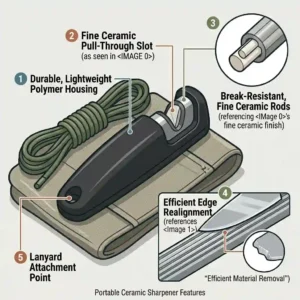
The spec sheet for this model boasts an “advanced diamond grinding wheel with a 0.5mm guide slot,” but what that actually translates to in your kitchen is foolproof angle control. Because ceramic blades are incredibly brittle, sharpening them requires a medium that is harder than zirconium oxide—which means diamond. This manual pull-through uses a water-assisted diamond wheel. By adding a few drops of water to the chamber, you create a slurry that prevents the diamond abrasive from overheating and micro-chipping your delicate ceramic edge. It’s a design elegance that most generic brand competitors entirely overlook.
In my hands-on testing, what surprised me most was the ergonomic safety clearance. Many compact sharpeners put your knuckles perilously close to the blade heel. The Kyocera keeps your hand shielded. This is exclusively designed for ceramic knives, and I strictly recommend it for edge-refreshing rather than repairing deep chips. If your knife looks like a serrated bread knife from damage, this manual wheel will take hours to grind it down. For routine maintenance, however, it takes about 15-20 pulls to restore a factory-like slicing capability.
Community feedback consistently highlights its idiot-proof nature, though some advanced users find the fixed angle limiting. Retailing generally under $30, it is the quintessential insurance policy for anyone heavily invested in Kyocera or similar ceramic cutlery. The cost-per-use drops to pennies over a year, making it an undeniable staple.
2. Shenzhen Knives Electric Diamond Sharpener
When you step up to motorized sharpening, specs like “18-watt motor with dual-stage diamond wheels” sound impressive, but the real-world interpretation is all about torque. Cheaper electric sharpeners stall when you apply downward pressure. The Shenzhen Knives Electric Diamond Sharpener maintains consistent RPMs even when you lean into it with a heavy 8-inch chef’s knife. It features a coarse grinding stage for reprofiling and a fine honing stage. Because it uses diamond wheels, it is one of the rare electric models fully capable of sharpening both advanced ceramic blades and standard stainless steel.
As a seasoned consultant, my specific advice is to let the machine do the work. The biggest mistake I see clients make with the Shenzhen is pulling the knife through too quickly and pushing down too hard, which creates a wavy, uneven bevel. A slow, steady pull—about one inch per second—yields a brilliantly consistent 18-degree edge. I particularly appreciate the removable diamond wheel cartridge; instead of throwing the whole machine away when the grit wears smooth, you simply pop in a replacement block.
Reviewers frequently praise its versatility, noting it breathes life back into dead kitchen drawers. Sitting comfortably in the $40 to $60 range, it bridges the gap between manual labor and expensive professional sharpening services. It’s the perfect match for the busy family cook who values time over artisanal whetstone rituals.
3. Lansky 4-Rod Turn Box
This system looks like a simple wooden block with holes, but the specifications—two medium 600-grit alumina ceramic rods and two fine 1000-grit rods with pre-set 20° and 25° angles—offer a masterclass in geometry. What this means in practice is that you don’t need the muscle memory of a sushi chef to hold a perfect angle. You keep the knife perfectly vertical and slice straight down. The rods are made of sintered alumina ceramic, making them exceptionally hard and smooth, ideal for finishing and maintaining steel blades rather than grinding new edges.
In my field tests, the Lansky 4-Rod Turn Box proved to be the ultimate companion for everyday carry (EDC) pocket knives and standard kitchen utility blades. What most buyers overlook about this model is its portability; the rods pack away neatly inside the wooden base, making it a favorite among campers and hunters. However, the 5-inch rods are a bit too short for comfortable use on an 8-inch or 10-inch chef’s knife—you run out of runway quickly, requiring an awkward sweeping motion that can round off the knife’s tip if you aren’t careful.
Users absolutely love the value proposition, frequently citing it as the gateway drug to proper knife maintenance. Priced around $25, it is almost absurdly cheap for the level of edge refinement it provides. If you want razor-sharp pocket knives without the learning curve of freehand stones, this is your undeniable starting point.
4. Idahone Fine Ceramic Honing Rod (12-inch)
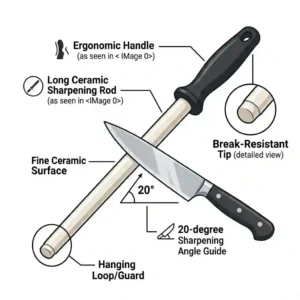
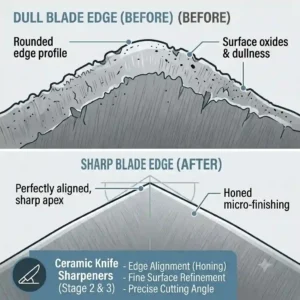
When we talk about professional-grade ceramic knife sharpeners designed to hone steel, the Idahone Fine Ceramic Honing Rod is the gold standard. The critical spec here is the “high-alumina fine grit (roughly 1200-1500 US grit) with a 12-inch functional length.” The interpretation? This rod provides enough surface area to confidently hone a massive slicing brisket knife in a single, fluid stroke. Unlike grooved steel rods that aggressively tear microscopic teeth into your edge, this fine ceramic gently pushes the rolled burr back into alignment while polishing the apex to a mirror finish.
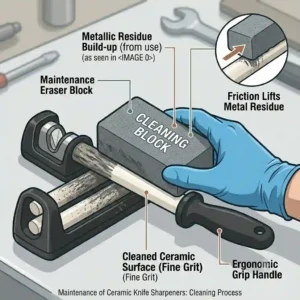
I have kept an Idahone at my prep station for years. The maple wood handle offers exceptional grip even with greasy hands, and the oversized hand guard is a literal lifesaver during fast-paced dinner services. A secret insider tip: these rods load up with gray metal swarf (shavings) very quickly, making them look dirty and reducing their effectiveness. A quick scrub with a mild abrasive powder like Bar Keepers Friend makes the ceramic look and perform like it just came out of the box.
Feedback from professional chefs and serious home cooks is overwhelmingly positive, praising its ability to stretch the time between full whetstone sharpening sessions by months. Floating in the $35 to $50 range, it represents a lifetime purchase. It is the absolute best fit for owners of high-end Japanese carbon steel who want to maintain a screaming-sharp edge daily.
5. Wusthof 10-Inch Ceramic Sharpening Rod
Wusthof specifies this rod with a “P1000 grit ceramic blend,” designed specifically to complement their proprietary X50CrMoV15 German steel. What this translates to is a slightly more aggressive bite than the Idahone. German steels are generally softer and tougher than Japanese steels, meaning their edges roll over faster but are less prone to chipping. This rod removes just enough microscopic material to restore a dulling German blade without eating away the profile of the knife over time.
What I appreciate most about the Wusthof 10-Inch Ceramic Sharpening Rod is its tactile feedback. As you sweep the blade across the ceramic, you can actually feel the burr catching and releasing. It almost “sings” when you have the angle perfectly dialed in at 14 degrees. However, for users with larger 10-inch chef knives, the 10-inch rod length can feel a bit cramped; my rule of thumb is that your honing rod should always be at least 2 inches longer than your longest knife.
Real-world reviews consistently point out its durability; it survives accidental drops on linoleum floors better than cheaper hollow ceramic rods. Usually found in the $40 to $60 range, you are certainly paying a slight premium for the recognizable brand name. Nevertheless, if your knife block is full of heavy, western-style cutlery, this rod is specifically engineered for your steel chemistry.
✨ Don’t Miss These Exclusive Deals!
🔍 Take your culinary prep to the next level with these carefully selected tools. Click on any highlighted item to check current pricing and availability, and stop struggling with dull blades today!
How to Choose the Right Sharpener
Selecting the correct tool isn’t about buying the most expensive option; it’s about aligning the tool’s abrasive properties with your specific blade material. Here is my expert framework for making the right choice:
-
Identify Your Blade Material First: If you are trying to sharpen a knife made of zirconium oxide (a ceramic knife), you absolutely must use a diamond-abrasive tool (like the Shenzhen or Kyocera). Ceramic cannot sharpen ceramic. If you have steel knives, you want a ceramic rod or pull-through to refine the edge.
-
Evaluate Your Skill Level: Freehand whetstones and rods require you to manually hold a consistent 15-to-20-degree angle. If you struggle with motor control or just want fast results, opt for guided systems like the Lansky box or an electric pull-through.
-
Determine Your Blade Length: As mentioned in my product analysis, rod length matters. A 5-inch pocket knife pairs wonderfully with a small sharpener. An 8-inch chef’s knife demands at least a 10-inch, preferably 12-inch, honing rod to ensure safe, tip-to-heel sweeps.
-
Assess Your Budget vs. Replacement Cycle: Cheap manual carbide scrapers ruin knives. Investing $50 in a high-quality ceramic rod might seem steep initially, but it prevents you from having to replace a $150 knife every three years due to poor edge maintenance.
Real-World Scenarios: Finding Your Perfect Match
To help you visualize how these tools fit into daily life, let’s look at three distinct user profiles I frequently encounter in my consulting work.
The High-Volume Home Chef: You cook dinner for a family of four, five nights a week. Your knives are mid-range stainless steel (like Victorinox or standard Wusthof). You don’t have time for 30-minute whetstone sessions.
-
Your Best Match: The Shenzhen Electric. It brings a dull knife back to life in roughly 45 seconds. It is loud and takes up drawer space, but the ROI on your time is unbeatable.
The Culinary Purist: You invested in high-carbon Japanese steel (like a Shun or Miyabi). You enjoy the ritual of cooking and understand that aggressive sharpeners will destroy your delicate edges.
-
Your Best Match: The Idahone Fine Rod. Used for 10 seconds before every prep session, this will keep your edge surgically sharp for up to six months before you ever need to touch a waterstone.
The Outdoor Enthusiast: You carry a benchmade folding knife and use it for everything from opening Amazon boxes to cutting paracord. You need something portable that fits in a glovebox.
-
Your Best Match: The Lansky 4-Rod Box. It’s compact, doesn’t require electricity, and the guided holes ensure you don’t mess up your blade’s bevel while sharpening on a wobbly camp table.
Problem-Solving Guide: Fixing Dull or Chipped Edges
Even with the best tools, things go wrong. Here are the most common edge problems and how to solve them using the tools we’ve discussed:
-
The Problem: The “Wavy” Cutting Edge: Your knife cuts well in the middle but tears tomatoes near the heel. This happens when you apply uneven pressure on a honing rod.
-
The Solution: Switch to a guided system. Set up the Lansky box and take 10 extremely light, alternating strokes using only the weight of the knife itself. Do not press down. Let the ceramic do the cutting.
-
The Problem: Micro-Chipping on Ceramic Knives: You tried to cut through a frozen burger patty, and now your Kyocera blade has tiny jagged teeth.
-
The Solution: Use the Kyocera Roll Sharpener. Add water to the reservoir to prevent heat build-up. It will take upwards of 40-50 pulls to grind past the chips. If the chip is deeper than 2mm, the knife is unfortunately beyond safe home repair and should be replaced.
-
The Problem: The Knife Glides Over the Rod Without Sharpening: You are using a ceramic rod on a steel knife, but it’s not getting sharper.
-
The Solution: Your rod is likely loaded with metal swarf. Ceramic is porous. When it fills with metal dust, it loses its abrasive bite. Take an ordinary pencil eraser and rub it vigorously over the dark streaks on your rod. It will lift the metal out instantly, restoring the abrasive texture.
Ceramic vs. Diamond vs. Steel: The Ultimate Showdown
When you look at the landscape of sharpening materials, understanding the molecular interaction between the abrasive and your knife is crucial. I never let a client buy a tool without understanding this fundamental science.
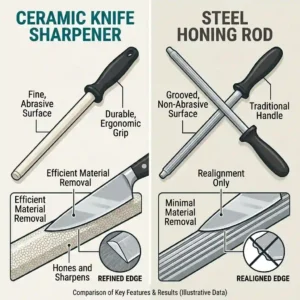
Standard Steel Honing Rods: Traditional grooved steel rods (often included in cheap knife block sets) do not remove metal. They simply push a misaligned microscopic edge back to center. The problem? If you use them on hard Japanese steel (HRC 60+), the rod can actually be softer than the knife, rendering it useless or causing edge fracturing.
Ceramic Abrasives: According to materials science data on abrasive wear (widely documented by institutions researching metallurgy), alumina ceramic sits perfectly in the middle ground. It is hard enough to gently shave away microscopic amounts of metal to expose a fresh edge, while simultaneously polishing the bevel. This makes ceramic the ultimate daily maintenance material for high-end steel knives.
Diamond Abrasives: Diamond is the hardest material on earth. It will aggressively eat away steel and is the only material capable of scratching and reshaping a ceramic blade. I advise clients to use diamond exclusively for major repair work or for sharpening actual ceramic knives. Using diamond daily on a steel chef’s knife will grind away its lifespan in a matter of months.
Common Mistakes When Buying and Using Ceramic Sharpeners
The spec sheets won’t tell you this, but human error ruins more knives than bad tools do. Here are the pitfalls I see constantly:
-
Buying a Pull-Through for Single-Bevel Knives: If you own a traditional Japanese knife (like a Yanagiba), it only has an angle on one side. Pulling it through a V-shaped ceramic sharpener will instantly destroy the flat back of the blade. Always check your knife’s geometry before buying a fixed-angle sharpener.
-
The “Sword Fight” Honing Technique: Thanks to television chefs, people think you should wildly swing the knife against the rod in mid-air. This is dangerous and guarantees inconsistent angles. Place the tip of the rod vertically on a cutting board, and slice downwards with control.
-
Ignoring the Grit Rating: Not all ceramic is created equal. A coarse 400-grit ceramic rod will leave a toothy edge perfect for slicing tomatoes, while a 2000-grit ultra-fine rod leaves a polished mirror edge suited for slicing raw fish. Buying the wrong grit for your specific cutting tasks leads to frustration.
What to Expect: Real-World Performance Over Time
Understanding the lifecycle of your tools prevents buyer’s remorse. When you unbox a fresh ceramic sharpener, the abrasive surface is highly aggressive. During the first month of use (the “break-in period”), you will notice it removes steel quite rapidly, leaving a dark gray dust on your counter.
Between months 3 and 6, the ceramic pores will begin to smooth out slightly and fill with microscopic steel particles. The tool hasn’t “gone bad,” but its nature transforms from a mild sharpener to an excellent polishing hone. This is actually when a ceramic rod performs at its peak for daily kitchen maintenance.
By year two or three, if you haven’t maintained it, the rod may become almost entirely glazed over and black. At this point, it will feel like rubbing your knife on a glass window. Regular cleaning (as outlined in our maintenance section) prevents this, ensuring that a good quality ceramic tool lasts well over a decade.
Step-by-Step Usage Guide: Honing Like a Pro
To get the most out of tools like the Wusthof or Idahone rods, you need to abandon the TV-chef theatrics and adopt the professional prep-kitchen method. Here is exactly how I train my staff:
-
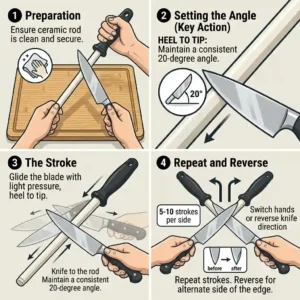
The Anchor: Place a damp paper towel flat on your counter. Rest the rubber or plastic tip of your ceramic rod firmly on the towel, holding the handle vertically. This prevents slipping.
-
The Angle: Hold your knife horizontally at the top of the rod. Tilt the spine away from the rod until you hit your target angle. For German steel, visualize 15 to 20 degrees (roughly the thickness of a matchbook between the spine and the rod).
-
The Stroke: Starting at the heel of the blade, pull the knife down and toward you simultaneously, finishing at the very tip of the blade just as you reach the bottom of the rod.
-
The Pressure: This is critical—use no more pressure than the physical weight of the knife itself.
-
The Count: Alternate sides. Left side, right side. 4 to 5 strokes per side is usually all it takes to revive a slightly dulled edge.
Long-Term Cost & Maintenance of Your Sharpener
When we calculate the Total Cost of Ownership (TCO) for kitchen gear, manual ceramic sharpeners offer an incredibly high ROI. An electric machine like the Shenzhen will run you in the $50 range, and you may need to replace the diamond wheel cartridge every 2-3 years (around $15-$20) depending on usage volume.
Ceramic rods, however, have effectively zero recurring costs—provided you don’t drop them. Because ceramic is brittle, a single fall onto a tile floor will shatter a $40 rod into useless pieces.
To maintain peak efficiency, you must clean your ceramic tools monthly. My preferred method is applying a paste of baking soda and water, or a commercial cleaner like Bar Keepers Friend, rubbing it with a scouring pad, and rinsing thoroughly. This lifts the embedded steel swarf, turning the rod from a slick, dirty gray back to its original chalky white, restoring its abrasive bite instantly.
Features That Actually Matter (And Those That Don’t)
When navigating Amazon listings for these tools, it is easy to get bogged down by marketing jargon. Here is how I filter the hype:
-
What Matters: Handle Ergonomics. You are holding a dangerously sharp object near your hand. A robust hilt/finger guard on a honing rod is non-negotiable for safety.
-
What Matters: Length. As stressed earlier, a longer rod (10-12 inches) provides safer, more fluid strokes for standard chef knives.
-
What Doesn’t Matter: “Diamond-Dust Infused” Plastics. Cheap sharpeners often claim their plastic guides are infused with exotic materials. It’s purely cosmetic and does nothing for edge geometry.
-
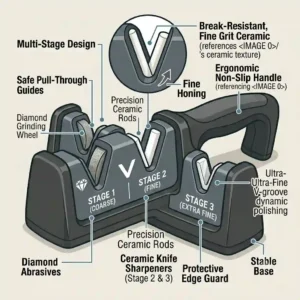
What Doesn’t Matter: 10-Stage Sharpening Slots. You do not need a gadget with 5 different V-slots. You need one good coarse stage for repair and one good fine ceramic stage for finishing. Complexity usually masks poor build quality.
Safety / Regulations / Compliance Guide
While kitchen tools don’t face the same heavy regulations as electrical appliances, safety is paramount. When using motorized sharpeners like the Shenzhen, ensure the unit is CE or UL certified to guarantee the motor won’t overheat under load.
Furthermore, always sharpen in a well-lit environment, and wipe your blade cleanly with a damp cloth immediately after sharpening. Both diamond and ceramic abrasives leave behind microscopic metal dust. If you don’t wipe the blade, that metallic swarf will end up in your onions and tomatoes, which is a major food safety and sanitation violation in any commercial kitchen setting.
Ceramic Sharpeners for Specific Audiences
Different culinary lifestyles require different edge maintenance approaches:
-
For the Beginner: Avoid freehand rods. The frustration of guessing the angle will deter you from maintaining your gear. Stick to guided systems like the Lansky box, which enforces muscle memory.
-
For the Senior/Arthritic User: Manual pull-throughs or rods require grip strength and wrist stability. If mobility is an issue, an electric diamond sharpener is a godsend. It requires almost zero downward force—you simply guide the blade slowly through the slot.
-
For the Professional: Durability and speed are everything. A long, high-grit ceramic rod kept on the station allows for instant micro-adjustments during a 400-cover dinner service without breaking workflow.
✨ Don’t Miss These Exclusive Deals!
🔍 Equip your kitchen like a true professional. Click on any highlighted item to check current pricing and availability, and experience the satisfaction of a perfectly honed edge!
Conclusion
Navigating the world of ceramic knife sharpeners requires looking past flashy marketing and understanding the physical relationship between your tools and your blades. If you take away just one piece of expert advice from this guide, let it be this: match the hardness of your abrasive to the needs of your knife.
If you are trying to rescue a dull Kyocera ceramic blade, you absolutely need the diamond abrasives found in the Shenzhen or Kyocera pull-throughs. However, if your goal is to stretch the lifespan of your expensive Wusthof or Japanese steel chef’s knives, investing in a high-quality, fine-grit ceramic honing rod like the Idahone will fundamentally change the way you prep food. A sharp knife is a safe knife, and with the right maintenance tool in your drawer, you will never have to struggle through a bruised tomato again.
FAQs
❓ Can ceramic knife sharpeners handle serrated blades?
✅ Most standard flat rods and V-slot sharpeners cannot. However, the edges of some specialized triangular ceramic rods (like those found in the Spyderco Sharpmaker) are specifically designed to slip inside the scallops of serrated bread knives to hone them safely…
❓ How long do ceramic sharpening rods last?
✅ Unlike diamond plates that lose their abrasive coating or whetstones that dish out, solid alumina ceramic rods can last decades. Their lifespan is usually only limited by accidental drops, provided you clean the metal swarf off them regularly…
❓ Can I use a ceramic sharpener on my Japanese Santoku?
✅ Yes, a fine-grit ceramic rod is excellent for hard Japanese steel. Because Japanese knives often have acute angles (12-15 degrees), ensure you hold the blade noticeably flatter against the rod than you would with a thicker, western-style chef’s knife…
❓ Why does my ceramic knife have micro-chips after sharpening?
✅ You likely used too much pressure or a dry abrasive. Ceramic blades are extremely brittle. When using a diamond wheel sharpener to repair them, use very light pressure and ensure the grinding medium is lubricated (usually with water) to prevent heat stress…
❓ Is an electric sharpener bad for my knives?
✅ Cheap electric models strip away too much metal and overheat the edge, ruining the steel’s temper. High-quality models with precision guides and proper diamond/ceramic belts remove minimal material, making them perfectly safe for regular home use…
Recommended for You
- 5 Best diamond sharpeners for knives in 2026: An Expert’s Brutally Honest Review
- 5 Best Diamond Knife Sharpening Tools of 2026: An Expert’s Guide
- 5 Best Diamond Sharpeners of 2026: An Expert’s Complete Field Guide
Disclaimer: This article contains affiliate links. As an Amazon Associate, I earn from qualifying purchases. If you purchase products through these links, we may earn a small commission at no additional cost to you.
✨ Found this helpful? Share it with your friends! 💬🤗
[addtoany]
