
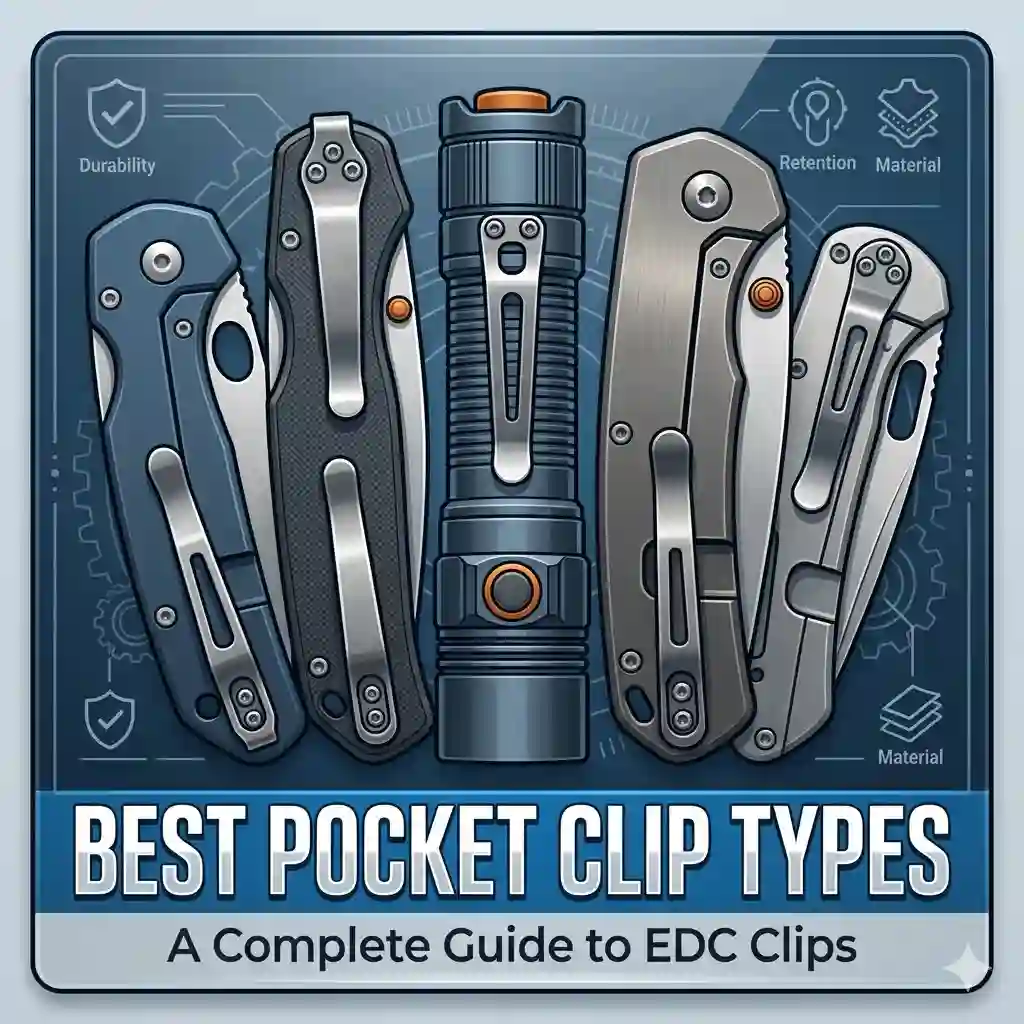
In my 10+ years of consulting in the Everyday Carry (EDC) and tactical gear industry, I’ve seen enthusiasts spend hundreds of dollars on premium blade steels, aerospace-grade flashlight bodies, and machined titanium pens. Yet, they entirely ignore the one component that dictates how that gear interacts with their body: the pocket clip.
A pocket clip is a tension-based retention device attached to tools, knives, flashlights, or pens, designed to secure the item to the hem of a pocket, belt, or webbing. But beyond the simple definition, it is the critical bridge between accessibility and security.
What surprised me most during field testing over the years is how a seemingly minor tweak in spring tension or ramp angle can completely alter your user experience. A poorly designed clip creates ergonomic “hot spots” that blister your hand during hard use, or worse, it lacks the necessary spring memory, resulting in your expensive gear falling out onto the asphalt. Today, we aren’t just looking at spec sheets. We are diving deep into the engineering, the biology of ergonomic fatigue, and the practical realities of upgrading your gear so you can carry smarter.
Quick Comparison Table: Top Upgrades Evaluated
| Model | Material | Carry Style | Best Fit / Use Case | Price Range |
| LynchNW Deep Carry | Grade 5 Titanium | Ultra-Deep | Spyderco/Benchmade Upgrades | $25 – $35 |
| Flytanium Universal | 6AL-4V Titanium | Standard/Deep | Custom Knife Modding | $20 – $30 |
| Nite Ize HipClip | Stainless Steel | Surface Mount | Phones, Wallets, Multi-tools | Under $15 |
| Civivi Titanium | Milled Titanium | Deep | Budget EDC Enhancements | $15 – $20 |
| TEC Accessories P-7 | Spring Stainless | Suspension | Keys & Keychain Flashlights | Under $15 |
Looking at the comparison above, the LynchNW delivers the absolute best value in the premium tier, but if you require a universal application for items without screw holes, the adhesive-backed Nite Ize justifies its spot in your kit. Budget buyers should note that while the Civivi option is highly affordable, it is specifically milled for certain hole patterns, requiring you to verify compatibility before sacrificing the flexibility of standard clips.
💬 Just one click — help others make better buying decisions too!😊
[addtoany]
Top 5 Upgrades: Expert Analysis & Field Tests
1. LynchNW Deep Carry Titanium Pocket Clip
The LynchNW has essentially become the gold standard for aftermarket retention, primarily due to its flawless execution of the fold-over deep carry design.
Machined from Grade 5 Titanium (Ti-6Al-4V), this clip boasts an incredibly high strength-to-weight ratio. What this means for you in the real world is “spring memory.” Unlike factory steel clips that permanently bend when caught on a steering wheel or doorframe, this titanium alloy flexes and returns to its original position. In my field tests, the matte sandwashed finish isn’t just for tactical aesthetics; it actually hides micro-scratches from daily abrasion against rivets and keys.
Most reviewers claim it completely disappears in the pocket, but in practice, I found the real benefit is the shift in the tool’s center of gravity. By dropping the tool lower, it prevents that annoying top-heavy pendulum swing when you jog or climb stairs. This is strictly for the serious EDC enthusiast who wants to conceal their Benchmade or Spyderco in professional office environments.
Customer Feedback Summary: Users consistently rave about the lifetime “guaranteed for life” warranty, though a few note that the included screws can occasionally be slightly too long for thinner handle scales.
-
Pros: Exceptional spring memory, true deep concealment, unconditional lifetime warranty.
-
Cons: Premium price point, specific to brand hole patterns.
-
Price & Value: Sitting in the $25-$35 range, this is a lifetime investment that outlasts the tool it’s attached to.
2. Flytanium Universal Titanium Pocket Clip
Flytanium brings boutique knife modding to the masses with a clip that focuses heavily on customization and aesthetic flair.
This model features standard three-hole patterns but comes in various anodized finishes—from raw titanium to vibrant blurples and golds. The practical interpretation here is chemical resistance and personalization. Anodized titanium doesn’t chip like painted factory steel; the color is literally oxidized into the metal’s surface layer. If you work in marine environments or sweat heavily, this resists galvanic corrosion completely.
The spec sheet won’t tell you this, but what most buyers overlook about this model is the ramp angle. The lip sweeps up at an aggressive 30 degrees, which makes it incredibly easy to slide over thick workwear denim like Carhartts with one hand. I recommend this specifically for the tradesman or mechanic who needs robust retention without tearing up their work pants.
Customer Feedback Summary: Modders love the color-matching capabilities, though some users report the tension out of the box is incredibly stiff and requires a break-in period.
-
Pros: Incredible color options, corrosion-proof, excellent thick-hem clearance.
-
Cons: Very stiff initial tension, requires proper T6 torx drivers to install.
-
Price & Value: In the $20-$30 range, it’s the perfect mid-tier option for personalizing an otherwise stock tool.
3. Nite Ize HipClip
The Nite Ize completely abandons the traditional screw-mount system, opting instead for an industrial-strength 3M VHB adhesive pad.
Constructed from lightweight stainless steel, its primary specification is its surface-mount capability. This means you can attach it to literally any hard, flat surface—a smartphone case, a minimalist wallet, or a Swiss Army Knife that lacks factory mounting options. In my experience, the 3M VHB tape is no joke. Once the acrylic adhesive cures for 24 hours, it essentially creates a permanent bond that easily withstands 15+ pounds of shear force.
However, I have an “anti-recommendation” here: do not use this on silicone phone cases or highly textured rubber grips. The adhesive requires a non-porous surface to achieve molecular bonding. For a college student trying to minimalize their carry by clipping a slim wallet to their waistband, it’s a lifesaver.
Customer Feedback Summary: Buyers love the versatility and low cost, but a few have experienced adhesive failure when leaving their gear in 100-degree cars during summer months.
-
Pros: Universal application, no tools required, very low profile.
-
Cons: One-time use adhesive, fails on silicone/textured rubber.
-
Price & Value: Well under $15, making it an unbeatable budget hack for unconventional carry.
4. Civivi Titanium Pocket Clip
Civivi disrupted the budget knife market, and their standalone milled titanium clip is doing the same for the aftermarket accessory space.
Unlike bent sheet metal, this is a 3D-machined piece of solid titanium. The real-world translation? Absolute crush resistance. You can slam your hip into a doorway, and this piece will not deform. Furthermore, the screws are recessed into countersunk holes. This is a massive ergonomic win; it means there are no protruding screw heads to catch and shred the lip of your pocket every time you draw the tool.
If your current stock setup is chewing through your expensive jeans, here is what to look for in a replacement. The Civivi excels for the budget-conscious buyer who wants a premium milled feel without paying custom maker prices. Just verify the screw hole distance, as it is tailored to their specific models and a few universal clones.
Customer Feedback Summary: Praised for its premium “custom knife” aesthetic and smooth draw, though the proprietary hole spacing limits cross-brand compatibility.
-
Pros: Zero pocket-fray design, extreme crush resistance, highly affordable for milled Ti.
-
Cons: Limited compatibility, slightly heavier than bent-wire alternatives.
-
Price & Value: Hovering in the $15-$20 range, it punches way above its weight class in durability.
5. TEC Accessories P-7 Suspension Clip
The TEC P-7 completely reimagines how we carry small, dense items like keys and AAA flashlights by utilizing a suspension drop method.
Fashioned from tempered spring stainless steel, it forms a miniature, discreet fold over your pocket hem, allowing a small split-ring to dangle inside the pocket. The practical value here is organizational geometry. Normally, keys bunch up at the very bottom of your pocket, creating an uncomfortable lump that digs into your thigh when you sit down. The P-7 suspends the gear vertically along the pocket seam.
This is an absolute game-changer for office workers wearing tailored slacks or anyone dealing with limited pocket real estate. You won’t know it’s there until you need it. I’d avoid hanging more than 8 ounces on it, as the spring steel isn’t designed for heavy tactical tools, but for a Swiss Army Classic and a house key, it’s perfection.
Customer Feedback Summary: Users call it the best keychain management tool they’ve ever owned, though some wish the outer visible loop was slightly smaller for total stealth.
-
Pros: Eliminates pocket bulge, lightning-fast access, incredibly discreet.
-
Cons: Not for heavy items, can slide sideways in wide pockets.
-
Price & Value: Under $15, representing the cheapest way to vastly improve your daily comfort.
✨ Don’t Miss These Exclusive Deals!
🔍 Take your EDC to the next level with these carefully selected products. Click on any highlighted item to check current pricing and availability. These tools will help you create authentic gear setups your friends will envy!
Practical Usage Guide: Installing and Tuning Like a Pro
The biggest mistake I see beginners make isn’t buying the wrong product; it’s installing a premium accessory using dollar-store tools and poor technique. Upgrading your gear requires precision.
Step-by-Step Installation Protocol
-
Ditch the Cheap Tools: Stop using the L-keys that come in the package. Invest in a hardened Wiha T6 or T8 Torx bit driver. Cheap steel bits will strip the microscopic star-heads of your screws, turning a five-minute upgrade into a nightmare of drilled-out hardware.
-
Clean the Threads: Before installation, swab the female threads inside the handle scale with rubbing alcohol. Factory oils prevent threadlockers from curing.
-
The Blue Loctite Rule: Apply a microscopic dab of Blue Loctite 242 (never Red) to the tip of each screw. This liquid plastic cures in the absence of air, securing the hardware against the relentless micro-vibrations of walking and running.
-
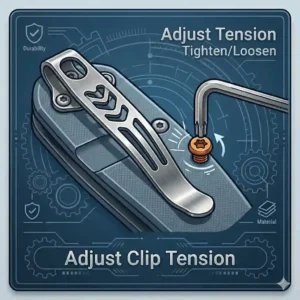
Tune the Tension: If the retention is too tight, do not try to bend it while it’s attached to the tool—you will strip the screws. Remove it, wrap the jaws of a pair of pliers in electrical tape (to prevent scratching), and gently flex the metal backward by one or two millimeters. Reattach and test.
By strictly following this “Year One” roadmap for installation, you ensure the hardware won’t vibrate loose after three months of daily use.
The Daily Carry Case Study: Matching Clips to User Profiles
A “perfect” piece of gear doesn’t exist in a vacuum; it only exists in the context of the user. Let’s look at three distinct profiles to see how environmental variables dictate our choices.
Profile 1: The Office Professional
-
The Scenario: Wears dress slacks, sits in office chairs with armrests (prime snag hazards), and needs utmost discretion.
-
The Solution: The LynchNW Deep Carry.
-
Why: Standard clips leave an inch of the tool exposed, screaming “tactical knife” to coworkers. The ultra-deep profile hides everything but the metal fold. Furthermore, the smooth titanium won’t shred thin merino wool trousers like aggressive milled steel will.
Profile 2: The First Responder / Tradesman
-
The Scenario: Wears heavy gloves, operates in high-stress environments, pulls gear from thick canvas work pants.
-
The Solution: A standard, non-deep-carry Flytanium Universal with an aggressive ramp.
-
Why: Here is the anti-recommendation logic at work. Deep carry is actually a terrible choice for a firefighter or mechanic. If the tool is fully buried in the pocket, you cannot access it with gross motor skills or gloved hands. You need that exposed inch of handle to grab onto quickly.
Profile 3: The Urban Minimalist
-
The Scenario: Wears athletic shorts or joggers without belts, prioritizes weight reduction.
-
The Solution: The TEC Accessories P-7 Suspension Clip.
-
Why: Athletic material lacks the rigidity to support heavy pocket clips without sagging. Suspending a micro-flashlight and house key via the P-7 distributes the weight cleanly along the seam, eliminating the pendulum effect while jogging.
Problem to Solution: Fixing Bent, Loose, or Snagged Gear
If you carry tools daily, you will inevitably face the holy trinity of retention problems. Here is exactly how to diagnose and solve them.
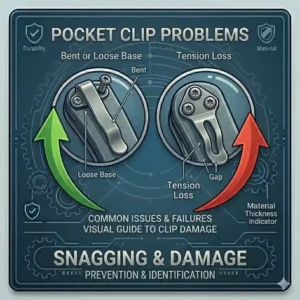
Problem 1: The “Seatbelt Snag” (Bent Metal)
You slid out of your truck, the ramp caught the seatbelt, and now it’s bent outward, offering zero retention.
-
The Solution: If it’s standard steel, remove it, place it in a bench vise with a soft cloth, and tap it back into geometry using a nylon mallet. If it’s titanium, you have to over-bend it slightly past its original resting point due to its high yield strength and memory.
Problem 2: Pocket Margin Destruction
Your gear is literally tearing holes in your jeans where it sits.
-
The Solution: The friction isn’t just from the tension; it’s from the texture of the handle scale underneath the metal point. Remove the clip, take 400-grit sandpaper, and lightly smooth out the G10 or polymer handle scale exactly where the contact point rests. You only need a smooth patch the size of a dime to save your pants. (For more on fabric wear, check out EverydayCarry.com‘s guide on pocket preservation).
Problem 3: The Wobbly Mount
The hardware keeps coming loose every few weeks, no matter how hard you crank it down.
-
The Solution: Your screws have stretched, or the internal threads are stripped. You need a slightly longer aftermarket screw set, and you must let Blue Loctite cure for a full 24 hours before putting it back in your pocket.
How to Choose: An Insider’s Decision Framework
When navigating the aftermarket, don’t just buy what looks cool. Use this priority checklist to filter out the marketing hype.
-
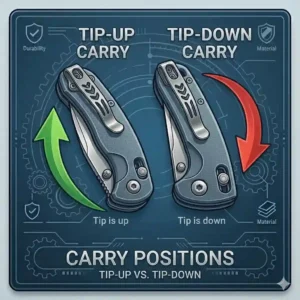
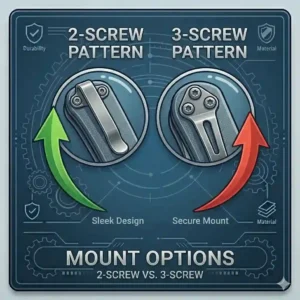
Verify the Hole Pattern: This is the ultimate gatekeeper. Benchmade uses a standard 3-hole triangular pattern. Spyderco uses a distinct 3-hole line pattern on many models. Never assume a universal fit. Always check the millimeter distance between screw centers.
-
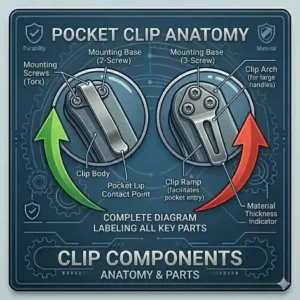
Assess Your Wardrobe: Are you wearing 14oz raw denim or thin chinos? Thick hems require a wider “ramp” (the upturned lip at the bottom). A tight ramp on thick pants requires a two-handed operation to put the tool away, which defeats the purpose of one-handed gear.
-
Determine Concealment Needs: Ask yourself if you need the tool to be invisible (deep carry) or rapidly deployable under stress (standard carry). You cannot have both.
-
Evaluate the “Hot Spot” Potential: Imagine squeezing the handle of your tool as hard as you can. Does the tail end of the metal dig into your palm? Milled 3D designs are smoother on the hand but bulkier in the pocket. Flat stamped metal is flatter in the pocket but sharper on the hand.
Titanium vs. Stainless Steel: The Ultimate Material Showdown
You’ll see a lot of arguments on forums like BladeForums about materials, but let’s break down the actual metallurgical impact on your daily life.
Stainless Steel (Typically 420J2 or Spring Steel)
Steel is incredibly cheap to stamp and bend. It takes a polish beautifully and is highly elastic. However, its yield strength—the point at which it bends and stays bent permanently—is relatively low. If you catch a steel clip on a doorframe, it will bow out 45 degrees, rendering it useless until you physically bend it back.
Titanium (Ti-6Al-4V Grade 5)
Titanium is roughly 40% lighter than steel but exponentially more resistant to yielding. This is why aerospace industries rely on it. In practical terms, a titanium pocket clip can be stretched significantly further away from the handle scale and still snap violently back to its zero-point. Furthermore, titanium is entirely non-ferrous and non-magnetic. If you work in an environment with high-powered magnets (like MRI rooms or certain engineering facilities), titanium is a safety requirement, not just a luxury.
Long-Term Cost & Maintenance of Aftermarket Upgrades
What happens to a premium upgrade after a year of hard use? Understanding the total cost of ownership goes beyond the initial $25 purchase price.
The “Efficiency Gap” of cheap accessories becomes apparent at about the 6-month mark. A $5 knockoff will lose its spring tension, leading to the loss of a $200 tool. That makes the cheap option incredibly expensive in the long run.
Premium titanium variants require practically zero maintenance regarding corrosion—they will outlast your life. However, the hardware (the steel T6 screws) is the weak link. Sweat is highly corrosive. Every 6 months, you should drop a tiny amount of mineral oil into the screw heads to displace moisture and prevent rust from welding the screws to the internal liners of your tool. A $30 titanium upgrade protects a $200 investment, yielding a massive return on investment when viewed as an insurance policy against loss.
Common Mistakes When Buying and Modding
In my consulting work, I’ve seen countless people ruin great gear by making a few predictable errors.
-
Buying Clones: Counterfeit clips from overseas marketplaces might look identical to a genuine LynchNW, but they use cheap, untempered pot-metal instead of Grade 5 titanium. They will snap cleanly in half the first time they catch on a steering wheel.
-
Overtightening: Titanium is harder than the small steel screws used to secure it. If you torque the screws down like a lug nut on a truck tire, you will snap the head of the screw clean off, leaving the threaded shaft permanently embedded in your tool’s handle. Finger-tight plus a quarter turn is all you need when using threadlocker.
-
Ignoring the Detent Interface: Some knives use the pressure of the pocket clip resting on the lockbar to help keep the blade closed (common in frame-locks). If you swap to a clip that applies pressure in the wrong spot, your blade might accidentally deploy in your pocket. Always test the tool’s mechanics after a hardware swap.
✨ Don’t Miss These Exclusive Deals!
🔍 Having trouble finding the right Loctite or Wiha torx bits? Click on the highlighted gear sections to explore the exact maintenance tools I use in my workshop. Fix it right the first time!
Conclusion: Elevating Your Everyday Carry
Ultimately, a pocket clip is much more than a bent piece of metal holding your gear in place. It is the tactical and ergonomic interface between you and the tools you rely on daily.
Whether you are a blue-collar tradesman requiring the robust ramp of a Flytanium to clear heavy canvas, or an office professional utilizing a LynchNW for absolute stealth in a corporate environment, optimizing this component changes everything. By moving away from cheap, factory-stamped metal and investing in purpose-built, high-grade retention, you eliminate pocket fray, prevent accidental loss, and customize the deployment speed of your gear. Stop settling for the lowest common denominator accessories that manufacturers throw in the box. Evaluate your wardrobe, identify your use-case profile, and upgrade your carry to match the demands of your actual life.
FAQs
❓ How do I know if a pocket clip will fit my knife?
✅ You must match the screw hole pattern and distance. Measure the millimeter gap between the center of the screws on your current tool. Most aftermarket manufacturers list specific compatible models (e.g., Spyderco Paramilitary 2, Benchmade Bugout) directly in their specifications…
❓ What does “deep carry” mean?
✅ Deep carry refers to a design where the metal folds over itself at the top, allowing the attached tool to sit completely below the pocket line. This maximizes concealment and lowers the center of gravity, preventing the tool from falling out…
❓ Can I fix a bent titanium pocket clip?
✅ Yes, but it requires more force than steel. Remove it from the tool, place it in a vise, and bend it slightly past its original resting point. Titanium has strong spring memory, so it will bounce back slightly after bending…
❓ Why do some pocket clips tear up pants?
✅ Pant damage is caused by high spring tension pressing against an aggressive handle texture (like G10 fiberglass). To fix this, you can lightly sand the handle scale directly underneath the contact point to create a smooth friction zone…
❓ Is titanium always better than stainless steel?
✅ Not always. While titanium offers superior corrosion resistance, lighter weight, and better spring memory, heat-treated spring steel is often more flexible and significantly cheaper to replace if severely damaged…
Recommended for You
- 7 Best Flashlight Pocket Clip Options for EDC Excellence
- Pocket Clip for Kydex Sheath: 7 Best Pro Choices for 2026 Carry!
- Knife Pocket Clip Upgrades: 5 Best Picks to Secure Your 2026 EDC
Disclaimer: This article contains affiliate links. As an Amazon Associate, I earn from qualifying purchases. If you purchase products through these links, we may earn a small commission at no additional cost to you.
✨ Found this helpful? Share it with your friends! 💬🤗
[addtoany]
