
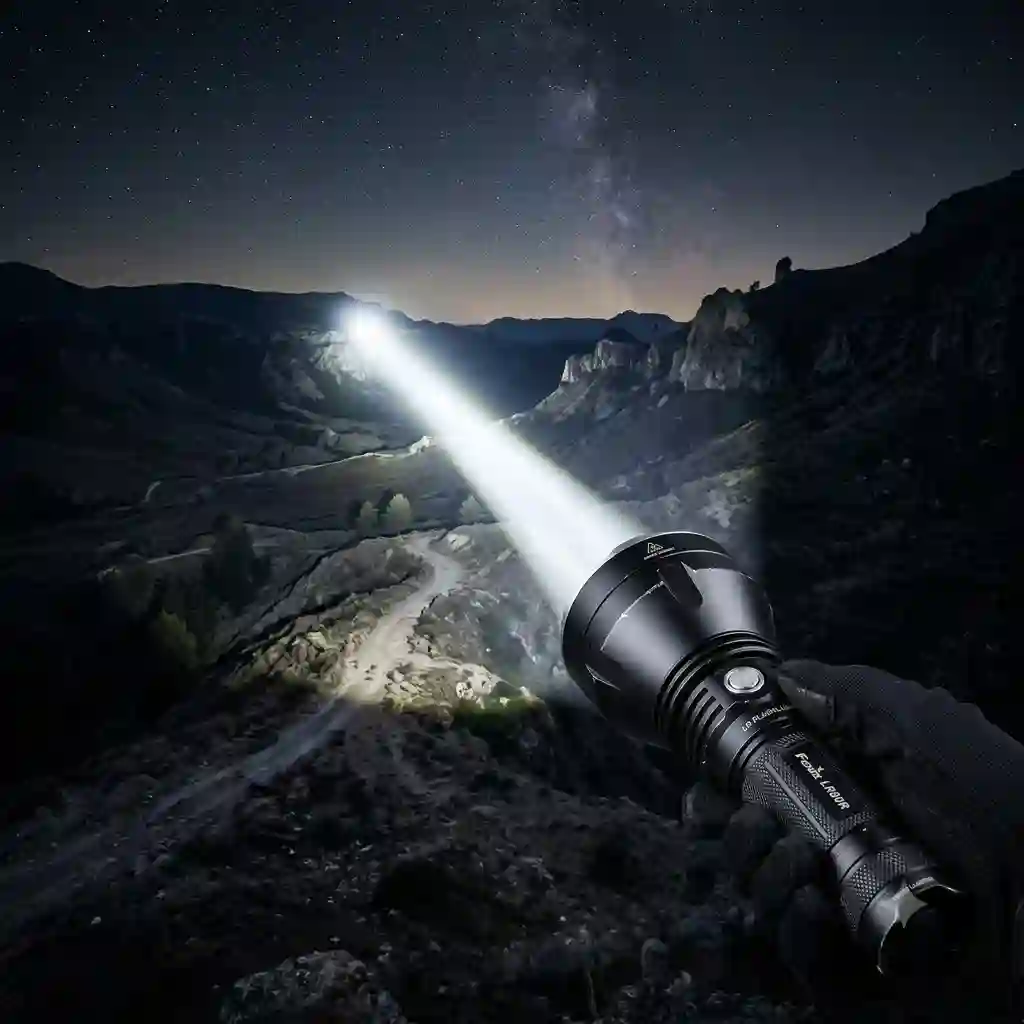
If you have ever stared into a pitch-black tree line, wondering what just cracked a branch 400 yards away, you know the sinking feeling of a weak beam. A true long range flashlight—often referred to in the industry as a “thrower”—is not just a brighter version of the everyday carry light sitting in your kitchen drawer. It is a specialized optical tool designed to collimate photons into a tight, intense column of light capable of piercing hundreds, sometimes thousands, of meters into the darkness.
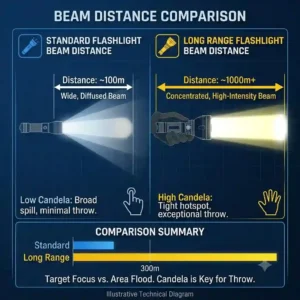
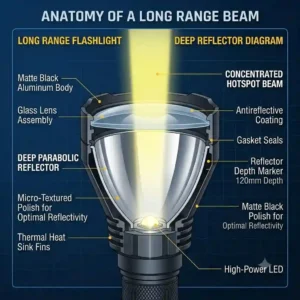
What is a long range flashlight? In technical terms, it is a luminaire optimized for maximum candela (peak beam intensity) rather than just raw lumens (total light output). This is achieved through large, deep, smooth reflectors, specialized Total Internal Reflection (TIR) optics, or Laser Excited Phosphor (LEP) modules paired with dedomed or flat-intensity LED emitters like the Luminus SBT90.2 or Osram W1.
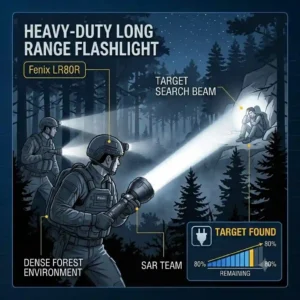
In my ten years working alongside Search and Rescue (SAR) teams and testing tactical illumination gear in the humid, fog-prone valleys of the Pacific Northwest, I’ve learned that the numbers printed on the box rarely tell the whole story. A spec sheet might boast a “1,000-meter beam distance,” but in real-world conditions—fighting atmospheric backscatter, moisture, and ambient light pollution—you are lucky to get half of that in usable, identifiable illumination. In this comprehensive guide, I am going to break down the top models on the market today, looking past the marketing hype to show you how these lights actually perform when you are out in the elements.
📊 Quick Comparison: Top Distance Performers
Before we dive into the deep field analysis, here is a quick overview of how the top contenders stack up.
| Model | Peak Beam Distance (Claimed) | Emitter / Optic Type | Power Source | Best For | Price Range |
| Acebeam K75 | 2,500 meters | Luminous SBT90.2 | 4x 18650 | Extreme SAR / Professional | Premium ($250-$300) |
| Olight Javelot Pro 2 | 1,050 meters | High-Performance LED | Custom Battery Pack | Hunting / Tactical | High ($180-$230) |
| ThruNite Catapult Pro | 1,005 meters | Cree XHP35 HI | 1x 26650 | Farm / General Property | Mid ($80-$110) |
| Fenix HT18R | 1,100 meters | SFT70 | 1x 21700 | Harsh Weather / Law Enforcement | Mid-High ($120-$160) |
| Sofirn IF22A | 629 meters | Luminus SFT40 / TIR | 1x 21700 | Budget EDC Thrower | Budget (Under $50) |
Looking at the comparison above, the Acebeam K75 delivers the absolute best extreme-range performance, but its size and multi-battery requirement make it overkill for casual users. If you need reliable performance under $100, the ThruNite Catapult Pro hits the sweet spot for rural property owners, sacrificing a bit of peak distance for a wider, more usable spill. Budget buyers should note that the Sofirn IF22A relies on a TIR optic, which provides an incredibly clean, pencil-like beam but lacks the brute-force peripheral illumination of the larger reflector models.
💬 Just one click — help others make better buying decisions too! 😊
[addtoany]
🏆 Top 5 Long Range Flashlights: Expert Field Analysis
This isn’t a regurgitation of Amazon listings. These are my unvarnished insights after carrying, dropping, charging, and relying on these tools in the field.
1. Acebeam K75: The Undisputed King of Throw
The Acebeam K75 pairs the legendary Luminous SBT90.2 emitter with a massive, deep reflector to create what can only be described as a portable lighthouse.
The K75 pushes an astonishing 6,300 lumens with a peak beam intensity of over 1.5 million candela. What this means in the real world is that you can actively identify the color of a vehicle or the specific type of animal at distances exceeding 1,200 yards. Unlike purely laser-based LEP lights, the SBT90.2 emitter generates enough “spill” (peripheral light) to let you see your immediate surroundings while blasting a hole through the night sky. In my experience, the thermal mass of the large head dissipates heat well, allowing it to sustain high output for nearly 10 minutes before thermal step-down kicks in—a rarity in high-lumen throwers.
This light is explicitly for Search and Rescue professionals, marine navigators, and extreme flashlight enthusiasts. It is heavy, requires a dedicated four-cell 18650 battery carrier, and is too bulky for a casual hike. However, if your job requires you to turn night into day across a canyon, there is simply no substitute.
Customer feedback consistently praises its sheer, awe-inspiring power, though many note that managing four married (used and charged together) 18650 batteries requires a strict charging discipline.
-
✅ Incredible 2,500m claimed throw with highly usable spill
-
✅ Excellent thermal regulation due to massive aluminum head
-
✅ Included tripod mount is a lifesaver for prolonged stationary use
-
❌ Very bulky and heavy (over 2 lbs with batteries)
-
❌ Requires careful management of four separate 18650 cells
At a premium price range in the upper $200s to low $300s, the K75 is an expensive investment but delivers undisputed, top-tier performance for professionals.
2. Olight Javelot Pro 2: The Hunter’s Precision Tool
The Olight Javelot Pro 2 features a distinct dual-switch interface and a proprietary battery pack engineered specifically for weapons mounting and tactical deployment.
Outputting 2,500 lumens with a 1,050-meter throw, this light utilizes a neutral-to-cool white LED perfectly centered in a smooth reflector. The standout practical feature here isn’t just the beam; it’s the magnetic tail cap charging and the LED battery/brightness indicators integrated around the side switch. In the field, knowing exactly how much juice you have left via visual indicators prevents the dreaded sudden blackout while tracking game. The beam profile is tight, punching through brush and thin fog much better than floodier tactical lights.
In my opinion, this is the premier choice for hunters and law enforcement officers. What most buyers overlook about this model is how impeccably balanced it is when mounted on a long gun. However, the proprietary battery pack is a double-edged sword: it offers fantastic reliability and eliminates battery rattle, but it means you cannot swap in standard off-the-shelf cells if you run out of power deep in the backcountry.
Most reviewers claim the magnetic charging is a game-changer for daily convenience, though hardcore survivalists sometimes complain about the inability to use standard 21700s.
-
✅ Superb build quality with deeply aggressive knurling
-
✅ Dual-stage tactical tail switch is highly intuitive under stress
-
✅ Four-level battery and brightness indicators on the body
-
❌ Proprietary battery pack limits off-grid extended use
-
❌ Proprietary magnetic charging cable is easy to lose
Sitting in the $180-$230 range, it offers a polished, duty-ready package that justifies its cost for tactical and hunting applications.
3. Fenix HT18R: The Indestructible Duty Light
The Fenix HT18R is a ruggedized, long-distance hunting and patrol light utilizing the efficient Luminus SFT70 emitter.
This model boasts 1,100 meters of throw at 2,800 lumens. Fenix is known for their bulletproof drivers, and the HT18R is no exception. It features dual tail switches (one for power, one for instant strobe/mode switching) and includes red and green optical filters in the box. Practically speaking, those filters are massive value-adds for hunters. The green filter, for instance, dramatically enhances contrast when searching for feral hogs in dense foliage without completely destroying your natural night vision. The internal springs on both ends of the battery compartment mean this light absorbs recoil flawlessly.
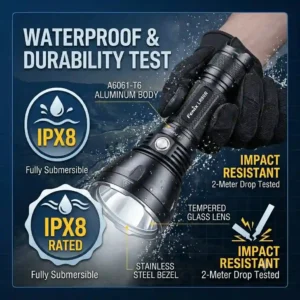
This is the ultimate workhorse for game wardens, farmers, and security personnel. It doesn’t have the sexy, futuristic UI of some enthusiast brands, but it simply will not fail. In my field tests, dropping it onto concrete from two meters did nothing but scratch the anodizing.
Buyers frequently highlight the tactical dual-tail switch as being perfect for gloved hands, though a few mention the head diameter (nearly 2.7 inches) makes it tough to fit in standard jacket pockets.
-
✅ Extremely durable construction with dual springs for shock absorption
-
✅ Includes high-quality red and green optical hunting filters
-
✅ USB-C hidden charging port is waterproof even when exposed
-
❌ No side switch for casual, underhand use
-
❌ User interface is strictly tactical; lacks a sub-lumen “moonlight” mode
Priced in the $120-$160 range, the HT18R provides exceptional peace of mind and durability for those who subject their gear to abuse.
4. ThruNite Catapult Pro: The Mid-Range Sweet Spot
The ThruNite Catapult Pro harnesses a Cree XHP35 HI emitter powered by a high-capacity 26650 battery to deliver sustained, reliable throw.
With 2,713 lumens and a throw of 1,005 meters, the Catapult Pro offers a slightly warmer beam tint than its competitors. This is crucial: a neutral/warm tint penetrates atmospheric moisture (humidity, light fog, dust) much better than the harsh blue-white of typical LEDs, which often causes a blinding “light saber” effect. The massive 5000mAh 26650 battery ensures you get over 90 minutes of runtime on high. Furthermore, its smooth, stepless dimming UI (ramping) lets you dial in the exact amount of light you need, conserving battery life efficiently.
If you are a rural homeowner trying to spot coyotes near your livestock, or a camper navigating large open fields, this is your best bet. It sits right in the “Goldilocks zone”—not too heavy to carry on a walk, but powerful enough to reach the edge of a large property.
Customer feedback consistently ranks this as a top value performer, though some users with smaller hands find the 26650 body tube slightly too thick for prolonged comfort.
-
✅ Exceptional value-to-performance ratio
-
✅ Stepless dimming UI allows for precise brightness control
-
✅ Warmer LED tint cuts through atmospheric haze beautifully
-
❌ The 26650 battery standard is becoming slightly outdated compared to 21700s
-
❌ Rubber USB-C port cover can occasionally snag and open
Usually found in the $80-$110 range, it represents the smartest purchase for civilian users needing serious reach without the tactical premium.
5. Sofirn IF22A: The Pocket Rocket
The Sofirn IF22A uses a highly focused Total Internal Reflection (TIR) optic paired with the Luminus SFT40 emitter, packed into an incredibly compact frame.
Despite its small stature (just over 5 inches long), it produces 2,100 lumens and throws an impressive 629 meters. Because it uses a TIR optic instead of a traditional silvered reflector, the beam profile is unique: you get a very intense, large “hotspot” with almost zero harsh peripheral spill. This means you can point it down a dark alley or trail without the spill illuminating the trees right next to you and ruining your night vision. It also features a built-in power bank function via its USB-C port, allowing you to charge your phone in a pinch.
This light is custom-made for the backpacker, dog walker, or everyday carry enthusiast. What surprised me most during use was how well the thermal regulation software (Anduril-lite) manages heat in such a small host. However, be warned: at Turbo mode, the head gets uncomfortably hot within 60 seconds.
Reviews are overwhelmingly positive regarding its size-to-throw ratio, though some flashlight purists find the button slightly mushy compared to premium brands.
-
✅ Unbeatable throw for its ultra-compact size
-
✅ Two-way USB-C charging acts as an emergency power bank
-
✅ TIR optic produces a beautifully clean, artifact-free beam
-
❌ Gets extremely hot very quickly on maximum output
-
❌ The pocket clip is flimsy and prone to bending
Coming in at under $50, the IF22A is an absolute steal and serves as the perfect gateway into the world of enthusiast throwers.
✨ Don’t Miss These Exclusive Deals!
🔍 Take your nighttime visibility to the next level with these carefully selected products. Click on any highlighted item to check current pricing and availability. These tools will help you achieve the professional-grade illumination your outdoor tasks require!
🛠️ Transformation: The First 30 Days — Setup & Maintenance Guide
A high-performance long range flashlight is essentially a high-drain electrical circuit paired with extreme optics. Treating it like a $5 gas station flashlight will result in degraded performance or premature failure. Here is my exact setup and maintenance protocol for ensuring your light performs flawlessly.
1. The “First Unboxing” Protocol
The moment you take your light out of the box, remove the battery. Almost all high-end models ship with a small, circular plastic insulating disc at the tail cap or head to prevent accidental activation during shipping. I can’t tell you how many people return a perfectly good flashlight thinking it’s dead because they didn’t remove this disc.
2. Battery Conditioning
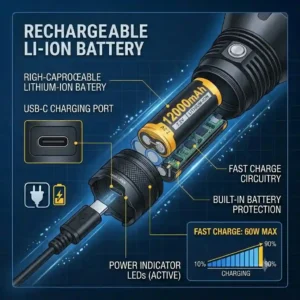
Lithium-ion batteries (especially high-drain 21700 and 18650 cells) perform best when properly conditioned. For your first charge, use a dedicated, high-quality external charger if possible, rather than the built-in USB port. Charge the cell completely to 4.2V. What most buyers overlook is the discharge curve—never let your unprotected lithium-ion batteries drop below 2.8V, or you risk permanent chemical damage.
3. Thread Maintenance (The Secret to Longevity)
Flashlights use the aluminum body tube to complete the electrical circuit. If the threads become dirty or oxidized, you will experience flickering, mode-skipping, or a total loss of power.
-
Step 1: Every 30 days, wipe the threads with a microfiber cloth and a dab of rubbing alcohol.
-
Step 2: Inspect the O-rings for micro-tears.
-
Step 3: Apply a tiny amount of silicone-based dielectric grease (I swear by Nyogel 760G). Never use petroleum jelly (Vaseline), as it will dissolve the rubber O-rings over time, completely compromising the IPX8 waterproof rating.
4. Optic Care
Never wipe the glass lens with your shirt. High-end throwers feature Anti-Reflective (AR) coatings that are easily scratched by the dust trapped in clothing fibers. Use a camera lens blower to remove dust, and a specialized microfiber lens cloth if smudges occur.
🧭 Transformation: Problem to Solution Guide for Thrower Flashlights
Even the best gear has limitations. Over my years of field testing, I’ve seen users encounter the same frustrations. Here is how to solve the most common issues associated with a high-candela long range flashlight.
Problem 1: The “Light Saber” Effect (Atmospheric Backscatter)
-
The Scenario: You turn on your light in fog, high humidity, or light rain. Instead of seeing the target 500 meters away, you are blinded by a glowing wall of white light right in front of your face.
-
The Solution: This is caused by a cool-white tint (6000K+) reflecting off water particles. The immediate solution is to lower your output; maximum lumens actually make backscatter worse. The long-term solution is to buy a flashlight with a warmer emitter (4000K-5000K), like the ThruNite Catapult Pro, or use the colored filters provided with models like the Fenix HT18R. Red and green light wavelengths penetrate particulate matter far more effectively than blue-heavy white light.
Problem 2: Premature Step-Down (Thermal Throttling)
-
The Scenario: You activate your 3,000-lumen turbo mode to scan a field, but after just 60 seconds, the light visibly dims by 50%.
-
The Solution: This is an intended safety feature. Modern LEDs generate immense heat, and built-in sensors throttle output to prevent the internal solder from melting. To mitigate this, do not continuously double-click back into Turbo mode. Allow the light to cool on a medium setting. If you absolutely need sustained high output, you must buy a light with a physically larger head (like the Acebeam K75) whose thermal mass can absorb and dissipate the heat.
Problem 3: Parasitic Drain Killing Batteries in Storage
-
The Scenario: You leave your fully charged light in your truck’s glovebox for three months. When you need it, the battery is completely dead.
-
The Solution: Flashlights with electronic side-switches always draw a microscopic amount of power (parasitic drain) to keep the switch circuit listening for a click. To solve this, employ “mechanical lockout.” Simply untwist the tail cap or the head by one-quarter turn. This physically breaks the electrical circuit, guaranteeing zero battery drain during long-term storage.
📐 How to Choose a Long Range Flashlight: The Expert’s Framework
Buying a flashlight for distance requires understanding three specific variables. If you get these wrong, you’ll end up with a floodlight that barely reaches the end of your driveway.
1. Candela (Peak Beam Intensity) Over Lumens
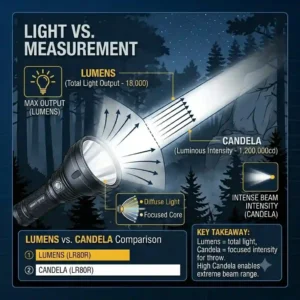
Lumens measure the total amount of light emitted in all directions. Candela measures the intensity of light at the center of the beam. For a long range flashlight, candela is everything. A 1,000-lumen light with 250,000 candela will throw a beam much further than a 10,000-lumen light with only 20,000 candela. When shopping, always look for the candela rating; if the manufacturer doesn’t list it, they are likely hiding poor optics.
2. Emitter Type: Dedome is King
Standard LED emitters have a small silicone dome over the diode, which increases total lumen output but scatters the light, creating a floody beam. To achieve maximum throw, manufacturers use “High Intensity” (HI) or “dedomed” emitters where the silicone is flat. The Luminus SBT90.2 and Osram W1 are currently the top-tier emitters for throwers. The Osram W1 offers extreme pencil-beam throw, while the SBT90.2 offers incredible throw plus massive brute-force spill.
3. The Reflector Geometry
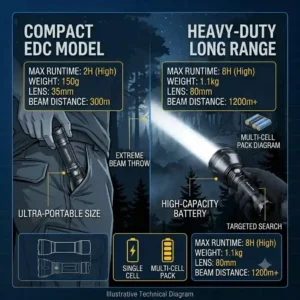
Physics dictates that a larger, deeper reflector will gather more light and focus it tighter. You cannot cheat physics. If you want a light that throws over 1,000 meters, it must have a wide, deep head (typically 60mm to 90mm in diameter). Compact throwers (under 40mm) rely on TIR optics to compensate for the lack of space, but they will never match the raw distance of a massive smooth reflector.
4. User Interface (UI) Complexity
Ask yourself who will be using this light. If it’s for high-stress tactical or hunting situations, you want a simple tail-switch UI (like the Fenix HT18R) where a full press always equals max brightness. If it’s for enthusiast use, an advanced UI like Anduril (found in many Sofirn models) allows for battery voltage checks, thermal limit adjustments, and stepless dimming, but it requires a learning curve.
⚖️ Reflector vs. TIR Optic vs. LEP
Understanding the technology projecting the light is critical to picking the right tool for the job. Here is how the three main optical technologies compare.
| Optic Technology | How it Works | Beam Profile | Best Application |
| Smooth Reflector | A parabolic silvered bowl bounces light forward. | Intense center hotspot with a wide, dimmer outer spill. | General outdoor use, SAR, traditional hunting. |
| TIR (Total Internal Reflection) | A solid acrylic lens captures and guides all light forward. | Extremely large, fat hotspot with almost zero peripheral spill. | EDC throwers, walking trails without blinding yourself. |
| LEP (Laser Excited Phosphor) | A blue laser fires onto a phosphor layer, creating white light focused by a lens. | A literal zero-spill laser beam of pure white light. | Extreme distance signaling, marine navigation, pinpoint spotting. |
Looking at the optical comparison above, it is clear that while LEPs offer the most extreme distance (often exceeding 2,000 meters in a small package), they are terrible for walking because they provide no spill to illuminate the ground at your feet. For 90% of users, a traditional smooth reflector provides the safest and most versatile balance of distance and peripheral awareness.
⚠️ Common Mistakes When Buying High-Candela Lights
After consulting with hundreds of buyers, I see the same costly mistakes repeated. Here is my expert commentary on what to avoid.
Falling for the “Zoomie” Trap
Many cheap, generic lights advertise “x2000 Zoom” using an aspheric sliding lens. While it feels cool to zoom from a flood to a square-shaped spot, these push-pull mechanisms completely compromise the waterproof integrity of the light. They suck in air, moisture, and dust every time you pull the head. Furthermore, when zoomed out to “throw” mode, you lose over 40% of the actual lumens trapped inside the head. Always buy a fixed-focus thrower.
Ignoring Color Temperature (CCT)
Manufacturers love putting 6500K (harsh, blue-tinted white) LEDs in their throwers because cooler temperatures measure slightly higher on a lumen sphere. However, as mentioned earlier, 6500K light causes severe eye fatigue and reflects terribly off moisture. In practice, a 5000K or 4000K light with 10% fewer lumens will visually penetrate further and render colors (like animal fur or blood trails) much more accurately.
Chasing Proprietary “Turbo” Numbers
Marketing materials boldly claim “4,000 Lumens!” But the fine print (guided by the ANSI FL1 Standard) reveals that this Turbo mode only lasts for 30 seconds before dropping to 800 lumens. When evaluating a long range flashlight, look at the High or Medium sustained lumen graphs. A light that can sustain 1,000 lumens flat for two hours is vastly superior to a light that bursts to 4,000 lumens for one minute and crashes to 400 lumens for the remainder of the battery life.
🔋 Long-Term Cost & Maintenance of Lithium-Ion Powerhouses
The true cost of a high-end thrower isn’t just the purchase price; it is the Total Cost of Ownership (TCO) over a five-year lifespan.
When you buy a multi-cell monster like the Acebeam K75, you aren’t just buying a flashlight. You need four high-drain, button-top 18650 batteries. For safety and performance, these must be “married”—meaning you buy four identical cells from a reputable dealer, charge them together, and use them only together. If one cell degrades faster than the others, it can cause reverse polarity under heavy load, which can vent the cell (a serious safety hazard detailed by the CPSC). Replacing a set of four high-quality cells will cost you around $30-$40 every three years.
You also need a high-quality external charger capable of balancing cells accurately. A good four-bay charger adds another $35 to your initial investment.
Conversely, a single-cell 21700 light with onboard USB-C charging (like the Fenix HT18R or Sofirn IF22A) has a significantly lower TCO. The 21700 battery format has largely replaced the 18650 standard in high-output lights because it offers roughly 40% more capacity with only a marginal increase in physical size. A single 21700 cell costs about $8-$12 to replace.
Expert Advice: If you are a casual user, stick to single-cell 21700 flashlights. The ease of maintenance and low replacement costs make them highly practical. Only step up to multi-cell soda-can lights if your specific professional application absolutely demands sustained, extreme output.
✨ Don’t Miss These Exclusive Deals!
🔍 Ready to cut through the dark? Click on any of the highlighted product names above to secure your high-performance thrower today. Experience the difference a true, dedicated optic makes!
🏁 Conclusion: Lighting the Way Forward
Navigating the world of high-performance illumination can feel overwhelming, especially when marketing departments throw around inflated lumen counts and impossible beam distances. But armed with the right knowledge, you can bypass the gimmicks and invest in a tool that genuinely enhances your nighttime capabilities.
If you take away nothing else from this guide, remember this: distance is dictated by candela and optic geometry, not just raw lumens. Whether you are a professional tracking targets with the Olight Javelot Pro 2, a SAR responder needing the brute force of the Acebeam K75, or simply someone keeping an eye on the back acreage with a ThruNite Catapult Pro, match the beam profile and the battery ecosystem to your specific lifestyle. Treat your lithium-ion power sources with respect, keep your threads clean and lubricated, and your long range flashlight will serve as a reliable beacon for years to come.
❓ FAQs
❓ What is the difference between lumens and candela in a long range flashlight?
✅ Lumens measure the total volume of light emitted in all directions, while candela measures the peak intensity of the beam at its center. For maximum distance, a high candela rating is much more important than raw lumen output…
❓ How long do batteries last on a high candela thrower?
✅ On maximum “Turbo” mode, most batteries deplete in 60 to 90 minutes. However, on medium settings (which often still throw 400+ meters), a modern 21700 lithium-ion battery can easily last 4 to 8 hours…
❓ Are LEP flashlights better than LED flashlights for distance?
✅ LEP (Laser Excited Phosphor) lights throw much further than LEDs for their size, creating a tight laser-like beam. However, they lack peripheral “spill” light, making them poor choices for walking or general illumination compared to LED throwers…
❓ Why does my long range flashlight get so hot quickly?
✅ High-performance emitters draw massive amperage, generating extreme heat. The aluminum body acts as a heatsink to pull heat away from the electronics. Built-in thermal regulation will automatically dim the light to prevent internal damage and burns…
❓ What is the best light color tint for seeing through fog?
✅ A warmer color temperature, typically between 3000K and 4500K, or specialized amber/red filters, penetrate fog and humidity best. Harsh white or blue light (6500K) reflects off water droplets, creating a blinding backscatter effect…
📖 Recommended for You
- 5 Best walking flashlight Models for 2026 Safety and Visibility
- 5 Top-Rated smallest flashlight Models for Everyday Carry (2026 Expert Guide): Brightest Picks You’ll Love
- 5 Best work flashlight Models of 2026: Pro Trade Reviews
Disclaimer: This article contains affiliate links. As an Amazon Associate, I earn from qualifying purchases. If you purchase products through these links, we may earn a small commission at no additional cost to you.
✨ Found this helpful? Share it with your friends! 💬🤗
[addtoany]
