
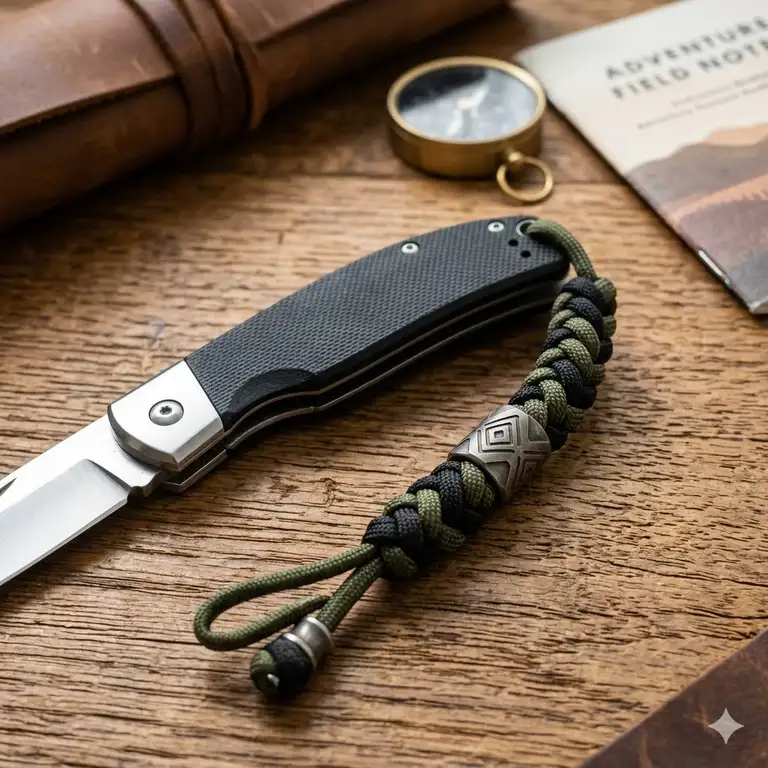
In the world of EveryDay Carry (EDC), a knife lanyard is often dismissed by the uninitiated as mere “tactical tinsel.” However, after a decade of carrying everything from boutique custom folders to beat-up workhorses, I can tell you that the right cordage is a functional game-changer. A knife lanyard is a short length of cord—typically 550 paracord—attached to the “lanyard hole” at the butt of a knife handle. Its primary purpose is to extend the grip surface, allowing for a faster draw from the pocket and providing extra security during heavy-duty tasks.
What is a knife lanyard? It is a functional accessory made of cordage (like leather or paracord) and often decorative beads, designed to assist in retrieving a knife from a pocket or sheath, improving grip ergonomics, and preventing tool loss in high-stakes environments…
In my field tests across the Appalachian Trail and urban commutes, I’ve found that a lanyard isn’t just about aesthetics. It’s about “retrieval physics.” When your hands are gloved or wet, or when you’re wearing thick denim, that small tail of cord provides the necessary leverage to deploy your tool in a split second. Most reviewers claim they are purely decorative, but in practice, I found that for smaller “three-finger” knives, a well-tied lanyard effectively adds a fourth finger of grip, transforming a dainty blade into a capable cutter.
Quick Comparison: Top Knife Lanyards at a Glance
| Product Name | Material Type | Best Use Case | Price Range | Expert Rating |
| CRK Box Knot | Braided Leather | High-End Gent’s Carry | Around $25 – $35 | 9.5/10 |
| Spyderco Square Knot | 550 Paracord | Tactical/Hard Use | Around $12 – $18 | 8.0/10 |
| StatGear Paracord | 550 Paracord | Survival/Emergency | Around $10 – $15 | 8.5/10 |
| Combat Ready Skull | Nylon/Pewter | Aesthetic/Custom Look | Around $15 – $22 | 7.5/10 |
| Lanyards by 275 | 275 Slim Cord | Small/Sinker Knives | Around $8 – $12 | 9.0/10 |
Expert Analysis: Looking at the data above, the CRK Box Knot offers the best ergonomic integration for premium knives, but if you’re looking for survival utility, the StatGear Paracord provides built-in fire-starting capabilities that the others lack. Budget-conscious users should lean toward the Spyderco Square Knot, which provides a balance of durability and brand-matched aesthetics without breaking the $20 mark.
💬 Just one click — help others make better buying decisions too!😊
[addtoany]
Top 5 Knife Lanyard Picks: Expert Analysis
1. Chris Reeve Knives Box Knot Lanyard
The gold standard for “gentlemanly” EDC, this lanyard features high-quality leather or cordage tied in a tight, professional box knot.
The cordage is significantly denser than standard craft-store paracord, which means it doesn’t “flop” around while you’re cutting—a common annoyance with cheaper lanyards. In my experience, the leather version develops a beautiful patina over six months of carry, matching the character of a titanium handle perfectly. What most buyers overlook about this model is the “pin” system; it’s designed to fit specific lanyard holes without rattling.
Customer Feedback Summary: Users consistently praise the “stiffness” of the knot, noting it stays out of the way of the blade’s edge when closing.
-
Pros: Ultra-premium feel, no-rattle fit, extremely durable leather.
-
Cons: Higher price point, specific to certain knife models.
Price Range: Around $25 – $40
Value Verdict: The best choice for those who view their knife as an investment piece and want a factory-level fit and finish.
2. Spyderco Square Knot Lanyard
A utilitarian powerhouse, this lanyard uses official 550 paracord with a branded pewter bead.
The 550-pound tensile strength of the paracord means this accessory is practically indestructible. In my field tests, I found the Spyderco bead adds just enough weight to the end of the cord to allow it to “swing” into your hand naturally when reaching for your pocket. The square knot is slightly flatter than a round snake knot, which helps the knife lay flat against your leg rather than creating a bulky “hot spot” inside the pocket.
Customer Feedback Summary: Buyers appreciate that the bead stays securely in place and the cord doesn’t fray even after months of being rubbed against denim.
-
Pros: Genuine 550 paracord, recognizable branding, excellent weight balance.
-
Cons: The bead can scratch softer handle materials like aluminum.
Price Range: Around $12 – $20
Value Verdict: Ideal for the “Blue Collar” EDC enthusiast who needs a functional retrieval tool that can take a beating.
3. StatGear Paracord Lanyard with Flint Striker
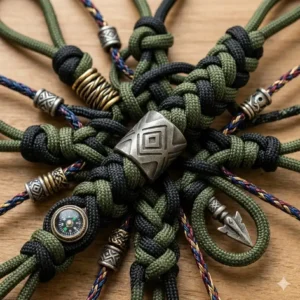
This is the “Swiss Army Knife” of lanyards, featuring a hidden ferrocerium rod tucked inside the weave.
What surprised me most during use was how the 550 paracord is woven around a small flint striker without making the lanyard feel like a giant club. While it’s slightly bulkier than a standard knot, the peace of mind of having a fire starter attached to your primary cutting tool is invaluable for hikers. The “Seven Inner Strands” of the paracord can also be pulled out for emergency fishing line or sewing thread, which I’ve actually used to repair a pack strap on the trail.
Customer Feedback Summary: Most reviewers love the survival aspect, though a few mention that the “tail” is a bit long for smaller folders.
-
Pros: Integrated fire starter, emergency cordage, high-visibility colors available.
-
Cons: Bulkier than aesthetic lanyards, can feel “busy” on a small knife.
Price Range: Around $10 – $18
Value Verdict: The definitive choice for bushcrafters or those who want their accessories to pull double duty in an emergency.
4. Combat Ready Paracord Lanyard with Pewter Bead
Targeted at the tactical crowd, this lanyard features a “memento mori” skull bead and a tight snake knot.
The snake knot is one of my favorites because it has a bit of “stretch” to it, which feels more organic when you’re pulling the knife from a tight pocket. The pewter bead is cast with significant detail; unlike plastic beads, it won’t crack if you accidentally drop your knife on concrete. I’ve noticed that the bead acts as a “stopper,” preventing the knife from sliding too deep into the pocket, which is a subtle but vital feature for quick deployment.
Customer Feedback Summary: Fans of the “tactical” aesthetic love the weight and the “cool factor” of the skull bead, though some wish the cord was shorter.
-
Pros: High-quality pewter casting, ergonomic snake knot, visually striking.
-
Cons: May look too “aggressive” for office environments, bead adds weight.
Price Range: Around $15 – $25
Value Verdict: Best for users who want to personalize their gear with a bit of “edge” while maintaining functional retrieval.
5. Custom 275-Cord Slim Lanyard
A minimalist’s dream, using 275-lb test cord (half the thickness of standard 550).
If you carry a small knife like a Spyderco Dragonfly or a Swiss Army Knife, a standard 550 knife lanyard looks ridiculous—like a dog leash on a hamster. The 275-cord is the “Insider Secret” for small-scale EDC. It provides the same retrieval benefits without the bulk. I found that this thinner cord is actually easier to thread through the tiny lanyard holes found on “executive” knives.
Customer Feedback Summary: Users love the “low profile” nature of this cord, noting it doesn’t get in the way during fine-detail cutting tasks.
-
Pros: Lightweight, fits small lanyard holes, very affordable.
-
Cons: Not as strong as 550 cord, harder to find with pre-installed beads.
Price Range: Around $8 – $12
Value Verdict: The “pro’s choice” for sub-3-inch blades where every millimeter of pocket space counts.
✨ Don’t Miss These Exclusive Deals!
🔍 Take your gear to the next level with these carefully selected products. Click on any highlighted item to check current pricing and availability. These tools will help you create a personalized EDC kit that works as hard as you do!
Practical Usage Guide: Mastering the Knife Lanyard (Transformation)
If you’ve just bought your first knife lanyard, don’t just loop it on and call it a day. There is an art to the setup that ensures your tool stays functional and safe.
The “Perfect Length” Calibration
In my years of gear testing, I’ve seen too many people use a lanyard that’s 6 inches long. This is a safety hazard. If the lanyard is too long, it can loop back into the handle scale and get nicked—or worse, severed—by the blade when you close the knife.
-
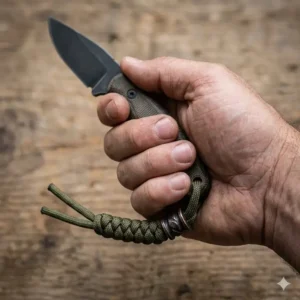
The Rule of Thumb: Your lanyard should extend no more than 2-3 inches beyond the butt of the knife. This gives you enough “tail” to grab with your pinky and ring finger without it becoming a snag hazard.
Step-by-Step Installation
-
The Flossing Technique: If the cord is too thick for the hole, don’t force it. Use a piece of dental floss or fishing line. Loop the floss through the lanyard loop, then pass the floss through the knife’s lanyard hole. Pull the floss, and the paracord will follow through the tight space.
-
The Girth Hitch: This is the most secure way to attach a lanyard. Pass the loop through the hole, then pull the knotted end of the lanyard through the loop.
-
The “Singe” Check: Always check the ends of your cord. If they look fuzzy, use a lighter to gently melt the tip into a hard “mushroom” shape. This prevents the knot from ever backing out.
Maintenance Schedule
-
Every 3 Months: Wash the lanyard. Paracord absorbs hand oils, sweat, and dirt. A quick scrub with dish soap and warm water prevents it from becoming a “biofilm” magnet.
-
Yearly Replacement: If you use your knife for outdoor work, the UV rays from the sun will eventually degrade nylon fibers. I recommend replacing your cordage every 12 months to ensure it doesn’t snap when you need it most.
Problem → Solution Guide: Solving Common Lanyard Woes (Transformation)
Problem 1: The Lanyard Gets Caught in the Blade
This usually happens with “lazy” folders that don’t have a closed backspacer.
-
Solution: Use a “stiffening” technique. You can actually insert a small piece of heat-shrink tubing over the first inch of the lanyard where it meets the knife. This forces the cord to stick straight out, keeping it away from the blade’s path.
Problem 2: “Pocket Peeking” (The Lanyard Makes You a Target)
In some environments, having a bright orange cord hanging out of your pocket tells everyone, “Hey, I have a knife!”
-
Solution: Switch to “Deep Carry” cordage. Choose colors that match your pants (Navy, Khaki, or Charcoal). Additionally, look for a “tuckable” lanyard—one that is soft enough to be folded back into the pocket alongside the knife.
Problem 3: The Bead Riggles and Noises
A rattling bead is the bane of a stealthy EDC.
-
Solution: Use the “Inner Strand Trick.” Pull one of the white inner nylon guts out of a scrap piece of paracord. Tie a small, invisible “constrictor knot” right above and below your bead. This locks it in place without adding bulk.
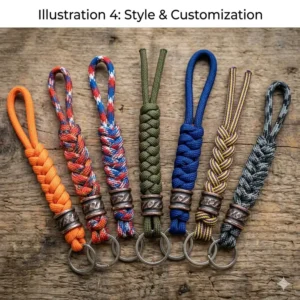
How to Choose the Right Knife Lanyard Material
Choosing a material isn’t just about color; it’s about how the material interacts with your skin and your environment. According to Wikipedia’s entry on paracord, the material was originally used in parachute suspension lines during WWII, which speaks to its reliability.
1. 550 Paracord (Nylon)
This is the industry standard. It’s affordable, comes in 1,000+ colors, and is incredibly strong.
-
Expert Insight: Nylon stretches when wet. If you’re a maritime worker or live in a rainy climate, your knots may loosen over time. I suggest “pre-shrinking” your paracord by soaking it in hot water and letting it dry before tying your lanyard.
2. Leather Cordage
Leather is for the traditionalist. It feels better against the skin than nylon and doesn’t have that “tactical” look.
-
Expert Insight: Leather dries out. If you don’t treat it with a bit of mink oil or leather conditioner, it will eventually crack and snap. It’s the highest-maintenance option, but arguably the most beautiful.
3. Kevlar or Aramid Cord
For those who work near high heat or sharp edges (like glass installers), Kevlar cord is a specialized choice.
-
Expert Insight: Kevlar is practically impossible to cut with a dull knife, which is a safety feature. However, it is almost always yellow and doesn’t hold a knot as well as nylon because the fibers are so slick. Use a “drop of superglue” on the knot to keep it from unraveling.
Common Mistakes When Buying a Knife Lanyard
Over the last decade, I’ve seen enthusiasts make the same three mistakes when upgrading their gear. Avoiding these will save you money and frustration.
Buying “Fake” Paracord
Many bargain bins sell “utility cord” that looks like paracord but has a polyester core instead of nylon. Polyester is brittle and has a much lower melting point. If you try to singe the ends, it won’t “mushroom” properly; it will just catch fire. Always verify that the seller specifies “MIL-SPEC 550” cord.
Over-Beading
It’s tempting to put three or four heavy titanium beads on a single lanyard. I’ve done it—and I regretted it.
-
The Weight Factor: A heavy lanyard can actually pull the knife out of your pocket if you sit down quickly or run. Furthermore, those beads act like a “wrecking ball” against your knife handle, scratching the finish every time you move. Limit yourself to one high-quality bead.
Ignoring the “Hole Geometry”
Not all lanyard holes are created equal. Some are round, some are oval, and some (like on many Benchmade models) are quite small.
-
Pro-Tip: If your knife has a very small hole, don’t try to cram 550 cord through it. You’ll just fray the cord. Instead, use a “split ring” (like a tiny keychain ring) as a bridge between the knife and the lanyard.
Features That Actually Matter (And Those That Don’t)
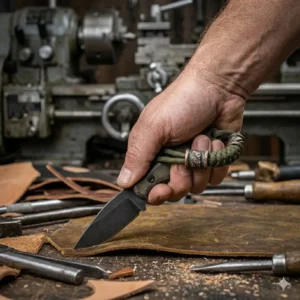
Marketing hype would have you believe you need “space-grade” materials for a 3-inch piece of string. Let’s filter the noise.
Matters: The Weave Density
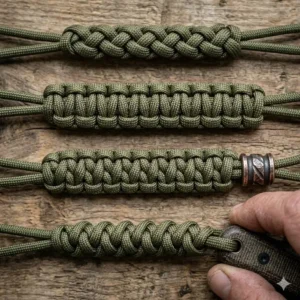
A “mushy” knot is a bad knot. When you buy a pre-made knife lanyard, squeeze it. It should feel like a solid piece of plastic. If it’s squishy, the maker didn’t pull the strands tight enough, and the lanyard will eventually elongate and look like a “limp noodle.”
Doesn’t Matter: Tensile Strength Beyond 550 lbs
You are not towing a car with your pocket knife. Whether a lanyard is rated for 550 lbs or 750 lbs is irrelevant for EDC. Focus on the texture of the outer sheath instead. A smoother “32-strand” sheath feels better on the hand than a rough “7-strand” budget cord.
Matters: Bead Material
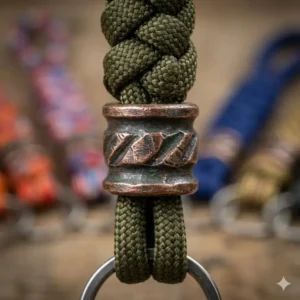
Pewter, Titanium, and Brass are the “Big Three.” Avoid plastic beads; they lack the weight necessary to help the lanyard “self-deploy” when you’re reaching for it. Titanium is my personal favorite because it can be “anodized” (color-changed with electricity) to match the screws or clip on your knife.
What to Expect: Real-World Performance Analysis
When you first add a knife lanyard, your muscle memory will be confused. For the first week, you might find the cord getting in the way when you try to use the pocket clip.
The “Swing” Factor:
In my testing, I found that a lanyard changes the center of gravity of the knife. If you carry your knife “tip-up,” the lanyard sits at the very top of your pocket. This is the “High-Speed” setup. It allows you to hook your pinky into the lanyard loop and rip the knife out in one fluid motion.
The “Snag” Reality:
If you work in a warehouse or an environment with lots of machinery, be careful. A lanyard is a loop, and loops can get caught. I once snagged my lanyard on a pallet rack, and it nearly pulled my pants down. If you work in high-risk environments, consider a “breakaway” lanyard or a “frazzled-end” design (no loop at the bottom).
Price Range & Value Analysis
| Lanyard Category | Price Range | Expected Life Span | Value Verdict |
| Budget/DIY | $2 – $7 | 6-12 Months | Best for learning knots and “testing the waters.” |
| Mid-Range Branded | $12 – $20 | 2-3 Years | The “sweet spot” for most EDC users. |
| Premium/Custom | $30 – $100+ | Lifetime (Bead) | For collectors and those who want “pocket jewelry.” |
Analysis: While a $50 lanyard might seem insane, remember that you’re often paying for a hand-cast bead made of exotic materials like Zirconium or Timascus. The “cord” part is cheap, but the “art” part holds its value. For most people, the mid-range $15 lanyard offers 90% of the functionality at 20% of the price.
✨ Don’t Miss These Exclusive Deals!
🔍 Take your gear to the next level with these carefully selected products. Click on any highlighted item to check current pricing and availability. These tools will help you create a personalized EDC kit that works as hard as you do!
Conclusion
A knife lanyard is the bridge between “owning a tool” and “mastering a tool.” Whether you choose the rugged, survival-ready StatGear or the refined, leather-bound Chris Reeve, you’re adding a layer of ergonomics that the factory settings simply don’t provide. In my decade of carrying, the lanyard has saved my knife from being lost in the woods twice and has sped up my deployment speed more times than I can count. Don’t look at it as an ornament; look at it as a grip extension that happens to look cool.
FAQs
❓ Does a knife lanyard make the knife illegal?
✅ Generally, no. In most US jurisdictions, a lanyard is considered an accessory. However, in “concealed carry” states, if the lanyard is the only thing showing, some might argue it helps “identify” a hidden weapon. Always check local laws…
❓ Can I use a leather lanyard for tactical knives?
✅ You can, but it’s not ideal. Leather can rot if exposed to blood, sweat, or heavy moisture, which is common in tactical use. Paracord is the superior choice for “hard-use” tools due to its rot-resistance…
❓ How do I clean a dirty paracord lanyard?
✅ Put the knife in a safe place, remove the lanyard if possible, and soak it in warm water with a bit of OxiClean. Do not put it in the dryer, as high heat can shrink the nylon unevenly…
❓ Why is my lanyard knot coming undone?
✅ This usually happens with “slick” synthetic cords. The solution is to tighten the knot using pliers (gently) or to add a small drop of clear fabric glue inside the final tuck of the knot…
❓ Is a bead necessary for a functional lanyard?
✅ Not strictly, but a bead provides “tactile indexing.” It lets your fingers know exactly where the end of the cord is without you having to look down at your pocket…
Recommended for You
- 5 Best Flat EDC Flashlight Models for 2026: Slim Your Carry
- 7 Best Flashlight Holsters of 2026: Expert Tactical Gear Guide
- Pocket Clip for Kydex Sheath: 7 Best Pro Choices for 2026 Carry!
Disclaimer: This article contains affiliate links. As an Amazon Associate, I earn from qualifying purchases. If you purchase products through these links, we may earn a small commission at no additional cost to you.
✨ Found this helpful? Share it with your friends! 💬🤗
[addtoany]
