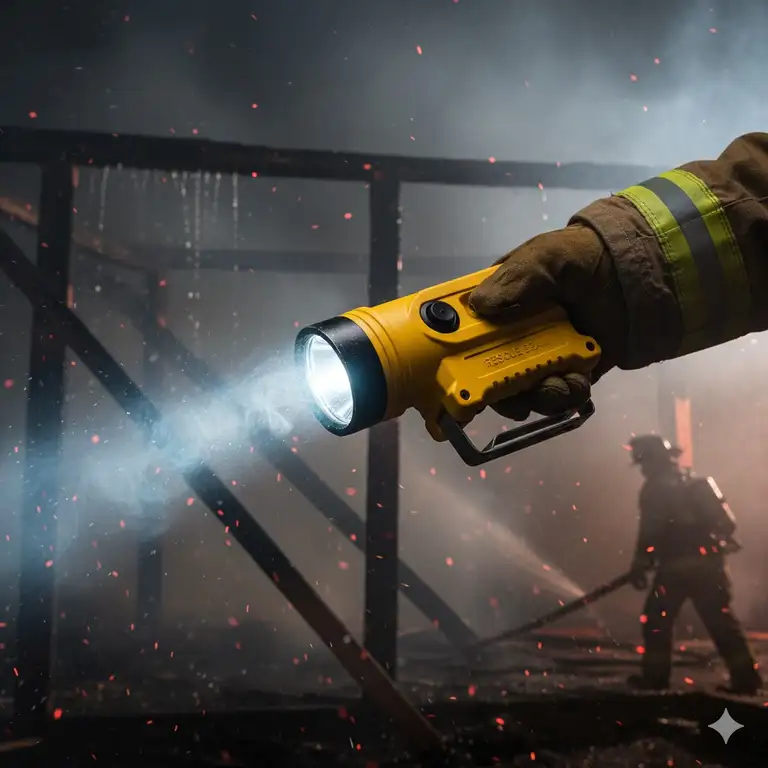
When the alarm sounds, you don’t have time to second-guess your gear. You grab your helmet, your coat, and your light. But in the disorienting chaos of a smoke-filled structure, is your flashlight a trusted tool or just a liability? We’re not talking about the plastic clicker you use to find your keys. We’re talking about dedicated fire service flashlights, the kind built to be abused, submerged, cooked, and still cut a beam through the darkest, thickest smoke.
I’ve seen (and, unfortunately, used) lights that failed at the worst possible moment. A cheap light might be bright in a backyard, but it’s a paperweight in a fire. Consequently, choosing the right light isn’t just about lumens; it’s about survival. It’s about having a tool that works when you—and the people you’re helping—need it most.
✨Was this helpful? Spread the word! 🚀
[addtoany]
Before we dive deep, let’s clear up a common misconception. Your high-powered “tactical” flashlight from a sporting goods store is not a fire service flashlight. Here’s a quick breakdown of why.
Table 1: Fire Service Flashlights vs. Standard Tactical Flashlights
| Feature | Fire Service Flashlights | Standard Tactical Flashlights |
| Primary Goal | Durability, smoke penetration, hands-free use | Maximum brightness, self-defense (strobe) |
| Key Certifications | NFPA 1971, Intrinsically Safe (I.S.) | Often none, maybe IP water rating |
| Heat Resistance | ✅ Yes (High-temp materials like nylon) | ❌ No (Aluminum bodies get dangerously hot) |
| Common Form | Right-angle, helmet-mounted | Handheld, cylindrical |
| Glove-Friendly | ✅ Yes (Large, simple switches) | ❌ Often (Small, multi-mode tail-click switches) |
| Beam Type | Focused hot-spot for smoke, some flood | Often wide flood or “tactical” spot |
| Atmosphere Safety | Often rated for explosive atmospheres | Not rated, can be an ignition source |
Quick Comparison: Top Fire Service Flashlights of 2025
Here’s a quick glance at the top-tier lights we’re breaking down today. These are the tools trusted by professionals across the USA.
Table 2: Top 7 Quick Specs
| Product Model | Type | Max Lumens | Key Feature |
| Streamlight Survivor X | Right-Angle | 250 | All-around workhorse, USB/Piggyback charge |
| Streamlight Vantage 180 X | Helmet/Right-Angle | 250 | Ultimate versatility (helmet, gear, handheld) |
| Pelican 3315R-RA | Right-Angle | 132 | Insane runtime, rechargeable |
| Nightstick INTRANT XPR-5592RX | Helmet/Right-Angle | 200 | Intrinsically Safe (I.S.) Dual-Light |
| Streamlight Knucklehead | Articulating | 200 | 360° rotating head, strong magnet |
| Pelican 3715 | Right-Angle | 237 | Downcast LEDs for path lighting |
| Streamlight PolyTac 90 X | Right-Angle | 500 | High-lumen, budget-friendly |
Top 7 Fire Service Flashlights: Expert Analysis
We’ve researched, analyzed reviews, and looked at the specs that matter on the fireground. Here are the best fire service flashlights you can buy.
1. Streamlight Survivor X: The Modern Workhorse
If you’ve been on a truck, you’ve seen a Streamlight Survivor. It’s the “Coke bottle” of fire lights, and the new Survivor X is the best version yet. It’s not a stats monster, but it’s arguably the most reliable, no-nonsense fire service flashlight on the market.
-
Detailed Specs:
-
Lumens: 250 (High) / 60 (Low)
-
Beam Distance: 447 meters
-
Battery: SL-B26 USB rechargeable battery pack; also accepts 3 AA batteries
-
Runtime: 3.75 hours (High), 15 hours (Low)
-
Safety Rating: Class 1, Div. 2 (Alkaline model is Class 1, Div. 1)
-
Material: High-impact super-tough nylon
-
Weight: 11.9 oz (with rechargeable)
-
-
Customer Review Analysis: Users consistently praise its bulletproof durability. Firefighters report dropping it from ladders, submerging it in water, and it just keeps working. The new USB-rechargeable option is a massive hit for convenience, though many still keep the AA-compatible model for backup. The clip is exceptionally strong, and the switch is easy to find with a gloved hand.
-
Warranty: Streamlight’s Limited Lifetime Warranty.
-
Pros/Cons:
-
Pros: ✅ Unmatched durability, simple glove-friendly operation, multiple battery options (huge plus), excellent smoke-cutting beam.
-
Cons: ❌ Not the absolute brightest, clip can be too stiff for some, Div. 1 rating only on AA model.
-
2. Streamlight Vantage 180 X: The Helmet Hero
Why have a right-angle light and a helmet light when you can have one that does both? The Vantage 180 X is a genius piece of engineering. It clips onto your helmet brim and the head flips 90 degrees to become a right-angle light you can clip to your gear or hold.
-
Detailed Specs:
-
Lumens: 250 (High) / 100 (Low)
-
Beam Distance: 170 meters
-
Battery: One (1) CR123A lithium; also accepts one (1) AA lithium or alkaline
-
Runtime: 4 hours (High on CR123A), 12 hours (High on AA)
-
Safety Rating: Class 1, Div. 1 (when used with specified batteries)
-
Material: High-impact nylon chemical-resistant polymer
-
Weight: 3.1 oz (with CR123A)
-
-
Customer Review Analysis: This light gets rave reviews for its versatility. Helmet-mounted, it provides a perfect spot beam right where you’re looking, with a blue taillight so your crew can see you. When popped off, it’s a fantastic compact right-angle light. The main complaint is that it’s so small and light, some users worry about losing it.
-
Warranty: Streamlight’s Limited Lifetime Warranty.
-
Pros/Cons:
-
Pros: ✅ Insanely versatile (helmet/gear/hand), lightweight, great safety ratings, bright blue “buddy-finder” taillight.
-
Cons: ❌ Uses disposable batteries (though this is a pro for some), lower overall lumen count.
-
3. Pelican 3315R-RA: The Runtime Champion
Pelican is the other massive name in this space, and they focus heavily on safety and runtime. The Pelican 3315R-RA (Right-Angle) is built for firefighters who need a light that will outlast the longest call.
-
Detailed Specs:
-
Lumens: 132 (High) / 15 (Low)
-
Beam Distance: 108 meters
-
Battery: Rechargeable Lithium-Ion
-
Runtime: 5 hours (High) / 48 hours (Low)
-
Safety Rating: Class 1, Div. 1
-
Material: Anti-static Impact Modified PC/PBT
-
Weight: 6.1 oz
-
-
Customer Review Analysis: Users are floored by the battery life. A 48-hour runtime on low is incredible for salvage, overhaul, or just having it on at an extended scene. It’s lightweight, compact, and features a battery level indicator, which is a rare and welcome feature. The 132 lumens don’t sound like much, but users report its beam is exceptionally well-focused for smoke.
-
Warranty: Pelican’s Legendary Lifetime Guarantee.
-
Pros/Cons:
-
Pros: ✅ Incredible battery life, battery level indicator, Class 1 Div 1 safety, very lightweight.
-
Cons: ❌ Lowest “High” lumen output on this list, rechargeable only (no disposable backup).
-
4. Nightstick INTRANT XPR-5592RX: The Intrinsic Safety Specialist
For crews that run a lot of hazmat or deal with potential explosive atmospheres, “Intrinsically Safe” (I.S.) isn’t a suggestion, it’s a requirement. The Nightstick INTRANT XPR-5592RX is a dual-light monster built for exactly that.
-
Detailed Specs:
-
Lumens: 200 (Spot) / 100 (Flood) / 275 (Dual-Light)
-
Beam Distance: 183 meters
-
Battery: Rechargeable Lithium-Ion
-
Runtime: 7 hours (Spot), 10 hours (Flood)
-
Safety Rating: Class 1, Div. 1 (cETLus, IECEx, ATEX certified)
-
Material: Glass-filled nylon polymer
-
Weight: 9.3 oz
-
-
Customer Review Analysis: This light is praised for its dual-light feature. Having a forward-facing spot beam to cut smoke and a downward-facing floodlight to see your feet is a game-changer. It’s built like a tank and has the highest-level safety ratings you can get. It’s a helmet-mounted light, but many use it as a right-angle light on their gear.
-
Warranty: Limited Lifetime Warranty.
-
Pros/Cons:
-
Pros: ✅ Dual-Light (spot + flood) is amazing, top-tier I.S. rating, rechargeable, very durable.
-
Cons: ❌ Heavier and bulkier than other helmet lights, can be complex with multiple buttons.
-
5. Streamlight Knucklehead: The Articulating Problem-Solver
Sometimes, you don’t need the light to point straight ahead. You need it to point up into a ceiling void, down at a fitting, or sideways into an engine compartment. The Streamlight Knucklehead is the ultimate “problem-solver” fire service flashlight.
-
Detailed Specs:
-
Lumens: 200 (High) / 60 (Low)
-
Beam Distance: 203 meters
-
Battery: Rechargeable NiMH pack; also accepts 4 AA batteries
-
Runtime: 3.5 hours (High), 16 hours (Low)
-
Safety Rating: Class 1, Div. 2 (Div. 1 model available)
-
Material: High-impact super-tough nylon
-
Weight: 23.1 oz
-
-
Customer Review Analysis: People who own this light love it. The head articulates 210 degrees and rotates a full 360 degrees. Combined with a powerful magnet on the base, you can stick this thing to a truck or steel beam and light up an entire scene, completely hands-free. It’s a favorite for engineers, extrication, and overhaul.
-
Warranty: Streamlight’s Limited Lifetime Warranty.
-
Pros/Cons:
-
Pros: ✅ Unmatched articulation, powerful magnet, dual-battery options, extremely versatile.
-
Cons: ❌ Heavy and bulky (not a primary “in-the-fire” light), lower IP rating than others.
-
6. Pelican 3715: The Downcast Innovator
This is one of those ideas that’s so simple, it’s brilliant. The Pelican 3715 is a standard right-angle light with one major addition: a set of “downcast” LEDs that shoot light at your feet.
-
Detailed Specs:
-
Lumens: 237 (High) / 113 (Low) / 22 (Downcast) / 31 (Flashing)
-
Beam Distance: 278 meters
-
Battery: 4 AA batteries
-
Runtime: 4.75 hours (High), 8.5 hours (Low)
-
Safety Rating: Class 1, Div. 1
-
Material: Impact Modified PC/PBT
-
Weight: 14.4 oz
-
-
Customer Review Analysis: Users report that the downcast LEDs are a game-changer for avoiding tripping hazards during overhaul or on a dark scene. You get the benefit of a powerful spot beam to see ahead, plus a flood beam at your feet, without having to re-aim. It’s tough, has a battery-level indicator, and is fully Div. 1 safe.
-
Warranty: Pelican’s Legendary Lifetime Guarantee.
-
Pros/Cons:
-
Pros: ✅ Downcast LEDs are incredibly useful, great safety rating, battery level indicator.
-
Cons: ❌ Uses 4 AA batteries (no rechargeable option), heavier than the 3315R-RA.
-
7. Streamlight PolyTac 90 X: The Best Budget-Friendly Option
Need a solid, reliable right-angle light without the $150+ price tag of a rechargeable system? The Streamlight PolyTac 90 X is your answer. It’s light, bright, and tough as nails for the price.
-
Detailed Specs:
-
Lumens: 500 (High) / 85 (Low)
-
Beam Distance: 195 meters
-
Battery: Two (2) CR123A lithium; also accepts Streamlight SL-B26 rechargeable pack
-
Runtime: 2.5 hours (High on CR123A), 18 hours (Low)
-
Safety Rating: Not I.S. rated (this is its main trade-off)
-
Material: High-impact super-tough nylon polymer
-
Weight: 4.4 oz (with CR123A)
-
-
Customer Review Analysis: This is a favorite for volunteers, as a backup light, or for “clean” work (like driving or EMS). It’s shockingly bright at 500 lumens and weighs almost nothing. The flexible “multi-fuel” system (CR123A or USB-rechargeable pack) is a huge bonus at this price point.
-
Warranty: Streamlight’s Limited Lifetime Warranty.
-
Pros/Cons:
-
Pros: ✅ Very high 500-lumen output, extremely lightweight, great price, multi-fuel flexibility.
-
Cons: ❌ Not Intrinsically Safe, shorter runtime on high, not as heat-resistant as Survivor.
-
Table 3: Detailed Feature Matrix: Fire Service Flashlights
| Model | Max Lumens | Battery Type | Runtime (High) | Safety Rating | Weight | Hands-Free |
| Streamlight Survivor X | 250 | Rechargeable / 3x AA | 3.75 hrs | C1, D2 (Rec) / C1, D1 (AA) | 11.9 oz | Clip |
| Streamlight Vantage 180 X | 250 | 1x CR123A / 1x AA | 4 hrs (CR123A) | C1, D1 | 3.1 oz | Helmet, Clip |
| Pelican 3315R-RA | 132 | Rechargeable | 5 hrs | C1, D1 | 6.1 oz | Clip |
| Nightstick INTRANT | 275 (Dual) | Rechargeable | 7 hrs (Spot) | C1, D1 | 9.3 oz | Helmet, Clip |
| Streamlight Knucklehead | 200 | Rechargeable / 4x AA | 3.5 hrs | C1, D2 (D1 available) | 23.1 oz | Clip, Magnet, Hook |
| Pelican 3715 | 237 | 4x AA | 4.75 hrs | C1, D1 | 14.4 oz | Clip |
| Streamlight PolyTac 90 X | 500 | 2x CR123A / SL-B26 | 2.5 hrs | None | 4.4 oz | Clip |
✨ Find Your Perfect Light & Stay Safe!
Ready to make a choice? A reliable light is a non-negotiable piece of gear. Click on any of the bolded product names above to check out the full specs, read more reviews, and find the best price. Your crew will thank you.
💬 Just one click – help others make better buying decisions too!😊
[addtoany]
What Actually Makes a Flashlight a “Fire Service Flashlight”?
So, why are these lights so special? It’s not just about being bright. In fact, some of the best flashlights for fire service aren’t the brightest. It’s about a specific set of features that keep you safe and effective.
🛡️ The “Intrinsically Safe” (I.S.) Requirement: Explained
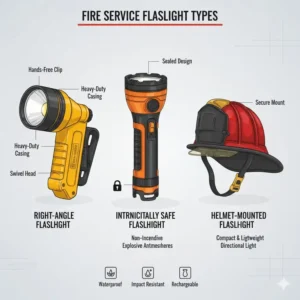
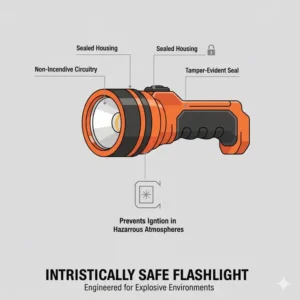
This is the most critical and most misunderstood feature. “Intrinsically Safe” means the flashlight is certified not to create a spark, high heat, or electrical energy that could ignite a flammable or explosive atmosphere.
Think about it: you’re at a car wreck with a fuel leak, a home with a natural gas leak, or a commercial building with unknown chemicals. The last thing you want is for your own flashlight to be the ignition source.
According to the National Institute for Occupational Safety and Health (NIOSH), “Using unapproved electronic equipment… in potentially explosive atmospheres can lead to catastrophic explosions.” This is not a place to cut corners.
A true I.S. light, like the Nightstick INTRANT or Pelican 3315R-RA, is sealed and designed so that even if a component fails, it can’t spark.
Table 4: Intrinsic Safety Ratings Explained (Simplified)
| Rating | Environment | Protection Level |
| Class 1, Div. 1 | Flammable gases/vapors are present continuously or intermittently under normal conditions. | Highest Protection. Safe for the most hazardous areas. |
| Class 1, Div. 2 | Flammable gases/vapors are present only in abnormal conditions (e.g., a container leak). | Moderate Protection. Safe for areas adjacent to hazards. |
🔥 NFPA Standards: More Than Just a Sticker
The National Fire Protection Association (NFPA) sets the standards for everything in the fire service. While there isn’t one single “flashlight” standard, the equipment standards, like NFPA 1971 (Standard on Protective Ensembles for Structural Fire Fighting), dictate that any electronic equipment worn on the gear must withstand extreme conditions.
This means a true fire service flashlight must be:
-
Heat Resistant: It won’t melt or deform when exposed to the high ambient heat of a fire. Aluminum-bodied lights become branding irons; nylon polymer bodies do not.
-
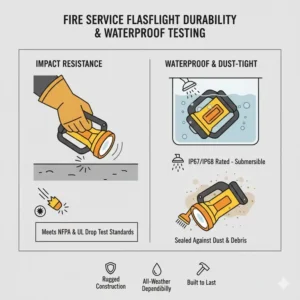
Water Resistant: It needs a high IP rating (like IPX7) to survive being sprayed by a hose or dropped in a puddle.
-
Impact Resistant: It’s going to be dropped. A lot. It has to survive a fall from at least 6 feet (2 meters) onto concrete.
Choosing Your Light: Right-Angle vs. Helmet-Mounted vs. Handheld
Where you carry your light is just as important as which one you carry. There are three main styles, each with a specific job.
-
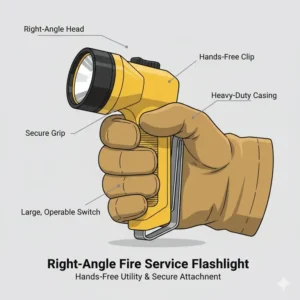
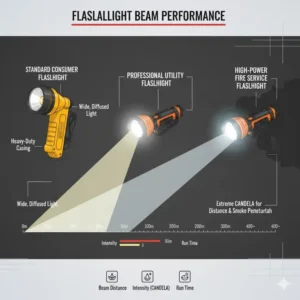
The Classic Right-Angle Light: This is the iconic firefighter light (e.g., Streamlight Survivor X). It clips onto the D-ring or strap on your bunker coat, pointing forward. This is the definition of a hands-free light, letting you work with a halligan or an axe.
-
The Modern Helmet-Mounted Light: This style (e.g., Streamlight Vantage 180 X) is gaining huge popularity. Its main advantage? The light goes exactly where you look. This is priceless for situational awareness, reading gauges, or searching.
-
The Tactical Handheld: Many firefighters carry a small, powerful handheld light (like a smaller PolyTac) in a pocket. This is not a primary light but a backup, or a “spotter” light used for pointing things out to the crew from outside.
Table 5: Light Style Comparison: Pros & Cons
| Light Style | Pros | Cons | Best For |
| Right-Angle |
✅ True hands-free use
✅ Very durable, large switches
✅ Easy to grab |
❌ Beam points where your chest points
❌ Can be snagged |
Interior attack, general use |
| Helmet-Mounted |
✅ Light points where you look
✅ Excellent situational awareness
✅ Often has “buddy-finder” taillight |
❌ Can add weight/bulk to helmet
❌ Can be snagged on wires
❌ Can blind your crew |
Search & rescue, command, engineers |
| Handheld |
✅ Powerful, focused beam
✅ Great for spotting
✅ Versatile pocket-carry |
❌ Not hands-free (at all)
❌ Easy to drop
❌ Often not I.S. or heat-rated |
Backup, RIT, exterior operations |
🔋 Battery Wars: Rechargeable vs. Disposable in the Fire Service
This debate is almost as old as the fire service itself. Should you use a light with a rechargeable pack or one that takes disposable batteries?
The Rise of Rechargeable (Li-Ion/NiMH)
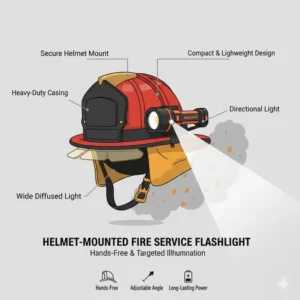
Most modern fire service flashlights, like the Survivor X or Knucklehead, come with rechargeable packs and charging bays that mount right on the truck.
-
Pros: Lower long-term cost. Your light is always 100% charged and ready to go when you pull it off the truck.
-
Cons: If the battery dies during a 10-hour call, it’s a brick. You’re dependent on the truck’s charging system.
The Case for Disposables (CR123A/AA)
Lights that use common disposable batteries, like the Pelican 3715 (AA) or Vantage 180 X (CR123A), still have a huge following.
-
Pros: Instant swap. If your light dies, you can pop in fresh batteries in 30 seconds and you’re back in the fight. CR123A batteries, in particular, have a 10-year shelf life and work great in extreme cold.
-
Cons: Higher long-term cost. You have to remember to buy and carry spares. Alkaline AAs can leak and their performance plummets in the cold.
The best solution? A multi-fuel light like the Survivor X or PolyTac 90 X, which can use either a rechargeable pack or disposable batteries. This gives you the best of both worlds.
Table 6: Cost-Benefit Analysis: Rechargeable vs. Disposable (5-Year Outlook)
| Battery Type | Initial Cost | 5-Year Fuel Cost (Heavy Use) | Convenience | Reliability |
| Rechargeable | High (Light + Charger) | $0 | ✅ High (Always charged) | ❌ Low (If it dies, it’s dead) |
| Disposable AA | Low | $150 – $300 | ❌ Low (Must buy/carry) | ✅ High (Instant swap) |
| Disposable CR123A | Low | $300 – $600 | ❌ Low (Must buy/carry) | ✅ Highest (Instant, all-weather) |
| Multi-Fuel | High | $0 – $100 (for backups) | ✅ Highest | ✅ Highest |
Beyond the Lumens: Understanding Beam, Tint, and “Smoke Cutting”
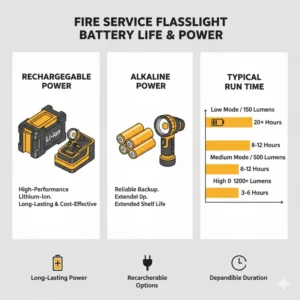
Let’s get one thing straight: lumens are not everything. I’d take a 200-lumen light with a good beam over a 1000-lumen “flood” light any day.
-
Beam Profile: In the fire service, you need a focused hot-spot. This tight, powerful center beam is what “cuts” through smoke and water. A wide “flood” beam is great for lighting up a room, but in smoke, all it does is light up the particles right in front of your face, blinding you.
-
Color Temperature (Tint): Most LED flashlights are a “cool white” or blueish tint. This looks brighter. However, many veteran firefighters, as covered in publications like Firehouse Magazine, will tell you a “neutral” or “warmer” tint (more yellowish) penetrates smoke and fog better. It reduces glare and helps your eyes pick out details.
-
What about a “smoke cutting flashlight”? This is a marketing term. No light removes smoke. A “smoke cutting” light is simply one with a very tight, powerful hot-spot (high candela) and often a neutral tint.
Table 7: Beam Profile Applications
| Beam Type | Description | Best For | Worst For |
| Spot (High Candela) | Tight, focused beam | ✅ Cutting smoke, distance spotting | ❌ Close-up tasks (too bright) |
| Flood (Low Candela) | Wide, even beam | ✅ Lighting a whole room, overhaul | ❌ Cutting smoke (blinding glare) |
| Combo Beam | Spot + some flood | ✅ Versatility, helmet lights | ❌ Not as good as a dedicated tool |
Table 8: Budget vs. Premium Feature Comparison
| Feature | Budget Option (e.g., PolyTac 90 X) | Premium Option (e.g., Survivor X, I.S.) | Why it Matters |
| Safety Rating | None | Class 1, Div. 1 or 2 | Your life. A non-I.S. light can cause an explosion. |
| Heat Resistance | Good (Polymer) | Excellent (Super-tough nylon) | A melted light is a failed light. |
| Battery System | Disposable (w/Rechargeable option) | Integrated Rechargeable (w/Disposable option) | Truck-mounted charging is a huge convenience. |
| Durability | Very Good | “Bulletproof” | A premium light is built to last a 20-year career. |
| Glove-Friendly | Good (Side switch) | Excellent (Large, top-mounted switch) | Fumbling for a switch in a fire is not an option. |
My Personal Take: What I Look for in a Fire Service Light
Look, the specs and tables are great. But what do I, as someone who has relied on these tools, really look for?
-
Simplicity. I want one big button I can find and mash with a frozen, wet, bulky glove. I don’t want to cycle through 8 modes (High-Med-Low-Strobe-SOS-Blinky-Coffee-Maker). The Survivor X is king here.
-
A “T-Rex” Clip. The clip needs to be spring-loaded and made of steel, with a grip so strong I can’t accidentally knock it off. If I have to fight to get it onto my gear, that’s a good sign.
-
Battery Versatility. I run a rechargeable, but I always want the option to throw in disposable batteries as a backup. Multi-fuel capability is a must-have for me.
The brightest light isn’t the best. The lightest light isn’t the best. The best fire service flashlights are the ones that are reliable. The one you can trust, without a single doubt, to light the way.
🛡️ Equip Yourself for the Call – Shop Now!
Your light is your lifeline. Don’t settle for less. We’ve laid out the best options trusted by fire service professionals. Click the links in the “Top 7” section to compare prices, read more reviews, and make the investment in your safety today.
Conclusion: Your Light is Your Lifeline
In the end, all the gear we carry—the helmet, the coat, the SCBA—is designed to do one thing: get us in, do the job, and get us out safely. Your flashlight is a critical, non-negotiable part of that system.
Don’t trust your life to a cheap, unproven light. Whether you go for the all-around durability of the Streamlight Survivor X, the helmet-mounted versatility of the Vantage 180 X, or the insane runtime of the Pelican 3315R-RA, you’re investing in a tool that will be there when you need it most.
FAQs
❓ What's the best fire service flashlight for a helmet?
❓ Are 1000-lumen flashlights good for fire service?
❓ What is an 'intrinsically safe' fire service flashlight?
❓ Streamlight vs. Pelican: Which is better for firefighters?
❓ Why do firefighters use right-angle flashlights?
Recommended for You
- Fire Dept Flashlights: 7 Lifesaving Tools That Truly Conquer Darkness
- Fire Fighter Flashlights: 7 Ultimate Tools for 2025
- Firefighting Lights: 7 Best Options for 2025 Safety
Disclaimer: This article contains affiliate links. If you purchase products through these links, we may earn a small commission at no additional cost to you.
✨ Found this helpful? Share it with your friends! 💬🤗
[addtoany]
