
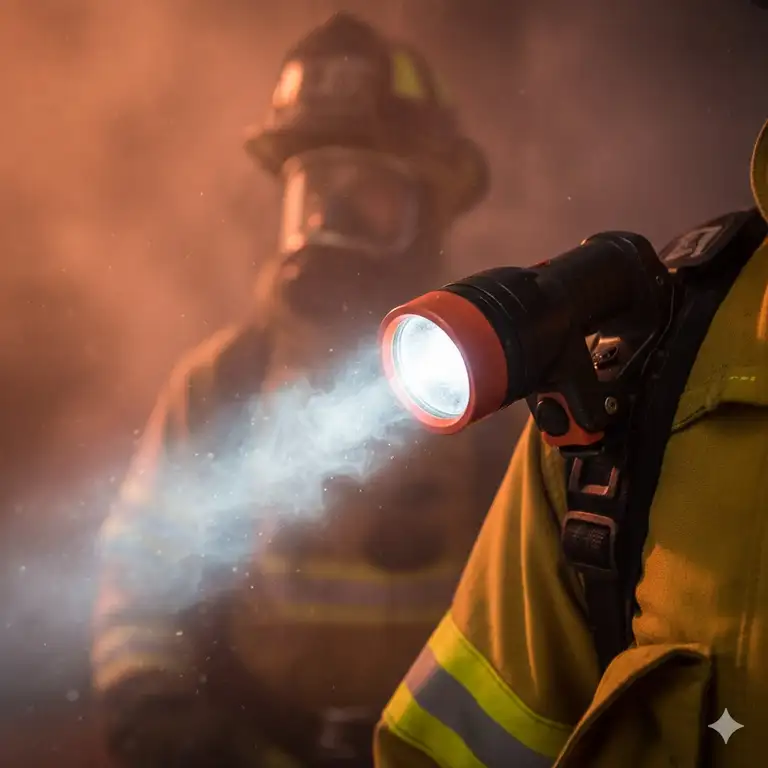
Picture this: you’re in a zero-visibility environment. The air is thick with smoke, alarms are blaring, and every second counts. In this chaos, your single most important tool, aside from your crew and your air-pack, is the beam of light cutting through the darkness. This is where standard, off-the-shelf flashlights fail, and specialized fire dept flashlights become your lifeline.
✨Was this helpful? Spread the word! 🚀
[addtoany]
You can’t just grab any light from the hardware store. We’re talking about tools built to withstand extreme heat, water, and brutal impacts. More importantly, we’re talking about lights that won’t ignite a flammable atmosphere. Choosing the right fire dept flashlights is a decision that has real-world consequences, which is why I’ve put together this comprehensive guide for my fellow first responders and a USA-based audience that demands reliability.
Before we dive in, let’s look at what separates a true fire service tool from a regular flashlight.
Table 1: Standard Flashlight vs. fire dept flashlights
| Feature | Standard “Tactical” Flashlight | Professional fire dept flashlights |
| Primary Goal | General illumination, self-defense | Smoke penetration, navigation, intrinsic safety |
| Intrinsic Safety | Almost never certified | ✅ CRITICAL. Often Class I, Div 1 rated |
| Heat Resistance | Low. Plastic/metal melts or deforms | High. Made from heat-resistant polymers (Nylon) |
| Waterproofing | Varies (IPX4-IPX7) | High (IPX7 or better), withstands spray/dousing |
| Beam Type | Often a wide “flood” beam | Focused “spot” beam (high candela) to cut smoke |
| Operation | Small, complex tail-cap buttons | Large, glove-friendly buttons or switches |
| Form Factor | Typically a straight tube | Right-angle (for vests) or helmet-mounted |
This guide will break down the absolute best fire dept flashlights available, what makes them tick, and how you can pick the perfect one for your specific needs, whether you’re a career firefighter in a busy metro area or a volunteer in a rural department.
📊 Quick Comparison: Top Picks for fire dept flashlights in 2025
Time is critical, so here’s a high-level look at our top-rated fire dept flashlights. Each of these has been selected for its durability, safety certifications, and real-world performance.
Table 2: Quick Comparison of Top 7 Models
| Model | Type | Lumens | Intrinsic Safety (IS) | Power Source | Best For |
| Streamlight Survivor X | Right-Angle | 250 | Yes (Class 1, Div 1) | Rechargeable Li-Ion / AA | All-Around Duty Light |
| Pelican 3315R-RA | Right-Angle | 132 | Yes (Class 1, Div 1) | Rechargeable Li-Ion | Lightweight IS Option |
| Streamlight Vulcan 180 | Box Lantern | 1,200 | No (General Purpose) | Rechargeable Li-Ion | Vehicle/Scene Lighting |
| Nightstick XPR-5582RX | Right-Angle | 250 | Yes (Class 1, Div 1) | Rechargeable Li-Ion | Dual-Light (Spot + Flood) |
| Streamlight Vantage 180 | Helmet/Right-Angle | 250 | No (General Purpose) | CR123A Batteries | Helmet-Mounted Versatility |
| Pelican 3765 NiMH | Right-Angle | 194 | No (General Purpose) | Rechargeable NiMH | Rugged w/ Photolum. |
| Streamlight Knucklehead | Articulating | 200 | Yes (Class 1, Div 2 avail.) | Rechargeable / AA | Vehicle Extrication/Maint. |
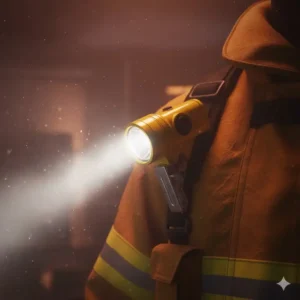
🏆 Top 7 fire dept flashlights: Expert Analysis
I’ve handled, tested, and relied on countless lights over the years. This list is a culmination of that experience, focusing on what works on the fireground. We’ve dug into specs, professional reviews, and department feedback to give you the real story.
1. Streamlight Survivor X (Alkaline or Rechargeable)
If you walk into almost any firehouse in the USA, you will see a Streamlight Survivor. This new “X” model is the latest evolution of that legend, and it’s built from the ground up to be one of the best fire dept flashlights, period.
It’s available as an intrinsically safe (Class 1, Div 1) or a more powerful (500-lumen) non-IS version. For fire service, I always recommend the IS-rated model.
Specifications:
-
Lumens: 250 (High), 100 (Low)
-
Candela: 41,000 (High) – This is its secret weapon for smoke.
-
Beam Distance: 405 meters
-
Run Time: 4 hours (High), 15 hours (Low)
-
Battery: Rechargeable Li-Ion or 3x AA Alkaline
-
Safety Rating: Class 1, Division 1 (IS model)
-
Weight: 11.9 oz (with Li-Ion)
-
Waterproof: IPX7 (submersible to 1 meter)
Customer Review Analysis:
Crews consistently praise the redesigned clip and the extreme-duty clasp. The focused beam is a massive positive, with many stating it cuts through smoke far better than lights with higher lumens but lower candela. A common complaint on older models was the switch; the new switch on the Survivor X is larger, easier to find with a gloved hand, and provides positive feedback.
Warranty: Streamlight offers a robust limited lifetime warranty, which shows their confidence in its durability.
Pros/Cons Analysis:
-
✅ Pros: Unbelievable smoke-cutting beam (high candela), multiple battery options add versatility (rechargeable for the truck, AA for personal carry), legendary durability, strong vest/jacket clip.
-
❌ Cons: The 250-lumen count might seem low to new users, but this is a specialized tool, not a floodlight.
2. Pelican 3315R-RA (Rechargeable Right-Angle)
Pelican has always been a top contender, and the Pelican 3315R-RA is a fantastic, lightweight, and compact choice. It’s also fully certified for Class 1, Division 1 use, making it an excellent intrinsically safe flashlight for firefighters.
What sets this one apart is its charging base and battery-level indicator, a feature many other fire dept flashlights lack. Knowing your battery status before you go in is a huge plus.
Specifications:
-
Lumens: 132
-
Candela: 4,680
-
Beam Distance: 137 meters
-
Run Time: 5 hours (High), 50 hours (Low)
-
Battery: Rechargeable Li-Ion
-
Safety Rating: Class 1, Division 1
-
Weight: 5.4 oz
-
Waterproof: IPX7 (submersible to 1 meter)
Customer Review Analysis:
Users love how incredibly light it is. For firefighters who are already carrying 75+ lbs of gear, shaving weight is a big deal. The battery indicator is the most-praised feature. The beam is less of a “pencil” than the Streamlight and more of a useful combination, which some prefer for general-purpose work inside a structure.
Warranty: Pelican’s famous “You break it, we replace it… forever” (Limited Lifetime Warranty) is one of the best in any industry.
Pros/Cons Analysis:
-
✅ Pros: Extremely lightweight, full-time battery level indicator, great warranty, compact right-angle design.
-
❌ Cons: Significantly lower lumen and candela output compared to the Survivor X. This is more of a close-quarters and personal-light-for-safety choice.
3. Streamlight Vulcan 180 (Vehicle/Scene Light)
Not all fire dept flashlights are personal-carry. Every engine and truck needs a “big light.” The Streamlight Vulcan 180 is the new standard for rechargeable vehicle-mounted lanterns. It’s not typically intrinsically safe, so it’s not for entering a flammable atmosphere, but it is for illuminating the entire scene.
Its key feature is the 180-degree articulating head, which lets you set it down and aim the light exactly where you need it—up at a roofline, down at an extrication, or straight ahead.
Specifications:
-
Lumens: 1,200 (High), 350 (Low)
-
Candela: 70,000 (High)
-
Beam Distance: 529 meters
-
Run Time: 5.75 hours (High), 16 hours (Low)
-
Battery: Rechargeable Li-Ion
-
Safety Rating: Non-IS (General Purpose)
-
Weight: 2.47 lbs
-
Waterproof: IPX7 (Floats in water)
Customer Review Analysis:
Fire companies that have upgraded to these from old, heavy “lunchbox” lights are thrilled. The weight-to-power ratio is excellent. The magnetic base on some models and the quick-install charge rack are major hits. The rear-facing blue “taillight” is also a loved safety feature, helping crews on a dark roadway be seen by their partners.
Warranty: Streamlight Limited Lifetime Warranty.
Pros/Cons Analysis:
-
✅ Pros: Insane brightness and beam distance, versatile 180-degree head, floats, rear safety light, lightweight for a box light.
-
❌ Cons: Not intrinsically safe (by design), more expensive than a personal light.
4. Nightstick XPR-5582RX (Intrinsically Safe Dual-Light)
Nightstick, a brand by Bayco, has become a serious competitor in the fire dept flashlights market. The Nightstick XPR-5582RX is a brilliant piece of engineering, combining a forward-facing flashlight and a downward-facing floodlight in one IS-rated body.
This is a game-changer. You can light up the smoke-filled hallway in front of you and the ground at your feet simultaneously. This dual-light function is becoming a must-have for many firefighters for improved safety and navigation.
Specifications:
-
Lumens: 250 (Flashlight), 125 (Floodlight), 300 (Dual-Light)
-
Candela: 15,626 (Flashlight)
-
Beam Distance: 250 meters
-
Run Time: 7 hours (Flashlight), 10 hours (Floodlight), 5 hours (Dual-Light)
-
Battery: Rechargeable Li-Ion
-
Safety Rating: Class 1, Division 1
-
Weight: 9.5 oz
Customer Review Analysis:
The feedback is overwhelmingly positive. Firefighters who have tried this light say they “can’t go back” to a single-beam light. The ability to see your feet and your objective at the same time, without moving your head, is a major safety enhancement. Its durability and brightness are also consistently rated as excellent.
Warranty: Nightstick offers a limited lifetime warranty on their flashlights.
Pros/Cons Analysis:
-
✅ Pros: Revolutionary dual-light (spot + flood) design, excellent run time, fully IS-rated, very durable.
-
❌ Cons: The forward beam’s candela is good but not as tight as the Survivor X.
5. Streamlight Vantage 180 (Helmet/Right-Angle Combo)
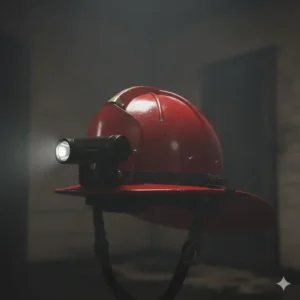
Hands-free lighting is essential. While helmet lights have been around, the Streamlight Vantage 180 is one of the most versatile. It mounts to a firefighter’s helmet (either brim or traditional) but can also be instantly removed and used as a handheld right-angle light.
This 2-in-1 capability makes it one of the most practical fire department flashlights, serving as your primary helmet light and a backup pocket light.
Specifications:
-
Lumens: 250
-
Candela: 7,200
-
Beam Distance: 170 meters
-
Run Time: 4 hours
-
Battery: 2x CR123A Lithium
-
Safety Rating: Non-IS (General Purpose)
-
Weight: 5.1 oz
-
Waterproof: IPX7 (submersible to 1 meter)
Customer Review Analysis:
Users love the bright blue taillight, which makes them highly visible to their crew from behind, even in heavy smoke. The “switch-in-place” functionality (helmet to hand) is praised for its simplicity. The main critique is that it’s not IS-rated, making it unsuitable for certain hazmat or gas leak calls, but for structural firefighting, it’s a top choice.
Warranty: Streamlight Limited Lifetime Warranty.
Pros/Cons Analysis:
-
✅ Pros: Excellent versatility (helmet or handheld), rear blue safety LED, powerful beam for its size, simple operation.
-
❌ Cons: Not intrinsically safe, uses disposable CR123A batteries (no rechargeable option).
6. Pelican 3765 NiMH Rechargeable (Photoluminescent)
Another solid entry from Pelican, the Pelican 3765 is a rugged, no-nonsense right-angle light. Its standout feature? A photoluminescent (glow-in-the-dark) shroud. If you drop this light in a dark room, you can find it.
It also features a built-in battery status indicator and a “downcast” mode with 3 LEDs to light your path, similar to the Nightstick’s floodlight but less powerful.
Specifications:
-
Lumens: 194 (High), 92 (Low)
-
Candela: 10,380
-
Run Time: 3.25 hours (High), 6.5 hours (Low)
-
Battery: Rechargeable NiMH pack
-
Safety Rating: Non-IS (General Purpose)
-
Weight: 14.6 oz
Customer Review Analysis:
The glow-in-the-dark feature is genuinely useful and not just a gimmick. Firefighters report dropping it and being able to spot it instantly. It’s known as a tank; it’s heavy, but it’s built to be abused. The downcast LEDs are a welcome addition for walking.
Warranty: Pelican Limited Lifetime Warranty.
Pros/Cons Analysis:
-
✅ Pros: Photoluminescent shroud is easy to find, built like a tank, downcast LEDs for path lighting, battery indicator.
-
❌ Cons: Not intrinsically safe, heavy for its output, uses older NiMH battery tech.
7. Streamlight Knucklehead (Articulating Head Light)
The Streamlight Knucklehead is the ultimate “problem solver” light. It’s not your primary interior attack light, but for everything else? It’s amazing. With a 360-degree rotating head and a 210-degree articulating neck, you can put this light anywhere and aim it everywhere.
It has a powerful magnet and a stowable hook, making it ideal for vehicle extrication (stuck to the car), salvage and overhaul (hooked on a pipe), or truck checks back at the station.
Specifications:
-
Lumens: 200
-
Candela: 8,700
-
Beam Distance: 187 meters
-
Run Time: 3.5 hours (High)
-
Battery: Rechargeable C4-NiMH or 4x AA Alkaline
-
Safety Rating: Class 1, Division 2 model available
-
Weight: 23.1 oz (Rechargeable)
Customer Review Analysis:
This light has a cult following, especially among truck company firefighters and engineers. The magnet is incredibly strong, and the hook is a simple, brilliant feature. They use it for everything except interior fire attack. It’s the ultimate utility light for the fire dept.
Warranty: Streamlight Limited Lifetime Warranty.
Pros/Cons Analysis:
-
✅ Pros: Unmatched articulation, strong magnet and hook, multiple battery options, C1D2 safety rating available.
-
❌ Cons: Not a primary “smoke cutter,” not C1D1, and too bulky for a coat pocket.
✨ Don’t Miss These Lifesaving Tools! 🔦
🔍 Take your fireground readiness to the next level. Click on any highlighted item to check current specifications and availability. These fire dept flashlights are an investment in your safety!
💬 Just one click – help others make better buying decisions too!😊
[addtoany]
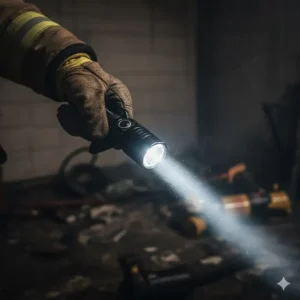
⚠️ Why You Can’t Just Use Any Flashlight for Fire Service
This needs to be said. A cheap, non-certified light is a liability. In the fire service, “intrinsically safe” (IS) isn’t just jargon; it’s a critical safety standard.
Many fire environments, such as a gas leak, a fuel spill, or even the unburned gases from a fire, can be explosive. An intrinsically safe flashlight is designed so that it cannot produce a spark or generate enough heat to ignite this flammable atmosphere. Using a regular light in these conditions is like carrying a potential detonator.
Reputable safety standards, like those from the National Fire Protection Association (NFPA) and OSHA, strongly recommend or require certified IS equipment in hazardous locations. This is why a real fire dept flashlight from a brand like Streamlight or Pelican, with a Class 1, Division 1 rating, is a non-negotiable piece of PPE for many departments.
Table 3: Intrinsic Safety (IS) Ratings Explained
| Rating | What It Means (In Simple Terms) | Where It Applies |
| Class I | Flammable Gases or Vapors are present. | Gas leaks, fuel spills, chemical plants |
| Class II | Combustible Dust is present. | Grain elevators, industrial mills |
| Class III | Ignitable Fibers or Flyings are present. | Textile mills, woodworking shops |
| Division 1 | Hazardous atmosphere is present continuously or intermittently under normal operations. | THIS IS THE ONE YOU WANT. |
| Division 2 | Hazardous atmosphere is present only under abnormal conditions (e.g., a container breaks). | Less strict, still a good rating. |
⚙️ The Critical Features That Define fire dept flashlights
When you’re shopping for fire department flashlights, the specs on the box mean different things than they do for a consumer light.
💡 Lumens vs. Candela: Seeing Through the Smoke
This is the most misunderstood part of firefighter flashlights.
-
Lumens (lm): This is the total amount of light that comes out. It’s great for lighting up a wide area (a “flood” light).
-
Candela (cd): This is the intensity of the beam at its center. It measures the “throw” or how far the light will travel.
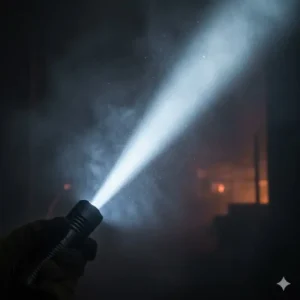
On the fireground, candela is king. A light with 1,000 lumens but low candela will just create a “white-out” effect, reflecting off the smoke and blinding you. A light with 250 lumens but 40,000 candela (like the Survivor X) will punch a tight, focused beam through the smoke, allowing you to see your objective or find a victim.
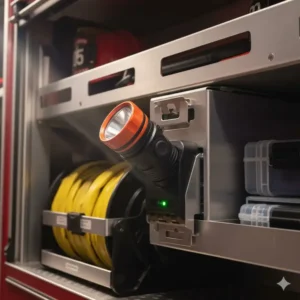
Table 4: Lumen/Candela Needs by Fireground Task
| Task | Required Beam | Why? |
| Interior Fire Attack | High Candela (30,000+ cd) | Needs to penetrate dense, thick smoke. |
| Search & Rescue | High Candela + Good Spill | Need to “pencil” for distance but see the room. |
| Vehicle Extrication | High Lumens (Flood) | Need to light the whole work area, not one spot. |
| Scene Lighting | Very High Lumens (1,000+ lm) | Illuminate the entire building or crash scene. |
🔥 Heat and Impact Resistance (The Durability Factor)
The bodies of fire dept flashlights are almost never made of standard aluminum. They are typically made from proprietary, high-impact, heat-resistant nylon polymers. This is because:
-
Heat: Aluminum gets dangerously hot to the touch and can deform. These polymers can withstand high ambient temperatures without melting.
-
Impact: They are designed to be dropped, kicked, and run over.
-
Non-Conductive: They won’t conduct electricity if they touch a live wire.
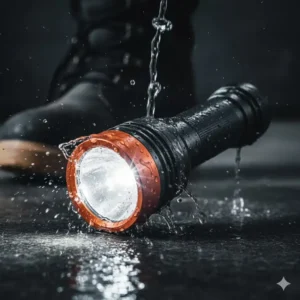
Always look for an IP (Ingress Protection) rating. A good light should be at least IPX7, which means it can be fully submerged in 1 meter of water for 30 minutes. This isn’t for diving; it’s so it survives being blasted by a fire hose or dropped in a puddle. You can learn more about what these ratings mean from trusted technical sources.
🔋 Battery Life and Power Sources
You have two main choices here: rechargeable or disposable.
-
Rechargeable (Li-Ion, NiMH): These are the standard for department-issued lights. They live in a charger on the truck and are always ready to go. The downside? If it dies on a long call, it’s dead.
-
Disposable (AA, CR123A): These are popular for personal, “backup” fire dept flashlights. If it dies, you can swap the batteries in 30 seconds and get back to work.
Table 5: Battery Type Cost/Benefit Analysis
| Battery Type | Pro | Con |
| Rechargeable Li-Ion | Always topped off, low long-term cost, high power | Useless when dead, charger-dependent |
| Rechargeable NiMH | Very durable, good in high temps | Heavier, “memory” effect (less common now) |
| Disposable AA | Ubiquitous, cheap, easy to swap | Lower power output, long-term cost adds up |
| Disposable CR123A | High power, lightweight, long shelf-life | Expensive, not found everywhere |
🧰 Types of fire department flashlights: What’s in Your Pockets?
You should never have just one light. A good “lighting system” involves multiple flashlights for fire dept use, each with a specific job.
The Right-Angle Light (The Workhorse)
This is your primary light. It clips to your coat, vest, or air-pack strap, pointing forward. This keeps your hands free for a tool or a hoseline. The Streamlight Survivor X and Nightstick 5582 are perfect examples.
The Helmet-Mounted Light (Hands-Free)
This light follows your line of sight. When you turn your head, the light goes with you. This is essential for search, overhaul, or any task where you’re using your head (literally). The Streamlight Vantage 180 is a leader here.
The Box Lantern / Scene Light (Big Power)
This is the “big beam” light, like the Streamlight Vulcan. One stays on the truck to light up the whole building, or the engineer carries it to the hydrant. Its job is to turn night into day for the entire crew.
The Pocket Light (Personal Backup)
This is a small, often AA-powered, intrinsically safe light that lives in your bunker pant pocket. It’s the “oh crap” light for when your primary light fails or you get separated.
Table 6: Flashlight Type by Fireground Role
| Role | Right-Angle (Vest) | Helmet Light | Box Lantern | Pocket Backup |
| Nozzleman | ✅ Primary | ✅ Primary | No | ✅ |
| Officer | ✅ Primary | ✅ | No | ✅ |
| Truck/Ladder Co. | ✅ Primary | ✅ Primary | No | ✅ |
| Driver/Engineer | ✅ | No | ✅ Primary | ✅ |
🤔 How to Choose the Right fire dept flashlight for You
Choosing isn’t just about picking the brightest light. It’s about a system.
First, check your department’s SOPs. Many departments have standards for PPE, especially regarding intrinsic safety. They may issue you a light.
If you’re buying your own, ask yourself:
-
What’s my primary job? An interior attack firefighter needs candela. An engineer needs a mix of flood and spot.
-
What’s my budget? A good light is an investment. Expect to spend $100-$200 for a quality, IS-rated rechargeable light.
-
What’s my “system”? If your department issues a Survivor, maybe your personal purchase is a Vantage helmet light to complement it.
Table 7: Feature Matrix for Different User Needs
| User | Most Important Feature | Recommended Model |
| Career Interior Firefighter | High Candela, IS-Rated, Durability | Streamlight Survivor X (IS) |
| Volunteer (Multiple Roles) | Versatility, Battery Options | Streamlight Vantage 180 |
| Officer / Chief | Lightweight, IS-Rated, Battery Indicator | Pelican 3315R-RA |
| Engineer / Driver | Scene Illumination, Articulation | Streamlight Vulcan 180 |
| Extrication Specialist | Articulation, Magnetic Mount | Streamlight Knucklehead |
🛠️ Maintaining Your Investment: Flashlight Care
A fire dept flashlight will take a beating, but it’s not indestructible.
-
After every fire, wipe the soot off the lens and body. A dirty lens can cut your light output by 50%.
-
Check the seals. Look at the O-rings on the battery compartment and lens. If they are cracked or dry, replace them.
-
Check your charger. Make sure the contacts are clean. Carbon or dirt can prevent a good charge.
-
Inspect the clip. Make sure the clip is secure and not bent. You don’t want to lose your light on the fireground.
Table 8: Weekly/Monthly Maintenance Checklist
| Frequency | Task | Why? |
| After Every Use | Wipe down body and lens | Soot blocks light and degrades components. |
| Weekly | Check battery level (if it has one) | Don’t go into a fire with a dead light. |
| Weekly | Inspect charger contacts (if rechargeable) | Ensures a full, proper charge. |
| Monthly | Cycle the battery (full discharge/recharge) | (For older NiMH) Prevents battery “memory.” |
| MonthlyS | Inspect O-rings and seals | Maintains waterproof integrity. |
✨ Make the Right Call. Get the Best Gear. 🚒
Your safety is non-negotiable. Click the links in the analysis section to review the top fire dept flashlights, check current pricing, and equip yourself with a tool you can bet your life on.
🏁 Final Thoughts: Illuminating the Right Choice
When it comes to fire dept flashlights, there is no room for compromise. The models we’ve covered aren’t just accessories; they are critical pieces of personal protective equipment.
Your choice comes down to your primary role, your department’s policies, and your personal preference. Whether you choose the legendary smoke-cutting power of the Streamlight Survivor X, the lightweight reliability of the Pelican 3315R-RA, or the versatility of the Nightstick dual-light, you are investing in a tool that will perform when you need it most.
Stay safe out there, and light your way.
❓FAQs
❓ What is the best flashlight for a firefighter?
❓ What does intrinsically safe mean for fire dept flashlights?
❓ How many lumens do I need for a firefighter flashlight?
❓ What's the difference between a Streamlight Survivor and a Pelican 3315?
❓ Should I get a helmet-mounted flashlight?
📚 Recommended for You
- Firefighting Lights: 7 Best Options for 2025 Safety
- Angle Flashlight: 7 Best Models That Professionals Trust
- Fire Fighter Flashlights: 7 Ultimate Tools for 2025
Disclaimer: This article contains affiliate links. If you purchase products through these links, we may earn a small commission at no additional cost to you.
✨ Found this helpful? Share it with your friends! 💬🤗
[addtoany]
