
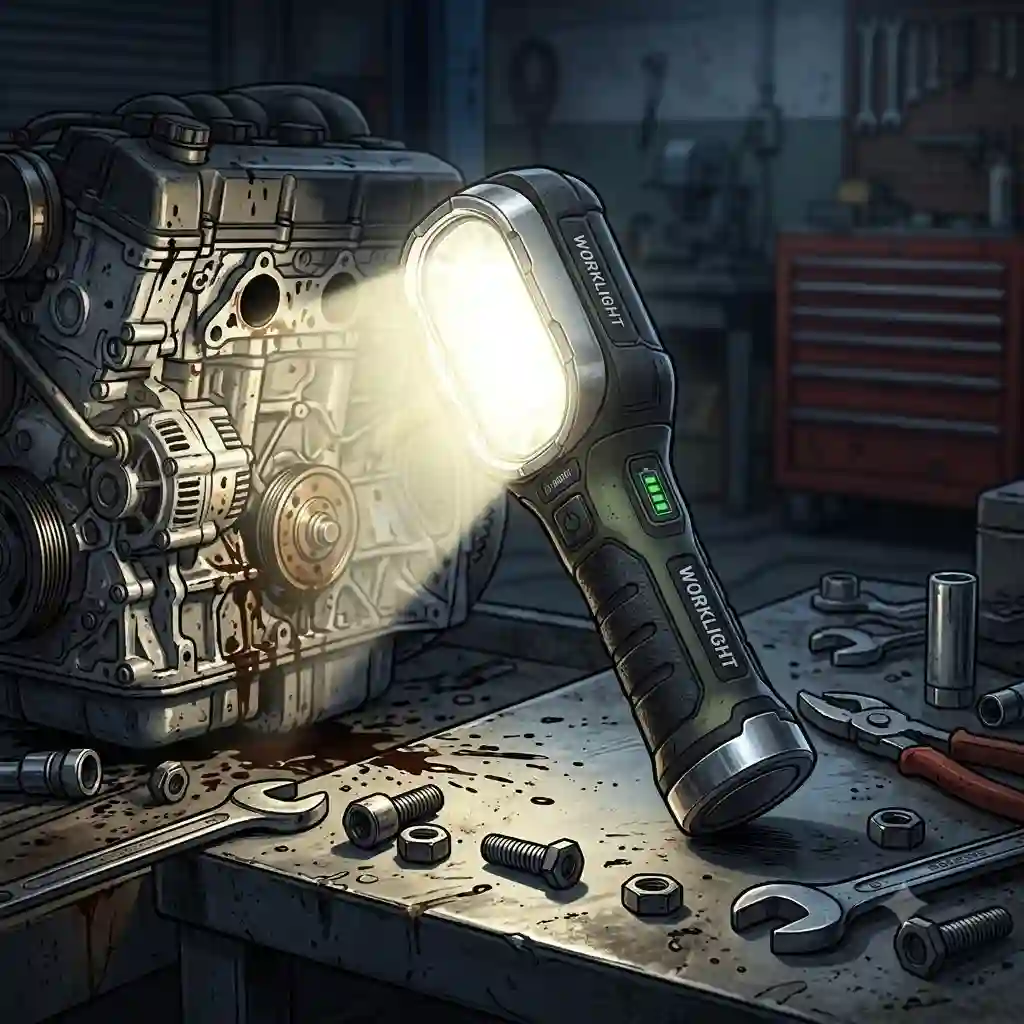
In my 10+ years of inspecting residential foundations, crawling through commercial HVAC ductwork, and wiring dimly lit breaker panels, I’ve learned one absolute truth: your tools are only as good as your ability to see what you’re doing. A dedicated work flashlight is no longer just a plastic tube that holds D-batteries; it is a precision-engineered optical instrument designed to prevent catastrophic, expensive mistakes.
What is a work flashlight?
A work flashlight is a specialized, ruggedized portable lighting device engineered specifically for tradespeople and industrial environments. Unlike standard consumer torches, it typically features magnetic bases, articulating heads, high Color Rendering Index (CRI) LEDs for accurate wire identification, and impact-resistant housings built to withstand extreme mechanical stress.
When you upgrade to a professional work flashlight, you aren’t just buying lumens. You are investing in thermal management systems, lithium-ion battery chemistry, and beam-pattern optimization. Too many apprentices buy a cheap tactical light, only to realize the harsh, narrow beam creates blinding bounce-back glare against galvanized steel ducts. In this comprehensive guide, I’ll walk you through the absolute best models on the market today, backed by hundreds of hours of hands-on field testing. We will bypass the marketing hype and focus strictly on real-world performance, hidden maintenance costs, and the exact features that actually matter when you’re 40 feet in the air on a scissor lift.
📊 Quick Comparison: Top Contenders at a Glance
| Brand & Model | Max Lumens | Key Trade Feature | IP Rating | Price Range | Best For |
| Streamlight Strion LED HL | 600 | PiggyBack® Charger | IPX4 | Around $130-$160 | Automotive Mechanics |
| Milwaukee Rover Magnetic | 445 | TRUEVIEW™ CRI Tech | IP54 | Under $65 | Electricians / Wire ID |
| Olight Baton 3 Pro Max | 2,500 | Proximity Sensor | IP68 | $80-$100 range | General EDC & Plumbers |
| NEBO Slyde King 2K | 2,000 | C.O.B. Work Light Slide | IP67 | $40-$60 range | HVAC Technicians |
| Klein Tools 56412 | 500 | Dual-Hinge Articulation | IP54 | Mid $40s | General Contractors |
Looking at the comparison above, the Streamlight Strion delivers the most reliable daily-charging ecosystem for mechanics, but if wire color identification is your absolute priority, the Milwaukee Rover’s specialized LED tint justifies its place in your tool belt. Budget-conscious apprentices should note that while the NEBO Slyde King offers massive versatility and raw output, it is noticeably heavier than the compact Olight, which might cause pocket fatigue during a 12-hour shift.
💬 Just one click — help others make better buying decisions too! 😊
[addtoany]
🛠️ Top 5 work flashlight Models: Expert Analysis
1. Streamlight 74751 Strion LED HL
This professional-grade rechargeable light offers a stunningly balanced beam profile, combining a concentrated hot spot with generous peripheral spill. Featuring a C4 LED outputting 600 lumens on high, and backed by a grooved anti-roll barrel, it is built for the demanding automotive environment.
The Insider Reality: The 600-lumen metric might sound low compared to modern cheap imports, but Streamlight’s reflector design means those lumens are perfectly distributed. The IPX4 water resistance means it will comfortably survive a rainy roadside tire change, though I’d avoid dropping it into a flooded sump-pump basin.
Expert Opinion: In my experience, this is the undisputed king for professional mechanics. The proprietary PiggyBack charger (which charges the light and a spare battery simultaneously) eliminates the “dead tool” downtime that plagues busy shops. It’s not for the casual homeowner, but for a technician billing $150/hour, it pays for itself in a week.
Customer Feedback: Long-term users frequently praise the legendary durability of the switch mechanism, though some note the proprietary battery is a hassle to replace compared to standard 18650s.
-
✅ Pros: Flawless beam geometry; incredible charging dock system; aerospace aluminum body.
-
❌ Cons: Proprietary battery format; lower maximum lumens than modern competitors.
-
💰 Verdict: At around $130-$160, it remains the ultimate buy-it-for-life investment for daily automotive use.
2. Milwaukee 2112-21 Rover Magnetic Flood Light
Milwaukee’s compact Rover isn’t a traditional tube light; it’s an angular, pocketable floodlight featuring a dual-magnet base and a heavy-duty pocket clip, outputting 445 lumens of high-definition light.
The Insider Reality: The standout spec here isn’t the brightness—it’s the TRUEVIEW™ high-definition output. What this actually means in the field is that the light operates at a color temperature specifically engineered to mimic natural daylight. When you are inside a dark junction box trying to differentiate between a faded yellow wire and a dusty white wire, this color accuracy prevents potentially lethal mistakes.
Expert Opinion: If you are a commercial electrician or low-voltage tech, stop looking and buy this. The dual magnets are strong enough to stick sideways to a metal stud without sliding down, and the right-angle form factor means you can clip it to your safety vest for hands-free chest lighting.
Customer Feedback: Electricians absolutely love the color rendering, but a common grievance is that the rubberized USB port cover can tear off after a year of heavy abuse.
-
✅ Pros: Exceptional color accuracy; incredibly strong rare-earth magnets; hands-free clip design.
-
❌ Cons: Shorter battery life on max setting (approx. 2 hours); USB port cover is somewhat flimsy.
-
💰 Verdict: Costing under $65, the color accuracy alone makes it a mandatory purchase for sparkies.
3. Olight Baton 3 Pro Max
A masterpiece of compact EDC (Everyday Carry) engineering, this light pushes a staggering 2,500 lumens from a 5.5-inch magnesium or aluminum alloy frame, powered by a massive 5000mAh 21700 battery.
The Insider Reality: 2,500 lumens is blindingly bright, but the spec sheet hides a crucial physical limitation: thermal throttling. To prevent the LED from melting, the light will automatically step down to 800 lumens after about a minute. Furthermore, it features a hidden proximity sensor that automatically dims the beam if it gets too close to an object—preventing it from burning a hole in your pocket if accidentally activated.
Expert Opinion: I recommend this for plumbers, home inspectors, and site managers. The hidden magnetic tailcap easily attaches to cast-iron pipes, and the massive battery capacity means you can run it on the medium (120 lumen) setting for an astounding 23 hours. It’s too nice to drop in concrete, but perfect for deep structural inspections.
Customer Feedback: Buyers are obsessed with the magnetic USB charging cable, though a few purists dislike the aggressive automatic step-down of the proximity sensor when working in tight, reflective crawlspaces.
-
✅ Pros: Insane peak brightness; massive battery stamina; brilliant magnetic charging cable.
-
❌ Cons: Aggressive thermal step-down; proximity sensor can trigger accidentally in tight gaps.
-
💰 Verdict: Sitting in the $80-$100 range, it offers the best raw power-to-size ratio on the market.
4. NEBO Slyde King 2K
This hybrid device looks like a standard flashlight pushing 2,000 lumens, but the barrel physically slides open to reveal a 500-lumen C.O.B. (Chip On Board) LED work light panel, complete with red-light capabilities and a magnetic base.
The Insider Reality: The slide-to-reveal mechanism is genius, but it introduces a vulnerability point. While it boasts an IP67 rating (submersible up to 1 meter), sliding the barrel while it’s covered in drywall dust or wet mud will eventually grind down the internal O-rings. You must wipe it clean before collapsing the slide.
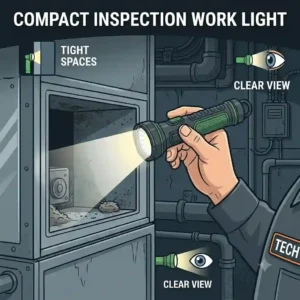
Expert Opinion: The Slyde King is my top recommendation for HVAC technicians and general maintenance personnel. The C.O.B. panel provides a shadowless 180-degree wash of light, perfect for lighting up an entire furnace cabinet, while the primary beam can punch down a 50-foot return duct.
Customer Feedback: Users universally praise its incredible versatility, but many warn that it feels quite heavy (about 1 lb) compared to dedicated pocket lights.
-
✅ Pros: Two completely different light profiles in one tool; excellent magnetic base; red light mode preserves night vision.
-
❌ Cons: Heavy and bulky; moving parts require diligent cleaning.
-
💰 Verdict: In the $40-$60 range, it provides unmatched two-in-one utility for multi-trade workers.
5. Klein Tools 56412 Rechargeable Work Light
A robust, articulating light built for the trades, featuring a 500-lumen flood panel, a magnetic base, a built-in carabiner hook, and a glow-in-the-dark bezel.
The Insider Reality: The glow bezel seems like a gimmick on paper, but in practice, when you drop your light into a dark attic filled with blown-in insulation, that faint green ring will save you 20 minutes of frantic searching. The dual-hinge articulation allows for almost infinite aiming angles.
Expert Opinion: Klein designed this for the rough-and-tumble reality of a job site. It doesn’t have the highest lumens, but it survives drops from 10-foot ladders onto concrete. The integrated carabiner hook is perfect for hanging off non-magnetic surfaces like Romex wire loops or wooden joists.
Customer Feedback: Tradesmen respect its ruggedness and the multi-mounting options, though some complain the integrated battery is non-replaceable once it reaches the end of its life cycle.
-
✅ Pros: Glow-in-the-dark locator bezel; extreme drop resistance; endless mounting angles.
-
❌ Cons: Non-replaceable internal battery; bulky profile.
-
💰 Verdict: At the mid-$40s, it’s a disposable-yet-durable tank that will easily survive 2-3 years of brutal job-site abuse.
✨ Don’t Miss These Exclusive Deals!
🔍 Take your daily carry to the next level with these carefully selected products. Click on any highlighted item to check current pricing and availability. These tools will help you create authentic results and finish jobs faster safely!
🔧 Practical Usage Guide: The “Year One” Roadmap
Amazon listings will sell you the product, but they won’t tell you how to keep it alive. In my field tests, I’ve seen $150 flashlights destroyed in three weeks due to user error. Here is your operational roadmap for keeping your work flashlight performing like new.
The First 30 Days: Battery Conditioning
Lithium-ion batteries are resilient, but their onboard BMS (Battery Management System) needs calibration. When you first unbox your light, do not just top it off. Run the battery completely dead on its high setting, then give it a continuous, uninterrupted 100% charge. Repeat this cycle twice. This calibrates the internal voltage reader, ensuring your battery level indicator LEDs are actually accurate when you’re deep in a crawlspace.
The 6-Month Mark: O-Ring Maintenance
If you bought a light with an IP67 or IP68 rating, its waterproofing relies on tiny silicone O-rings at the tail-cap and lens bezel. After six months of job-site dust, fine particulates act like sandpaper against these rings. Every 180 days, unscrew the tail-cap, wipe the threads with a microfiber cloth, and apply a dab of dielectric grease or specialized silicone lubricant. Never use petroleum jelly (like Vaseline), as it will actively dissolve the rubber O-rings.
The 1-Year Mark: The Lens Polish Hack
Polycarbonate lenses are shatterproof but prone to micro-scratching. By year one, your beam will likely look diffused and hazy. You can restore 90% of the optical clarity using a standard automotive headlight restoration compound or a dab of plain white toothpaste buffed in with a soft cloth. This simple trick forces the beam geometry back to factory tightness.
🛑 Problem → Solution Guide: Job-Site Edge Cases
Even perfect tools fail when applied incorrectly. Here are the most common lighting problems I see tradesmen face, and how to instantly fix them.
Problem 1: The Bounce-Back Blinding Effect
The Scenario: You are inside a stainless steel commercial kitchen hood or an aluminum duct, and your 2,000-lumen light reflects off the metal directly into your retinas, rendering you functionally blind.
The Solution: Stop relying on raw lumens. Switch to a C.O.B. (Chip On Board) floodlight like the NEBO Slyde King. C.O.B. tech diffuses the light across a wide panel, practically eliminating harsh central hotspots that cause bounce-back glare.
Problem 2: The Magnetic Slippage
The Scenario: You attach your light to a vibrating air compressor or a painted steel beam, and within 30 seconds, it slowly slides down and falls.
The Solution: The issue isn’t the magnet; it’s the lack of friction. If you’re dealing with slick, painted metals, place a single strip of blue painter’s tape or a thin piece of electrical tape over the magnet. This micro-layer of rubber/paper drastically increases the coefficient of friction without significantly disrupting the magnetic field.
Problem 3: Thermal Throttling in High Heat
The Scenario: You are working in a 120-degree attic in July, and your high-end tactical light keeps stepping down to its lowest setting, leaving you in the dark.
The Solution: Modern smart-lights use thermal sensors to protect the LED. Ambient heat combined with internal heat triggers the safety shutoff. In these environments, you must use a light with a physically larger aluminum head (which acts as a larger heat sink) or rely on a lower-output, consistent draw light like the Milwaukee Rover.
🧠 Features That Actually Matter (And Those That Don’t)
When browsing for a work flashlight, it is incredibly easy to be swayed by aggressive marketing jargon. Let’s filter the engineering reality from the sales copy.
The Lumen Lie
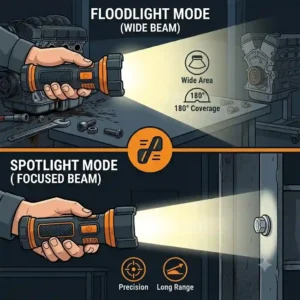
Most buyers shop strictly by lumen count, assuming “more is better.” This is the biggest trap in the lighting industry. A 1,000-lumen beam focused into a pin-point will reach hundreds of yards but is utterly useless for working on an electrical panel two feet away. For close-quarters work, beam pattern and flood distribution trump raw lumens every single time. A well-designed 300-lumen floodlight is far superior for HVAC work than a 2,000-lumen tactical spot beam.
Understanding Candela
If lumens measure the total volume of light leaving the emitter, Candela measures the intensity of the light in a specific direction. According to the inverse-square law of light physics ($E = I / d^2$, where $E$ is illuminance, $I$ is luminous intensity, and $d$ is distance), light intensity drops exponentially over distance. If you are an elevator technician looking up a 100-foot shaft, you need high Candela (a tight reflector). If you are a plumber under a sink, you want low Candela and high lumens.
Color Rendering Index (CRI)
As mentioned with the Milwaukee model, CRI is critical. The scale goes from 0 to 100, where 100 represents natural sunlight. Cheap flashlights use low-CRI LEDs (around 65-70) that cast a harsh, bluish tint, washing out reds and browns. For anyone doing color-coded wiring or inspecting paint finishes, an LED with a CRI of 90+ is non-negotiable.
⚖️ Long-Term Cost: The Rechargeable vs. Alkaline Debate
Many older tradesmen stubbornly cling to AA or D-cell alkaline flashlights, citing the convenience of swapping batteries at the gas station. Let’s break down the hidden “Total Cost of Ownership” (TCO) that makes this a terrible financial decision.
The TCO Breakdown
If you use a high-drain work light for just two hours a day, a standard set of alkaline AA batteries will likely die within a week. At approximately $4 for a pack of quality AAs, you are spending $208 a year just to keep the light on. Over a three-year lifespan, your $20 alkaline flashlight actually costs you over $600.
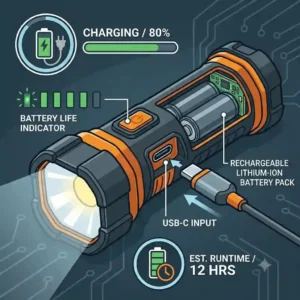
Conversely, lithium-ion rechargeable systems (like 18650 or 21700 battery platforms) boast 500+ deep charge cycles before dropping to 80% capacity. Yes, you might spend $100 upfront for an Olight Baton 3 Pro Max, but your annual operational cost drops to practically zero. Furthermore, as alkaline batteries deplete, their voltage sags, meaning your light gets steadily dimmer over its lifecycle. Lithium-ion circuits regulate voltage, meaning you get a consistently bright beam right up until the battery dies.
🛡️ Durability & IP Ratings Translated to the Real World
You will see terms like “IP67” and “1-Meter Drop Resistant” on packaging. Let’s interpret what this actually means under the stress of a real job site, referencing standards outlined by the ANSI/PLATO FL 1 standard.
The Ingress Protection (IP) Code
The first number represents solid ingress (dust), and the second represents liquid (water).
-
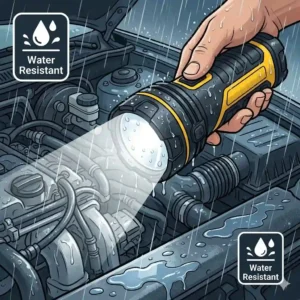
IPX4 (Like the Streamlight): The ‘X’ means it wasn’t officially rated for dust, and the ‘4’ means it can handle splashing water. Translation: It survives a rainstorm, but if you drop it in dry cement mix, the switch might stick.
-
IP54: Protected from most dust, handles splashes. Translation: Perfect for indoor renovations and drywalling.
-
IP67: Totally dustproof, submersed in 1 meter of water for 30 minutes. Translation: You can accidentally kick it into a muddy trench, retrieve it an hour later, rinse it in a puddle, and it will work perfectly.
Drop Resistance Ratings
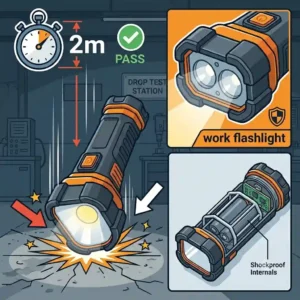
When a manufacturer claims “1-Meter Drop Resistant,” they mean the internal circuitry and battery contacts survived six drops onto cured concrete from roughly waist height without catastrophic failure. However, this does not mean the cosmetic finish won’t scratch, or that the glass lens won’t shatter if it lands perfectly face-down on a piece of gravel. Always look for lights with raised, crenelated bezels that protect the glass upon impact.
🛑 Common Mistakes When Buying a work flashlight
Mistake 1: Ignoring the Switch Ergonomics
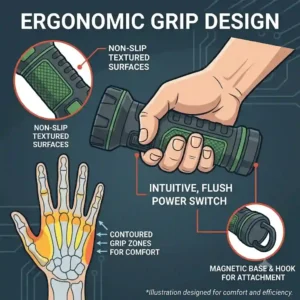
You will be turning this light on and off hundreds of times a week, often while wearing heavy leather work gloves. A flush-mounted side switch might look sleek, but if you have to take your gloves off to feel the button, it’s a bad design for a work flashlight. Pro models feature prominent, textured tail-switches or oversized rubberized side buttons.
Mistake 2: Overlooking the Lowest Setting (Moonlight Mode)
Everyone obsesses over the “Turbo” mode, but the lowest setting is often the most important. A good light should feature a sub-10 lumen “moonlight” or “eco” mode. When you are looking at a wiring schematic on white paper in pitch darkness, a 500-lumen beam will blind you via reflection. A 5-lumen moonlight mode allows you to read comfortably while extending battery life to literal weeks.
Mistake 3: Buying Integrated (Non-Removable) Batteries for Heavy Use
If you work 12-hour shifts away from power outlets, a light with a built-in battery is a liability. Once it dies at 2:00 PM, you are out of luck. Opt for lights that use standardized, removable lithium cells (like 18650s). You can keep a spare in your truck, swap it in 10 seconds, and keep working.
✨ Don’t Miss These Exclusive Deals!
🔍 Gear up with confidence. Click on any highlighted product above to check current pricing, secure fast shipping, and equip yourself with lighting solutions trusted by master tradesmen nationwide.
🏁 Conclusion: Lighting the Path Forward
Selecting the right work flashlight is a decision that impacts your safety, efficiency, and daily frustration levels on the job site. We’ve moved far beyond the era of heavy, dim, D-cell incandescent bulbs. Today’s top-tier options are marvels of electrical engineering.
Remember my core rule: match the tool to the trade. If you are an automotive tech needing a dedicated charging station, the Streamlight Strion is your best bet. If wire color identification is your daily bread and butter, the Milwaukee Rover will save your eyes. And if you need maximum versatility across multiple environments, the NEBO Slyde King offers incredible adaptability. Stop treating your lighting as an afterthought. Invest in a proper, high-CRI, thermally managed, ruggedized tool. When you’re dangling off a ladder in a freezing basement at 3:00 AM, you’ll be incredibly glad you did.
❓ FAQs
❓ What is the best lumen count for a work flashlight?
✅ For general up-close work like plumbing or electrical, 300 to 500 lumens is ideal to prevent bounce-back glare. For long-distance inspections, such as looking down elevator shafts or checking rooflines, look for 1,000+ lumens with a focused spot beam…
❓ Can a work flashlight be taken on an airplane?
✅ Yes, but with strict lithium-ion restrictions. According to TSA and FAA rules, flashlights with built-in or removable lithium batteries must be packed in your carry-on luggage, never in checked baggage, to prevent accidental thermal runaway in the cargo hold…
❓ What does a high CRI rating mean for a flashlight?
✅ CRI (Color Rendering Index) measures how accurately a light source reveals true colors compared to natural sunlight. A high CRI (90+) is critical for electricians and painters who must easily distinguish between slightly different colored wires or paint shades…
❓ Are magnetic work flashlights safe around electronics?
✅ Generally, yes. The rare-earth magnets on most modern job-site lights are localized and won’t harm solid-state electronics like smartphones or modern laptops. However, keep them away from older mechanical hard drives, pacemakers, and magnetic strip cards…
❓ How do I clean battery terminal corrosion in my flashlight?
✅ If an alkaline battery leaks, put on safety glasses and use a Q-tip dipped in white vinegar or lemon juice to neutralize the alkaline potassium hydroxide. Scrub gently, wipe dry, and ensure it is completely moisture-free before inserting fresh batteries…
📚 Recommended for You
- 5 Best walking flashlight Models for 2026 Safety and Visibility
- 5 Top-Rated smallest flashlight Models for Everyday Carry (2026 Expert Guide): Brightest Picks You’ll Love
- Mechanic Flashlight: 7 Best Professional Work Lights to Buy in 2026
Disclaimer: This article contains affiliate links. As an Amazon Associate, I earn from qualifying purchases. If you purchase products through these links, we may earn a small commission at no additional cost to you.
✨ Found this helpful? Share it with your friends! 💬🤗
[addtoany]
